
Catalogue Search | MBRL


Are you sure you want to remove the book from the shelf?

{{itemTitle}}
177
result(s) for
"Tompkins, Cynthia"
Sort by:


Experimental Latin American Cinema
While there are numerous film studies that focus on one particular grouping of films-by nationality, by era, or by technique-here is the first single volume that incorporates all of the above, offering a broad overview of experimental Latin American film produced over the last twenty years.
Analyzing seventeen recent films by eleven different filmmakers from Argentina, Brazil, Cuba, Mexico, Paraguay, and Peru, Cynthia Tompkins uses a comparative approach that finds commonalities among the disparate works in terms of their influences, aesthetics, and techniques. Tompkins introduces each film first in its sociohistorical context before summarizing it and then subverting its canonical interpretation. Pivotal to her close readings of the films and their convergences as a collective cinema is Tompkins's application of Deleuzian film theory and the concept of the time-image as it pertains to the treatment of time and repetition. Tompkins also explores such topics as the theme of decolonization, the consistent use of montage, paratactically structured narratives, and the fusion of documentary conventions and neorealism with drama. An invaluable contribution to any dialogue on the avant-garde in general and to filmmaking both in and out of Latin America,Experimental Latin American Cinemais also a welcome and insightful addition to Latin American studies as a whole.
eBook

Re-reading the World 1
This essay reviews a series of perspectives aimed at a different understanding of the environment and a call to action. The text introduces theoretical approaches ranging from Karen Barad's agential realism to Eduardo Viveiros de Castro's perspectivism and Eduardo Kohn's semiotic reading of the Runa Puna cosmologies to offer different understandings of the world around us and the sentient beings that inhabit it. Then, it compares Donna Haraway's emphasis on the present in the configuration of place, time, and meaning with the sense of morality that arises from Kohn's semiotic reading of the shared thoughts of living beings and Rosi Braidotti's posthuman affirmative ethics. Based on Stacey Alaimo and Susan Heckman's call for the political dimension of material feminism, the text focuses on the environmental emphasis of the constitutions of Ecuador and Bolivia and calls for legislation at the national and supranational level to enshrine and enforce the rights of living beings and the eco-system in general. Finally, the text calls for an interpellation of youth to ensure the continuation of these efforts in the following generation.
Journal Article

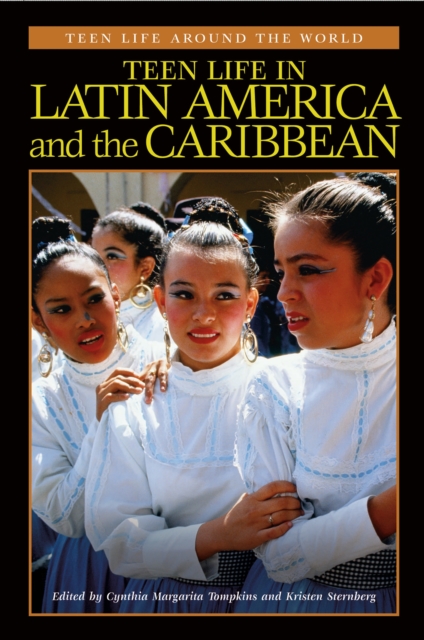
Teen life in Latin America and the Caribbean
Teens in Latin America and the Caribbean generally face a difficult path to adulthood. Poverty and unemployment, violence, political instability, and emigration are frequently the norm in their native countries. Those from poorer families must often work as well as attend school, and opportunities for higher education and good jobs are limited. Wealthier teens, on the other hand, are sheltered from harshness and enjoy private schools, vacations abroad, and access to American consumer products. Yet family is important no matter what the class, and most of these teens share a love of parties, music, and current fashions. Latin America and the Caribbean are important regions to the United States, since large numbers of Americans can trace their roots there. Teen Life in Latin America and the Caribbean allows U.S. teens to understand the unique challenges and opportunities of teens in 15 Latin American or Caribbean countries. Photos complement the text.
eBook
