
Catalogue Search | MBRL


Are you sure you want to remove the book from the shelf?

{{itemTitle}}
384
result(s) for
"Tooze, Adam"
Sort by:


Kindleberger, Mehrling y ese Premio Nobel
Este escrito sostiene que el premio “Nobel” de economía de este año celebra uno de los aspectos más débiles del pensamiento macroeconómico moderno: su limitada capacidad para entender la inestabilidad macrofinanciera del capitalismo moderno. En vez de desafiar la obstinada negativa de tomar en serio a los pensadores que afrontan la importancia esencial de las finanzas y sus peligros para el mundo moderno, como Hyman Minsky o Hyun Song Shin, hace alarde de la tendencia a ignorarlos. Y argumenta que si el Comité del premio hubiese querido galardonar a quienes procuran entender la dinámica del sistema financiero global moderno y sus interconexiones con la economía real, debería habérselo entregado al equipo del BIS, que se remonta a la época de William White, y a economistas académicos asociados al BIS como Hyun Song Shin.
Journal Article
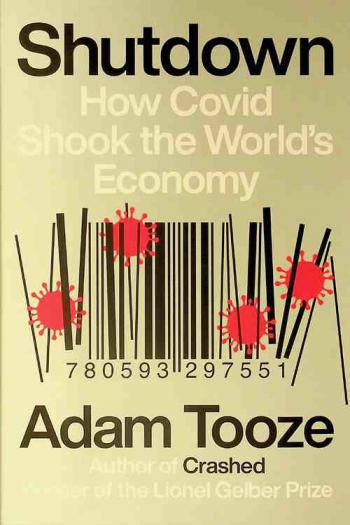
Shutdown : how COVID shook the world's economy
\"Deftly weaving finance, politics, business, and the global human experience into one tight narrative, a tour-de-force account of 2020, the year that changed everything--from the acclaimed author of Crashed. The shocks of 2020 have been great and small, disrupting the world economy, international relations and the daily lives of virtually everyone on the planet. Never before has the entire world economy contracted by 20 percent in a matter of weeks nor in the historic record of modern capitalism has there been a moment in which 95 percent of the world's economies were suffering all at the same time. Across the world hundreds of millions have lost their jobs. And over it all looms the specter of pandemic, and death. Adam Tooze, whose last book was universally lauded for guiding us coherently through the chaos of the 2008 crash, now brings his bravura analytical and narrative skills to a panoramic and synthetic overview of our current crisis. By focusing on finance and business, he sets the pandemic story in a frame that casts a sobering new light on how unprepared the world was to fight the crisis, and how deep the ruptures in our way of living and doing business are. The virus has attacked the economy with as much ferocity as it has our health, and there is no vaccine arriving to address that. Tooze's special gift is to show how social organization, political interests, and economic policy interact with devastating human consequences, from your local hospital to the World Bank. He moves fluidly from the impact of currency fluctuations to the decimation of institutions--such as health-care systems, schools, and social services--in the name of efficiency. He starkly analyzes what happened when the pandemic collided with domestic politics (China's party conferences; the American elections), what the unintended consequences of the vaccine race might be, and the role climate change played in the pandemic. Finally, he proves how no unilateral declaration of 'independence\" or isolation can extricate any modern country from the global web of travel, goods, services, and finance\"-- Provided by publisher.


Disciplining the 'black sheep of the Balkans': financial supervision and sovereignty in Bulgaria, 1902-38
Using the example of Bulgaria, we argue that familiar models of international political economy fail to capture the tension between national sovereignty and access to capital markets experienced by peripheral debtors in the late nineteenth and early twentieth centuries. Existing accounts exaggerate the significance of the gold standard as a good housekeeping seal of approval and underestimate the role of direct financial controls. Furthermore, they underestimate the linkage in zones of inter-imperial rivalry, such as the Balkans, between foreign borrowing and strategic alignment. We show how Bulgaria found its politics destabilized prior to 1914 by the demands of its creditors. After defeat in the First World War, Bulgaria was forced to submit to an even tighter system of creditor control. Though it obtained substantial debt relief during the 1930s, these concessions were gained not through an assertion of national sovereignty and default, but at the price of even closer supervision. This in turn casts new light on the conventional view of Bulgaria as a victim of Nazi 'informal imperialism'. In light of Bulgaria's previous experience, the more striking feature of its trade relations with Hitler's Germany is that they were conducted on a basis of sovereign equality.
Journal Article

Machine tools and mass production in the armaments boom: Germany and the United States, 1929-44
This article anatomizes the 'productivity race' between Nazi Germany and the US over the period from the Great Depression to the Second World War in the metalworking industry. We present novel data that allow us to account for both the quantity of installed machine tools and their technological type. Hitherto, comparison of productive technologies has been limited to case studies and well-worn narratives about US mass production and European-style flexible specialization. Our data show that the two countries in fact employed similar types of machines combined in different ratios. Furthermore, neither country was locked in a rigid technological paradigm. By 1945 Germany had converged on the US both in terms of capitalintensity and the specific technologies employed. Capital investment made a greater contribution to output growth in Germany, whereas US growth was capital-saving. Total factor productivity growth made a substantial contribution to the armaments boom in both countries. But it was US industry, spared the war's most disruptive effects, that was in a position to take fullest advantage of the opportunities for wartime productivity growth. This adds a new element to familiar explanations for Germany's rapid catch-up after 1945.
Journal Article

“Cruelly Absent Grandeur”?
Abstract
This essay approaches the idea that current conceptions of history are in fact tantamount to ideas about the historical unfolding of democracy, with history and democracy having become intellectually intertwined. This observation starts with various present-day challenges and debates, but then integrates them in broader historiographic and metahistorical interpretations. A survey of some major publications on the history of democracy in Europe and the United States from the nineteenth century to the present brings together US, British, French and German perspectives on the democratic condition of our age.
Journal Article

THE ALLURE OF DARK TIMES: MAX WEBER, POLITICS, AND THE CRISIS OF HISTORICISM
This article argues that realist invocations of Weber rely on an unrealistic reading of Weber's realism. In order to escape the allure of Weber's dramatic posture of crisis, we place his seminal lecture on \"Politics as a Vocation\" (1919) in its historical and philosophical context of a revolutionary conjuncture of dramatic proportions, compounded by a broader crisis of historicism. Weber's rhetoric, we argue, carries with it not only the emotion of crisis but is also the expression of a deeper intellectual impasse. The fatalistic despair of his position had already been detected by some of his closest contemporaries for whom Weber did not appear as a door-opener to a historically situated theory of political action but as a telling and intriguing impasse. Although the disastrous history of interwar Europe seems to confirm Weber's bleakest predictions, it would be perverse to elevate contingent failure to the level of retrospective vindication.
Journal Article