
Catalogue Search | MBRL


Are you sure you want to remove the book from the shelf?

{{itemTitle}}
249
result(s) for
"Topper, David"
Sort by:

Einstein’s Oxford cosmology blackboards: open portals to 1931
We give a detailed description of the May 16, 1931, lecture by Albert Einstein on cosmology at Oxford University. In this lecture, Einstein discussed his cosmological model of 1931, a model in which the universe was assumed to expand from zero size to a maximum size and then collapse back again. We use information from the two blackboards that Einstein filled for the lecture and intertwine it with a detailed newspaper transcript of what Einstein said concurrently in German. We thereby present a line-by-line explanation of what was conveyed on the blackboards visually and, in an approximate way, what was concurrently conveyed verbally by Einstein. Even though very few in the audience that day would qualify, we assume the point of view of a sufficiently prepared member of the audience. Our discussion is informed by a summary pamphlet that was handed out by the organizers of the talks. We also describe some mistakes that Einstein made in his talk, issues surrounding the successful preservation of one of the two blackboards, as well as some aspects of Einstein’s cosmological thinking after the talk.
Journal Article
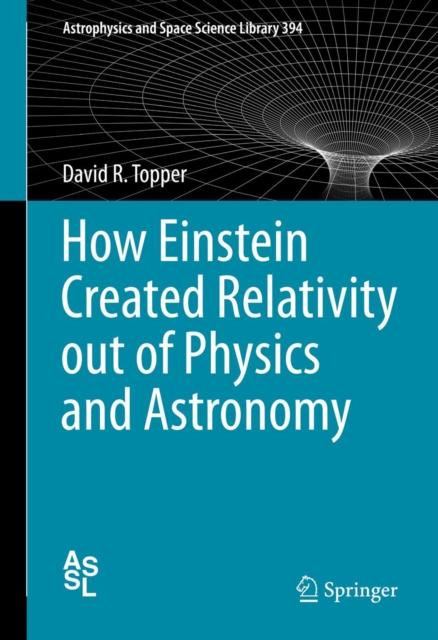
How Einstein Created Relativity out of Physics and Astronomy
This book tracks the history of the theory of relativity through Einstein's life, covering the origins of his ideas and his debt to the work of Galileo, Newton, Faraday, Mach and others; the birth of modern cosmology and his quest for a unified field theory.
eBook

On Anamorphosis: Setting Some Things Straight
Recently there has been a revival of anamorphic imagery, notably in its use as a metaphor by postmodern theorists. But often, discussions of anamorphosis are confused, and even wrong. In this article, the author not only focuses upon correcting these errors, but also analyzes our perception of anamorphic images, since there is a dearth of such in the literature. The resulting discussion points out aspects of how we see anamorphs that have never been pointed out before.
Journal Article


Network Socio-Synthesis and Emergence in NOMADS
NOMADS (Network-Operational Mobile Applied Digital System) is a network client–server-based system for participant interaction in music and multimedia performance contexts. NOMADS allows large groups of participants, including the audience, to form a mobile interactive computer ensemble distributed across a network. Participants become part of a synergistic interaction with other performers, contributing to the multimedia performance. The system enhances local performance spaces, and it can integrate audiences located in multiple performance venues. Individual user input from up to thousands of simultaneous users across a network is synthesised into a single emergent sound and visual structure in an approach we call socio-synthesis. This paper recounts research leading up to NOMADS, outlines its technological architecture, and describes several implementations. Current applications include the telematic opera Auksalaq, and performances by the MICE Orchestra. The authors also consider the potential of large-scale human–computer ensembles as a paradigm for composition and performance.
Journal Article