
Catalogue Search | MBRL


Are you sure you want to remove the book from the shelf?

{{itemTitle}}
7
result(s) for
"Tordoff, Rob"
Sort by:

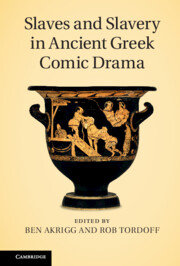
Slaves and Slavery in Ancient Greek Comic Drama
How did audiences of ancient Greek comedy react to the spectacle of masters and slaves? If they were expected to laugh at a slave threatened with a beating by his master at one moment but laugh with him when they bantered familiarly at the next, what does this tell us about ancient Greek slavery? This volume presents ten essays by leading specialists in ancient Greek literature, culture and history, exploring the changing roles and representations of slaves in comic drama from Aristophanes at the height of the Athenian Empire to the New Comedy of Menander and the Hellenistic World. The contributors focus variously on individual comic dramas or on particular historical periods, analysing a wide range of textual, material-culture and comparative data for the practices of slavery and their representation on the ancient Greek comic stage.
eBook


LITERARY ALLUSION IN THE PEACE
Lust am Lesen. Literarische Anspielungen im Frieden des Aristophanes by F. Zogg is reviewed.
Book Review

Have Welsh agri-environment schemes delivered for focal species? Results from a comprehensive monitoring programme
Agri‐environment schemes (AES) have been criticized for being inadequately monitored and for not delivering the expected benefits to nature. Consequently, the Welsh Government funded a comprehensive programme of monitoring of AES between 2009 and 2012. The AES assessment focused on Tir Gofal (which translates as “Land in Care”) but also included the Organic Farming Scheme, and monitoring focused on a range of taxa of conservation importance: arable plants, grassland fungi, bats (six species), butterflies (three species), birds (five species), water vole and brown hare. Field surveys were carried out on matched farms and fields within and outside of AES. Response variables were spatial trends of abundance, occurrence and species richness, and were modelled against AES status. Existing data were also available for two bird species. Few differences were observed between AES and non‐AES farms and fields. Those that were observed were for species that use arable habitats (which are uncommon in Wales): arable plants, yellowhammers and brown hares. The lack of differences in non‐arable habitats may reflect the smaller contrast between AES and non‐AES management in these habitats. It may also reflect the original condition of habitat entered into AES prescriptions, as most non‐arable prescriptions were defined by mandatory management of existing habitats, rather than optional habitat creation or restoration, which is the case for most arable prescriptions. Despite the lack of differences observed, AES may help to maintain populations of species, making it more likely that they will persist in the landscape. There is evidence, from this monitoring programme and elsewhere, that AES can increase the populations of species, when well targeted and implemented. Policy implications. Our results indicate that Welsh Agri‐environment schemes (AES) have been only partly successful in achieving their stated aim of “maintaining and enhancing species abundance”. They can be used to improve AES design and management, both in Wales and more widely, by identifying and promoting effective management interventions, and by identifying ineffective management interventions and seeking alternatives. Comprehensive monitoring of AES, combined with specific targets regarding expected outcomes, is essential to determine whether AES are providing value for money.
Journal Article