
Catalogue Search | MBRL


Are you sure you want to remove the book from the shelf?

{{itemTitle}}
7
result(s) for
"Tortajada, Cecilia, editor"
Sort by:

Increasing resilience to climate variability and change : the roles of infrastructure and governance in the context of adaptation
\"This book highlights the role that both infrastructure and governance play in the context of resilience and adaptation to climate variability and change. Eleven case studies analyze in-depth impacts of extreme events in projects, basins and regions in the Arid Americas (United States and Mexico), Australia, Brazil, China, Egypt, France, Nepal, Mexico, Pakistan, Turkey and South Africa. They discuss the importance of infrastructure (mainly reservoirs) in adaptation strategies, how planning and management aspects should improve in response to changing climatic, economic, social and environmental situations and what the management, institutional and financial challenges would be for their implementation. Governance aspects (policies, institutions and decision making) and technical and knowledge limitations are a substantial part of the analyses. The case studies argue that reservoirs are essential to build resilience contributing to adaptation to climate variability and change. However, that for them to be effective, they need to be planned and managed within a governance framework that considers long-term perspectives and multi-sector and multi-level actor needs and perspectives.\"--Page 4 of cover.
Book

Increasing Resilience to Climate Variability and Change
This book highlights the role that both infrastructure and governance play in the context of resilience and adaptation to climate variability and change. Eleven case studies analyze in-depth impacts of extreme events in projects, basins and regions in the Arid Americas (Unites States and Mexico), Australia, Brazil, China, Egypt, France, Nepal, Mexico, Pakistan, Turkey and South Africa. They discuss the importance of infrastructure (mainly reservoirs) in adaptation strategies, how planning and management aspects should improve in response to changing climatic, economic, social and environmental situations and what the management, institutional and financial challenges would be for their implementation. Governance aspects (policies, institutions and decision making) and technical and knowledge limitations are a substantial part of the analyses. The case studies argue that reservoirs are essential to build resilience contributing to adaptation to climate variability and change. However, that for them to be effective, they need to be planned and managed within a governance framework that considers long-term perspectives and multi-sector and multi-level actor needs and perspectives.
eBook

Water security, climate change and sustainable development
This volume pursues a comprehensive approach so as to arrive at a better understanding of the implications of climate change on sustainable development, focusing on the perspective of water. Climate change is one of today's most pressing global issues and will become increasingly important in the decades to come, as societies will feel its pervasive impacts in many aspects of their lives. Given that the majority of these climate change impacts will be felt through the medium of water, the book explores the interrelationships and inter-linkages between water, climate change, and sustainable development.
Book

Water as a human right for the Middle East and North Africa
Access to safe drinking water and proper sanitation is essential for human survival and for maintenance of a decent quality of life. Currently, more than a billion people do not have access to safe drinking water and more than two billion people lack proper sanitation. In 1992, the United Nations proclaimed that water should be considered to be a human right. This position, however, has not been accepted by many developed and developing countries.
This book systematically and comprehensively analyzes the legal development of the concept of water as a human right; implications for the national governments, and international and national organizations for the implementation of this concept; progress made in different Middle East and North African countries to provide every individual access to clean water and sanitation, constraints faced to assure universal access to water-related services and how these constraints can be overcome, and an overall research agenda in areas where more knowledge is necessary.
eBook

Assessing global water megatrends
This book highlights what are likely to be the future megatrends in the water sector and why and how they should be incorporated to improve water governance in the coming decades. In this first ever book on megatrends for the water sector, 22 leading world experts from different disciplines representing academia, business, government, national and international organisations discuss what the major megatrends of the future are and how they will radically change water governance in the coming decades.
Book
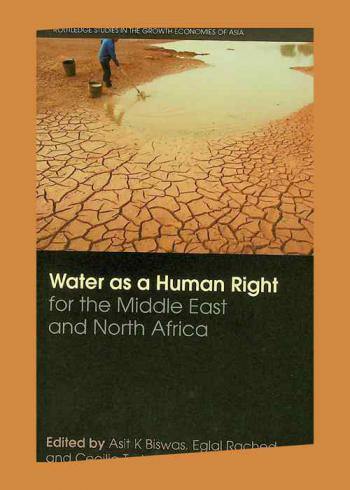
Water as a human right for the Middle East and North Africa
This text systematically and comprehensively analyzes the legal development of the concept of water as a human right and its implications for the national governments, as well as the impact of the implementation of this concept for international and national organizations.
Book

Water management and climate change : dealing with uncertainties
This text addresses water management practices and how these should and could be modified to cope with climatic and other related uncertainties over the next two to three decades; the types of strategies and good practices that may be available or have to be developed to cope with the current and expected uncertainties in relation to climate change; and the types of knowledge, information and technological developments needed to incorporate possible future climate change impacts within the framework of water resources management.
Book