
Catalogue Search | MBRL


Are you sure you want to remove the book from the shelf?

{{itemTitle}}
50
result(s) for
"Travis Rayne Pickering"
Sort by:

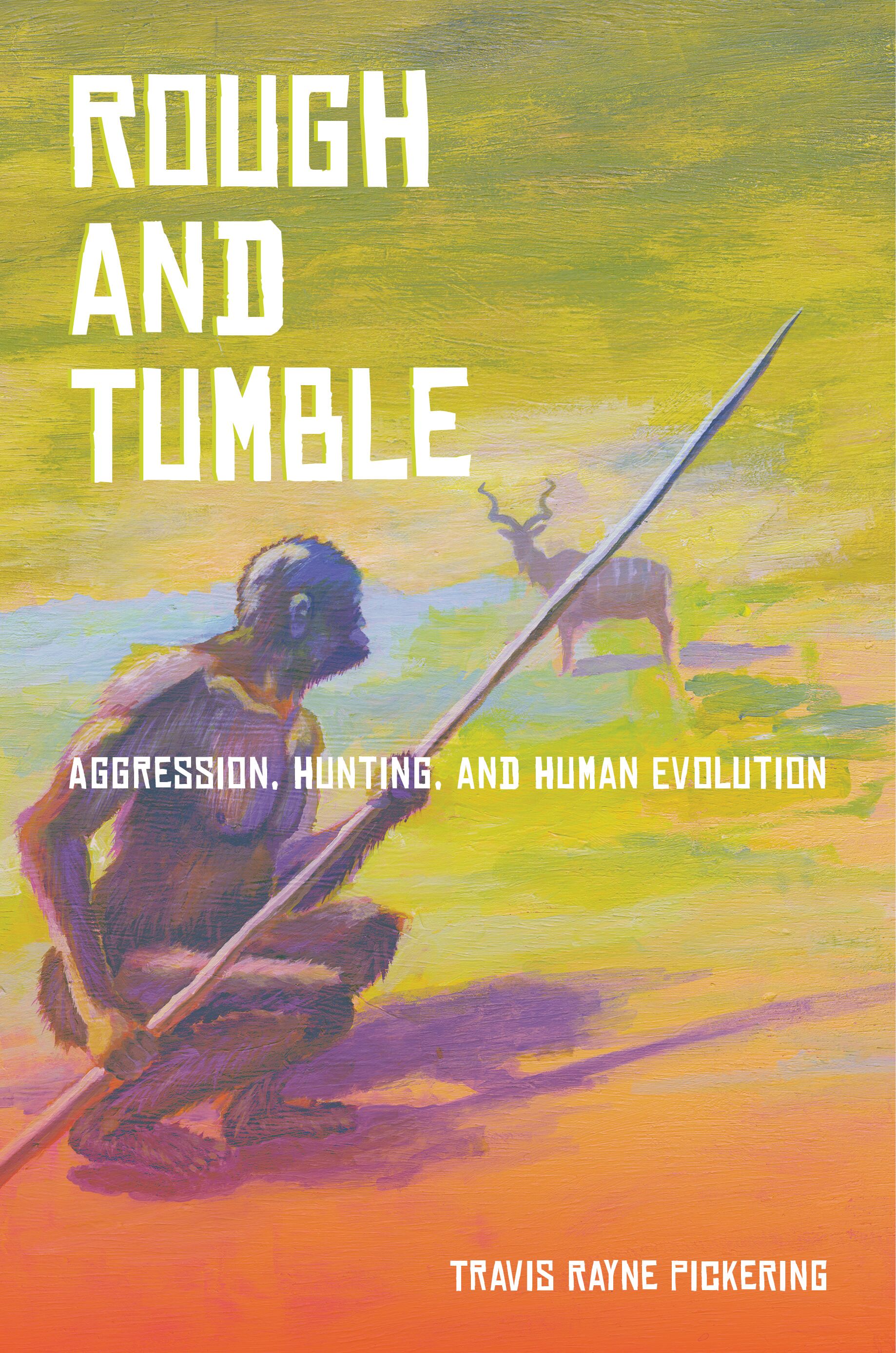
Rough and tumble
Travis Rayne Pickering argues that the advent of ambush hunting approximately two million years ago marked a milestone in human evolution, one that established the social dynamic that allowed our ancestors to expand their range and diet. He challenges the traditional link between aggression and human predation, however, claiming that while aggressive attack is a perfectly efficient way for our chimpanzee cousins to kill prey, it was a hopeless tactic for early human hunters, who—in comparison to their large, potentially dangerous prey—were small, weak, and slow-footed. Technology that evolved from wooden spears to stone-tipped spears and ultimately to the bow and arrow increased the distance between predator and prey and facilitated an emotional detachment that allowed hunters to stalk and kill large game. Based on studies of humans and of other primates, as well as on fossil and archaeological evidence, Rough and Tumble offers a new perspective on human evolution by decoupling ideas of aggression and predation to build a more realistic understanding of what it is to be human.
eBook


Configurational approach to identifying the earliest hominin butchers
The announcement of two approximately 3.4-million-y-old purportedly butchered fossil bones from the Dikika paleoanthropological research area (Lower Awash Valley, Ethiopia) could profoundly alter our understanding of human evolution. Butchering damage on the Dikika bones would imply that tool-assisted meat-eating began approximately 800,000 y before previously thought, based on butchered bones from 2.6- to 2.5-million-y-old sites at the Ethiopian Gona and Bouri localities. Further the only hominin currently known from Dikika at approximately 3.4 Ma is Australopithecus afarensis, a temporally and geographically widespread species unassociated previously with any archaeological evidence of butchering. Our taphonomic configurational approach to assess the claims of A. afarensis butchery at Dikika suggests the claims of unexpectedly early butchering at the site are not warranted. The Dikika research group focused its analysis on the morphology of the marks in question but failed to demonstrate, through recovery of similarly marked in situ fossils, the exact provenience of the published fossils, and failed to note occurrences of random striae on the cortices of the published fossils (incurred through incidental movement of the defleshed specimens across and/or within their abrasive encasing sediments). The occurrence of such random striae (sometimes called collectively \"trampling\" damage) on the two fossils provide the configurational context for rejection of the claimed butchery marks. The earliest best evidence for hominin butchery thus remains at 2.6 to 2.5 Ma, presumably associated with more derived species than A. afarensis.
Journal Article

The “Bear” Essentials: Actualistic Research on Ursus arctos arctos in the Spanish Pyrenees and Its Implications for Paleontology and Archaeology
Neotaphonomic studies of large carnivores are used to create models in order to explain the formation of terrestrial vertebrate fossil faunas. The research reported here adds to the growing body of knowledge on the taphonomic consequences of large carnivore behavior in temperate habitats and has important implications for paleontology and archaeology. Using photo- and videotrap data, we were able to describe the consumption of 17 ungulate carcasses by wild brown bears (Ursus arctos arctos) ranging the Spanish Pyrenees. Further, we analyzed the taphonomic impact of these feeding bouts on the bones recovered from those carcasses. The general sequence of consumption that we charted starts with separation of a carcass's trunk; viscera are generally eaten first, followed by musculature of the humerus and femur. Long limb bones are not broken open for marrow extraction. Bears did not transport carcasses or carcass parts from points of feeding and did not disperse bones appreciably (if at all) from their anatomical positions. The general pattern of damage that resulted from bear feeding includes fracturing, peeling, crenulation, tooth pitting and scoring of axial and girdle elements and furrowing of the upper long limb bones. As predicted from observational data, the taphonomic consequences of bear feeding resemble those of other non-durophagus carnivores, such as felids, and are distinct from those of durophagus carnivores, such as hyenids. Our results have paleontological and archaeological relevance. Specifically, they may prove useful in building analogical models for interpreting the formation of fossil faunas for which bears are suspected bone accumulators and/or modifiers. More generally, our comparative statistical analyses draw precise quantitative distinctions between bone damage patterns imparted respectively by durophagus (modelled here primarily by spotted hyenas [Crocuta crocuta] and wolves [Canis lupus]) and non-durophagus (modelled here by brown bears and lions [Panthera leo]) carnivorans.
Journal Article
Chimpanzee extractive foraging with excavating tools: Experimental modeling of the origins of human technology
It is hypothesized that tool-assisted excavation of plant underground storage organs (USOs) played an adaptive role in hominin evolution and was also once considered a uniquely human behavior. Recent data indicate that savanna chimpanzees also use tools to excavate edible USOs. However, those chimpanzees remain largely unhabituated and we lack direct observations of this behavior in the wild. To fill this gap in our knowledge of hominoid USO extractive foraging, we conducted tool-mediated excavation experiments with captive chimpanzees naïve to this behavior. We presented the chimpanzees with the opportunity to use tools in order to excavate artificially-placed underground foods in their naturally forested outdoor enclosure. No guidance or demonstration was given to the chimpanzees at any time. The chimpanzees used tools spontaneously in order to excavate the underground foods. They exhibited six different tool use behaviors in the context of excavation: probe, perforate, dig, pound, enlarge and shovel. However, they still excavated manually more often than they did with tools. Chimpanzees were selective in their choice of tools that we provided, preferring longer tools for excavation. They also obtained their own tools mainly from naturally occurring vegetation and transported them to the excavation site. They reused some tools throughout the study. Our new data provide a direction for the study of variables relevant to modeling USO extractive foraging by early hominins.
Journal Article

Savanna chimpanzees use tools to harvest the underground storage organs of plants
It has been hypothesized that plant underground storage organs (USOs) played key roles in the initial hominin colonization of savanna habitats, the development of the distinctive skull and tooth morphology of the genus Australopithecus, and the evolution of the genus Homo by serving as \"fallback foods\" exploited during periods of food shortage. These hypotheses have been tested mostly by morphological, isotopic, and microwear analyses of hominin bones and teeth. Archaeological evidence of USO digging technology is equivocal. Until now relevant data from studies of chimpanzees, useful in behavioral models of early hominins because of their phylogenetic proximity and anatomical similarities, have been lacking. Here we report on the first evidence of chimpanzees using tools to dig for USOs, suggesting that exploitation of such resources was within the cognitive and technological reach of the earliest hominins. Consistent with scenarios of hominin adaptation to savannas, these data come from Ugalla (Tanzania), one of the driest, most open and seasonal chimpanzee habitats. USOs are, however, exploited during the rainy season, well after the period of most likely food shortage, contradicting the specific prediction of fallback food hypotheses. The discovery that savanna chimpanzees use tools to obtain USOs contradicts yet another claim of human uniqueness and provides a model for the study of variables influencing USO use among early hominins.
Journal Article

Back from the dead: Another response to the contextual bases of the Rising Star 'deliberate body disposal' hypothesis
The hypothesis that >1500 Middle Pleistocene hominin bones represent the remains of complete corpses deposited deliberately in Rising Star Cave by conspecifics is provocative. This is because intentional handling of dead bodies might imply these hominins had developed a uniquely human sense of mortality salience >235 000 years ago. We assess the contextual bases of this hypothesis and find they do not, in fact, provide its unequivocal support. In sum, critical assessment of relevant geological and taphonomic data disallows falsification of the null hypothesis that the assemblage formed as the result of a non-anthropogenic process(es). Because so, the 'deliberate body disposal' hypothesis remains unsupported.
Journal Article
First Partial Skeleton of a 1.34-Million-Year-Old Paranthropus boisei from Bed II, Olduvai Gorge, Tanzania
Recent excavations in Level 4 at BK (Bed II, Olduvai Gorge, Tanzania) have yielded nine hominin teeth, a distal humerus fragment, a proximal radius with much of its shaft, a femur shaft, and a tibia shaft fragment (cataloged collectively as OH 80). Those elements identified more specifically than to simply Hominidae gen. et sp. indet are attributed to Paranthropus boisei. Before this study, incontrovertible P. boisei partial skeletons, for which postcranial remains occurred in association with taxonomically diagnostic craniodental remains, were unknown. Thus, OH 80 stands as the first unambiguous, dentally associated Paranthropus partial skeleton from East Africa. The morphology and size of its constituent parts suggest that the fossils derived from an extremely robust individual who, at 1.338±0.024 Ma (1 sigma), represents one of the most recent occurrences of Paranthropus before its extinction in East Africa.
Journal Article
Hominin lower limb bones from Sterkfontein Caves, South Africa (1998–2003 excavations)
We describe late Pliocene and early Pleistocene hominin fossils from Sterkfontein Caves (South Africa), including two femoral specimens, as well as a partial tibia and a partial fibula. The fossils are likely assignable to Australopithecus africanus and/or Australopithecus prometheus and the morphology of each corroborates previous interpretations of Sterkfontein hominins as at least facultative bipeds. Significance: * A recent series of papers by our research team describes the morphology of a hominin skeleton from Sterkfontein Caves (South Africa), nicknamed 'Little Foot'. Based on its unique skull morphology, R.J. Clarke, the skeleton's discoverer, places it in the species Australopithecus prometheus, as distinct from the better-known and co-occurring Australopithecus africanus. Here we describe additional hominin thigh and leg fossils from Sterkfontein that, when considered in a comparative context, support the hypothesis that there was significant (probably interspecific) variation in South African hominin postcranial morphology during the late Pliocene and early Pleistocene.
Journal Article