
Catalogue Search | MBRL


Are you sure you want to remove the book from the shelf?

{{itemTitle}}
101
result(s) for
"Tsesis, Alexander"
Sort by:


GENDER DISCRIMINATION AND THE THIRTEENTH AMENDMENT
Although the Thirteenth Amendment was ratified more than a century and a half ago, courts have yet to delve into its relevance to gender discrimination. This oversight is unfortunate given the extent to which jurisprudence about another Reconstruction Amendment, the Fourteenth Amendment, has evolved beyond its original racial confines to include gender, disability, sexual orientation, and other forms of group-specific inequalities. A progressive interpretation of the Thirteenth Amendment should likewise expand congressional enforcement authority beyond race. As was the case with its Fourteenth Amendment counterpart, the Thirteenth Amendment was initially ratified to prevent racial discrimination, but its antisubordination principles are also relevant to policies for abolishing gender discrimination. This underexplored area of law offers tremendous potential for providing redress against a variety of private, state, and institutional forms of gender discrimination that are not actionable under current civil rights statutes. This Essay demonstrates how broad concepts of liberty, which abolitionists, feminists, and Congress developed before and after the ratification of the Thirteenth Amendment, seamlessly lend themselves to the enforcement of gender equality norms. Over the last forty years, the Supreme Court has recognized the existence of federal authority to prevent state gender discrimination. The Thirteenth Amendment is a source of hgislative authority that can be used to address private acts of discrimination.
Journal Article

The Establishment of Religion in Schools
Recent Supreme Court opinions have upended laws that prohibited state support for and participation in devotional exercises, sectarian activities, and religious education. The Essay reviews a variety of historical antecedents that the Court formerly found highly persuasive to Establishment Clause jurisprudence. It next evaluates and critiques the Roberts Court's steady devaluation and erosion of disestablishment norms in opinions that struck down restraints on prayers at public school events and restrictions on public funding of religious schools. References to history and tradition in those cases are at best oblique and at worst misleading. Rather than formalistic recitations of the strict scrutiny test that exaggerate free exercise concerns, the Court should rely on nuanced contextual reasoning to protect the exercise of private religious convictions and maintain separation between religious beliefs and state actions.
Journal Article

The Free Speech Clause as a Deregulatory Tool
The U.S. Supreme Court increasingly leverages a rigid interpretation of the Free Speech Clause to strike regulations that address campaign financing, health care warnings, tax disclosures, collective bargaining agreements, and consumer protections. History has become little more than a slogan that the majority periodically invokes but seldom accurately evaluates. That lack of nuance augments the justices’ authority to articulate absolutist-sounding rules to the detriment of legislatures’ exercise of traditional governmental functions. Jurists would do better to rely on a more proportionate and less categorical approach to decide whether laws impose direct or peripheral burdens on communications. The level of safeguards enjoyed by expressions should be gauged by their value to political self-determination, personal development, or informational contribution. The degree of protections that speech enjoys should be balanced against countervailing government interests, alternatives available to speakers, fit between law and public ends, and relevant history.
Journal Article

The Thirteenth Amendment and American freedom : a legal history
In this narrative history and contextual analysis of the Thirteenth Amendment, slavery and freedom take center stage. Alexander Tsesis demonstrates how entrenched slavery was in pre-Civil War America, how central it was to the political events that resulted in the Civil War, and how it was the driving force that led to the adoption of an amendment that ultimately provided a substantive assurance of freedom for all American citizens.
The story of how Supreme Court justices have interpreted the Thirteenth Amendment, first through racist lenses after Reconstruction and later influenced by the modern civil rights movement, provides insight into the tremendous impact the Thirteenth Amendment has had on the Constitution and American culture. Importantly, Tsesis also explains why the Thirteenth Amendment is essential to contemporary America, offering fresh analysis on the role the Amendment has played regarding civil rights legislation and personal liberty case decisions, and an original explanation of the substantive guarantees of freedom for today's society that the Reconstruction Congress envisioned over a century ago.
eBook
The establishment of religion in schools
Recent Supreme Court opinions have upended laws that prohibited state support for and participation in devotional exercises, sectarian activities, and religious education. The Essay reviews a variety of historical antecedents that the Court formerly found highly persuasive to Establishment Clause jurisprudence. It next evaluates and critiques the Roberts Court's steady devaluation and erosion of disestablishment norms in opinions that struck down restraints on prayers at public school events and restrictions on public funding of religious schools. References to history and tradition in those cases are at best oblique and at worst misleading. Rather than formalistic recitations of the strict scrutiny test that exaggerate free exercise concerns, the Court should rely on nuanced contextual reasoning to protect the exercise of private religious convictions and maintain separation between religious beliefs and state actions.
Journal Article

Terrorist speech on social media
The presence of terrorist speech on the internet tests the limits of the First Amendment. Widely available cyber terrorist sermons, instructional videos, blogs, and interactive websites raise complex expressive concerns. On the one hand, statements that support nefarious and even violent movements are constitutionally protected against totalitarian-like repressions of civil liberties. The Supreme Court has erected a bulwark of associational and communicative protections to curtail government from stifling debate through overbroad regulations. On the other hand, the protection of free speech has never been an absolute bar against the regulation of low value expressions, such as calls to violence and destruction. Terrorist advocacy on the internet raises special problems because it contains elements of political declaration and self-expression, which are typically protected by the First Amendment. However, terrorist organizations couple these legitimate forms of communication with instigation, recruitment, and indoctrination. Incitement readily available on social media is sometimes immediate or, more often, calibrated to influence and rationalize future dangerous behaviors. This is the first Essay to analyze all the Supreme Court's free speech doctrines that are relevant to the enactment of a constitutionally justifiable anti-terrorism statute. Such a law must grant the federal government authority to restrict dangerous terrorist messages on the internet, while preserving core First Amendment liberties. Legislators should develop policies and judges should formulate holdings on the bases of the imminent threat of harm, true threats, and material support doctrines. These three frameworks provide the government with the necessary constitutional latitude to prosecute dangerous terrorist speech that is disseminated over social media and, thereby, to secure public safety, without encroaching on speakers' right to free expression.
Journal Article

Enforcement of the Reconstruction Amendments
This Article analyzes the delicate balance of congressional and judicial authority granted by the Reconstruction Amendments. The Thirteenth, Fourteenth, and Fifteenth Amendments vest Congress with powers to enforce civil rights, equal treatment, and civic participation. Their reach extends significantly beyond the Rehnquist and Roberts Courts' narrow construction of congressional authority. In recent years, the Court has struck down laws that helped secure voter rights, protect religious liberties, and punish age or disability discrimination. Those holdings encroach on the amendments' allocated powers of enforcement. Textual, structural, historical, and normative analyses provide profound insights into the appropriate roles of the Supreme Court and Congress in achieving aspirations of the Second Founding. The framework that emerges requires the judiciary to defer to legitimate legislative functions in enforcing racial equality, dignitary justice, and access to the ballot box. Congress's discretion extends to safeguards for fundamental rights, civil liberties, and political representation. Rational basis review is appropriate when Congress advances autonomy, equality, and franchise. However, when courts safeguard equal enjoyment of fundamental rights against legislative encroachments, those three amendments require heightened judicial scrutiny of adverse state actions.
Journal Article
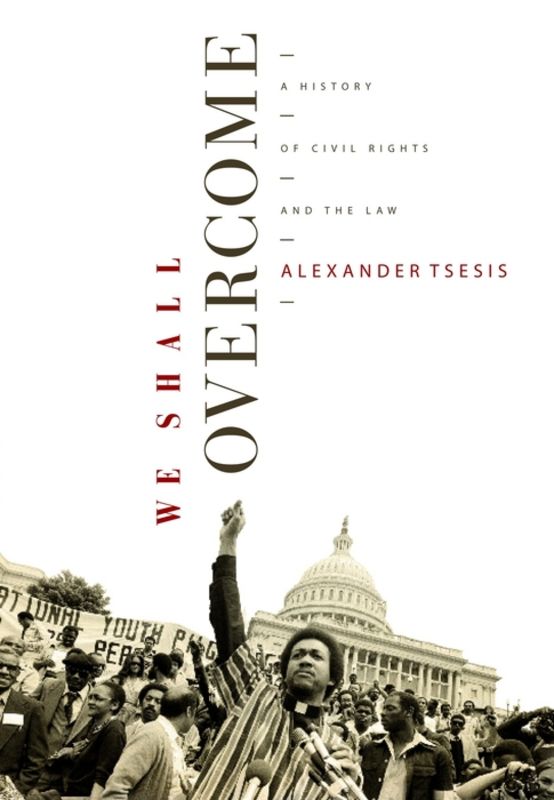
We Shall Overcome
Despite America's commitment to civil rights from the earliest days of nationhood, examples of injustices against minorities stain many pages of U.S. history. The battle for racial, ethnic, and gender fairness remains unfinished. This comprehensive book traces the history of legal efforts to achieve civil rights for all Americans, beginning with the years leading up to the Revolution and continuing to our own times. The historical adventure Alexander Tsesis recounts is filled with fascinating events, with real change and disappointing compromise, and with courageous individuals and organizations committed to ending injustice.
Viewing the evolution of civil rights through the lens of legal history, Tsesis considers laws that have restricted civil rights (such as Jim Crow regulations and prohibitions against intermarriage) and laws that have expanded rights (including antisegregation legislation and other legal advances of the civil rights era). He focuses particular attention on the African American fight for civil rights but also discusses the struggles of women, gays and lesbians, Japanese Americans, Latinos, Native Americans, and Jews. He concludes by assessing the current state of civil rights in the United States and exploring likely future expansions of civil rights.
eBook

BALANCING FREE SPEECH
This article develops a theory for balancing free speech against other express and implied constitutional, statutory, and doctrinal values. It posits that free speech considerations should be connected to the underlying purpose of constitutional governance. When deciding difficult cases involving competing rights, judges should examine (1) whether unencumbered expression is likely to cause constitutional, statutory, or common law harms; (2) whether the restricted expression has been historically or traditionally protected; (3) whether a government policy designed to benefit the general welfare weighs in favor of the regulation; (4) the fit between the disputed speech regulation and the public end; and (5) whether some less restrictive alternative exists for achieving it. Recent Roberts Court free speech jurisprudence has gone in the opposite direction, becoming increasingly formalistic. Cases dealing with violent video games, cruelty to animals, aggregation of campaign financing, and lies about military achievements have applied a categorical approach that is inadequately contextual. The recently formalized categorical test undervalues important normative considerations and a variety of free speech doctrines. On the normative side, free speech is not a separate value but one that fits within a sophisticated structure of constitutional law. After developing an ethical theory about the value of speech to representative democracy and discussing it in the context of several balancing doctrines, this article applies the framework to campaign financing legislation and copyright doctrine.
Journal Article