
Catalogue Search | MBRL


Are you sure you want to remove the book from the shelf?

{{itemTitle}}
2
result(s) for
"Tudor, Maya Jessica, 1975-"
Sort by:

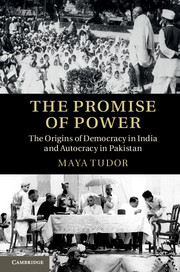
The Promise of Power
Under what conditions are some developing countries able to create stable democracies while others have slid into instability and authoritarianism? To address this classic question at the center of policy and academic debates, The Promise of Power investigates a striking puzzle: why, upon the 1947 Partition of British India, was India able to establish a stable democracy while Pakistan created an unstable autocracy? Drawing on interviews, colonial correspondence, and early government records to document the genesis of two of the twentieth century's most celebrated independence movements, Maya Tudor refutes the prevailing notion that a country's democratization prospects can be directly attributed to its levels of economic development or inequality. Instead, she demonstrates that the differential strengths of India's and Pakistan's independence movements directly account for their divergent democratization trajectories. She also establishes that these movements were initially constructed to pursue historically conditioned class interests. By illuminating the source of this enduring contrast, The Promise of Power offers a broad theory of democracy's origins that will interest scholars and students of comparative politics, democratization, state-building, and South Asian political history.
eBook