
Catalogue Search | MBRL


Are you sure you want to remove the book from the shelf?

{{itemTitle}}
10
result(s) for
"Turkle, Sherry author"
Sort by:

Alone Together
A groundbreaking book by one of the most important thinkers of our time shows how technology is warping our social lives and our inner ones Technology has become the architect of our intimacies. Online, we fall prey to the illusion of companionship, gathering thousands of Twitter and Facebook friends, and confusing tweets and wall posts with authentic communication. But this relentless connection leads to a deep solitude. MIT professor Sherry Turkle argues that as technology ramps up, our emotional lives ramp down. Based on hundreds of interviews and with a new introduction taking us to the present day, Alone Together describes changing, unsettling relationships between friends, lovers, and families.
eBook

Alone together : why we expect more from technology and less from each other
Technology has become the architect of our intimacies. Online, we fall prey to the illusion of companionship, gathering thousands of Twitter and Facebook friends, and confusing tweets and wall posts with authentic communication. But this relentless connection leads to a deep solitude. MIT professor Sherry Turkle argues that as technology ramps up, our emotional lives ramp down. Based on hundreds of interviews and with a new introduction taking us to the present day, Alone Together describes changing, unsettling relationships between friends, lovers, and families.
Book

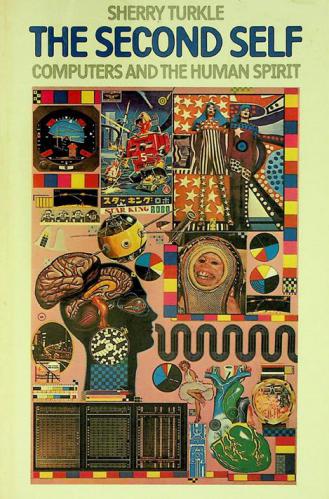
The Second Self
In The Second Self, Sherry Turkle looks at the computer not as a \"tool,\" but as part of our social and psychological lives; she looks beyond how we use computer games and spreadsheets to explore how the computer affects our awareness of ourselves, of one another, and of our relationship with the world. \"Technology,\" she writes, \"catalyzes changes not only in what we do but in how we think.\" First published in 1984, The Second Self is still essential reading as a primer in the psychology of computation. This twentieth anniversary edition allows us to reconsider two decades of computer culture--to (re)experience what was and is most novel in our new media culture and to view our own contemporary relationship with technology with fresh eyes. Turkle frames this classic work with a new introduction, a new epilogue, and extensive notes added to the original text.Turkle talks to children, college students, engineers, AI scientists, hackers, and personal computer owners--people confronting machines that seem to think and at the same time suggest a new way for us to think--about human thought, emotion, memory, and understanding. Her interviews reveal that we experience computers as being on the border between inanimate and animate, as both an extension of the self and part of the external world. Their special place betwixt and between traditional categories is part of what makes them compelling and evocative. (In the introduction to this edition, Turkle quotes a PDA user as saying, \"When my Palm crashed, it was like a death. I thought I had lost my mind.\") Why we think of the workings of a machine in psychological terms--how this happens, and what it means for all of us--is the ever more timely subject of The Second Self.
eBook

Reclaiming conversation : the power of talk in a digital age
Argues that today's digital culture is undermining relationships, creativity, and productivity, and pushes for the return of face-to-face interaction among people.
Book

DAUGHTERS, FIGHTING FOR FREUD'S MANTLE
[MELANIE KLEIN]'s theory is built around an idea that first entered Freud's writing in 1917 when he described the sufferings of melancholics in terms of mutual reproaches between the self and an internalized ''other,'' referring to this person-brought-inside as an inner ''object.'' Klein broadened Freud's idea of ''object relations,'' describing a richly populated inner world. The people (as well as the representations of parts of the body) that the child brings inside have psychological features, personalities. They can be loving, hatting, greedy, envious. Freud focused his attention on one internalized object, the superego - the taking in of an idealized parent when the child is about 5 years old. Klein felt that even the youngest children have fantasies of terrifying internal parents with which their egos cannot cope. And here began her confrontation with [Anna Freud]. Anna Freud expanded on other aspects of her father's legacy - on Freud's later writing, which turned attention away from the unconscious to how the ego strives to control it. Her 1935 work, ''The Ego and the Mechanisims of Defense,'' put her at the center of psychoanalytic ego psychology, best known forits view of the ego as having an autonomous, conflict-free capacity that can be mobilized in a ''therapeutic alliance'' with the analyst. Mrs. [Phyllis Grosskurth] sums up the difference between the two women as follows: ''Anna Freud was an expositor of her father's ideas, but only of those ideas that could be scrutinized in clearly lit, well-ventilated places. Sin, cruelty, suffering she shunned. The witches of the night ride on broomsticks and converse with the powers of darkness in Klein's work, but a Viennese spinster creates an tidy, reasonable world by vigorously sweeping away the cobwebs.'' In her extremism, Klein developed a new psycholanalytic vocabulary, as provocative as it was diosyncratic. If terms like ''castration anxiety'' and ''penis envy'' had turned people away from Freud, what was one to think of the Kleinian world of the ''good breast,'' the ''bad breast'' and the ''persecutory object''? And how was one to believe that infants who could not speak actually had these ideas in their heads? How to believe it and how to prove it? What was most enduring in Klein's work was buried in what many found too speculative or too fantastic.
Book Review
FRUDIAN APOSTLE OF PASSIVITY
Freud thought that many ''feminine'' characteristics were due to an actual genital inferiority - in which women also believed - and that the consequence of this felt inferiority was the lifelong need to overcome or hide it. Though Freud warned against equating masculinity with activity and femininity with passivity, he himself did this all the time. ''Anatomy is destiny'' and ''deficient'' female anatomy made for a problematic psychological destiny for women: their sense of genital deficit leads them to exaggerated physical vanity - narcissism as compensation; ''successful'' feminine development leads them to passivity, including a stronger wish ''to be loved than to love,'' and to masochism. Mr. [Paul Roazen] returns to material that supports the idea that Freud offered Deutsch a theory that corresponded to her psychological dynamics. [HELENE DEUTSCH] hated her mother; even in old age she spoke about her mother, Regina Fass Rosenbach, as a ''terrible woman,'' and idealized her father, Wilhelm, a lawyer. Deutsch reports that her analysis with Freud did not address her feelings toward her mother. Indeed in Helene Deutsch's last analytic hour with Freud, he encouraged her to retain her identification with her father, which Freud regarded as beneficial to her. And Mr. Roazen returns often to material that supports the idea that when Deutsch came to write her theory of women (which took passivity, narcissism and masochism to be the biological core of femininity - ''women's service to the species''), it was an expression of her personal psychology. Deutsch went to Berlin for a second analysis. Freud sent her to Karl Abraham. Mr. Roazen's most moving chapter is on the Berlin analysis. Training to be an analyst includes a didactic or teaching analysis; Deutsch's analysis with Freud had provided this credential. The tension between teaching and curing in the training analysis has sent many analysts into two analyses: one for their institute and one for themselves. The analysis with Abraham was to be for her. But this analysis, too, was a failure. Freud intruded into the privacy of her relationship with Abraham. Helene Deutsch told Mr. Roazen that early in her work with Abraham he showed her a letter from Freud in which the master advised his disciple that Deutsch's marriage with [Felix Deutsch] ought not to be disrupted by analysis. ''Freud's letter to Abraham had been, she later felt, a condition making an analysis impossible.'' And once having been an analysand and a colleague of Freud, the ''father'' of all other analysts, analyses with others of his ''children'' were deeply compromised. And so, in some ways, Helene Deutsch emerges as a victim of the psychoanalytic ''family romance'': the relationship of analysts to Freud the father. This problem of the psychoanalytic father is not unique to Freud and his circle. I met it in the French psychoanalytic movement where Jacques Lacan played that seminal, parental role and where his analysands and disciples suffered from not knowing where they could turn for a second, ''after Lacan,'' analysis.
Newspaper Article
The Boundaries of Humanity
To the age-old debate over what it means to be human, the
relatively new fields of sociobiology and artificial intelligence
bring new, if not necessarily compatible, insights. What have these
two fields in common? Have they affected the way we define
humanity? These and other timely questions are addressed with
colorful individuality by the authors of The Boundaries of
Humanity . Leading researchers in both sociobiology and
artificial intelligence combine their reflections with those of
philosophers, historians, and social scientists, while the editors
explore the historical and contemporary contexts of the debate in
their introductions. The implications of their individual
arguments, and the often heated controversies generated by
biological determinism or by mechanical models of mind, go to the
heart of contemporary scientific, philosophical, and humanistic
studies. Contributors : Arnold I. Davidson, John
Dupré, Roger Hahn, Stuart Hampshire, Evelyn Fox Keller, Melvin
Konner, Alan Newell, Harriet Ritvo, James J. Sheehan, Morton Sosna,
Sherry Turkle, Bernard Williams, Terry Winograd This title is part
of UC Press's Voices Revived program, which commemorates University
of California Press's mission to seek out and cultivate the
brightest minds and give them voice, reach, and impact. Drawing on
a backlist dating to 1893, Voices Revived makes high-quality,
peer-reviewed scholarship accessible once again using
print-on-demand technology. This title was originally published in
1991.
eBook
Dangerous Thoughts . . . And Machines With Big Ideas
[Herbert A. Simon] was born into a middle-class German immigrant family in Milwaukee in 1916. From his earliest years, and notably from the days of his first algebra course in high school, he had a strong love of order. He was, for instance, \"troubled by the fact that some quadratic equations had two solutions, some had one, and some none.\" Referring to his young self in the third person as \"the boy,\" Mr. Simon comments that the intensity of the boy's feelings \"seemed to reveal something of a Platonist within him, a desire to find pattern, and preferably simple pattern, in the world around him.\" He recalls that during his undergraduate years at the University of Chicago, in the early 1930's, a period of intense intellectual and political ferment, he argued philosophy with friends who were loyal to an unruly \"Aristotelian-Thomist-Catholic-Trotskyism.\" But his own tastes led him to less esoteric intellectual seas. A political scientist by training, Mr. Simon studied decision making within organizations and used his findings to lay the foundation for a critique of neoclassical economic theory. To the rest of the world, he was no less enthusiastic or unequivocal. In a letter to Bertrand Russell written the following October, Mr. Simon stressed that when the thinking machine had proved theorems from Russell and Alfred North Whitehead's \"Principia Mathematica,\" the solutions had involved \"genuine 'discovery.' \" (To this missive Russell replied: \"Thank you. . . . I am delighted to know that 'Principia Mathematica' can now be done by machinery. I wish Whitehead and I had known of this possibility before we both wasted ten years doing it by hand.\") In a much-cited 1957 paper, Mr. Simon predicted that in 10 years \"a digital computer will be the world's chess champion, unless the rules bar it from competition,\" and that after chess the possibilities were endless. Within the \"visible future,\" Mr. Simon declared, \"machines that think, that learn, and that create\" will be able to handle the range of problems \"coextensive with the range to which the human mind has been applied.\" In Mr. Simon's hands, even the most emotionally charged events become occasions to discover rules and defend theorems. For instance, he describes an episode during which he contemplated infidelity with an attractive former student he calls Karen. He begins by saying that he \"cannot deny\" the proposition that one might be \"genuinely in love with two women at once\" and then shows how he used his experience to add an important new corollary to his theory of love: \"You can love two or more women at once . . . but you cannot be loyal to more than one.\" In his account, Mr. Simon casts his wife in the role of dialogue partner for himself and Karen as they all agree that he was \"asking for the moon,\" attempting the logically impossible. The consistency of Mr. Simon's scientific and personal esthetic, the penchant for the propositional, will surely draw fire from those with Freudian sensibilities who will be alienated by his search for simple rules in complicated situations and his tendency to close down potentially discomforting questions.
Book Review
MIND/BODY/HEALTH; HERO OF THE LIFE CYCLE
Mr. [Erik H. Erikson] once described psychoanalysis as ''the principal modern form of systematic introspection and meditation.'' In fact, the language he invented - of ''identity,'' ''identity crisis'' and ''the life cycle'' - has become the principal American form of thinking about adolescence and, beyond this, about the widest range of adult trials and tribulations. In ''Configurations in Play'' and ''Studies in the Interpretation of Play,'' Mr. Erikson develops the highly original technique of interpreting children's play sequences the way an analyst interprets a dream. In observing the process of play, he looks for cadence, structure, disruption and spatial configuration as clues to its meaning. In ''The Dream Specimen of Psychoanalysis,'' Mr. Erikson uses his idea of the life cycle to throw new light on Freud's most famous dream. This is the ''Irma dream,'' a dream that Freud had about one of his own patients, and in his own words, ''the first dream ever subjected to an exhaustive interpretation.'' Mr. Erikson uses elements of Freud's biography, in particular his letters to Wilhelm Fliess, to put the Irma dream in the context of ''the moment in Freud's life when it was dreamed . . . the moment when creative thought gave birth to the interpretation of dreams.'' In doing so, Mr. Erikson finds more than the displaced conflicts of Freud's past. He finds Freud's aspirations for his future, going so far as to suggest that the Irma dream may carry ''the historical burden of being dreamed in order to be analyzed, and analyzed in order to fulfill a very special fate.'' The phrase ''a way of looking at things'' was originally Freud's. Freud was cautious about ego-psychology, fearful that it might compromise what he considered the core of psychoanalysis. And so he warned that in the exploration of the ego, ''it will be difficult to escape what is universally known; it will rather be a question of new ways of looking at things.'' At the end of ''Childhood and Society,'' Mr. Erikson says that he has ''nothing to offer except a way of looking at things.'' But the valence of Freud's phrase has been reversed. What is most powerful about reading Mr. Erikson is the experience of recognition. But this does not mean that he merely restates what is ''universally known.'' He tells us what we knew but did not or could not say -and that turns out to be a revolution in vision.
Book Review