
Catalogue Search | MBRL


Are you sure you want to remove the book from the shelf?

{{itemTitle}}
582
result(s) for
"Turner, J. Scott"
Sort by:

Homeostasis as a fundamental principle for a coherent theory of brains
‘Brains’ may be considered to be computation engines, with neurons and synapses analogized to electronic components wired into networks that process information, learn and evolve. Alternatively, ‘brains’ are cognitive systems, which contain elements of intentionality, purposefulness and creativity that do not fit comfortably into a brain-as-computer metaphor. I address the question of how we may think most constructively about brains in their various forms—solid, liquid or fluid—and whether there is a coherent theory that unites them all. In this essay, I explore cognitive systems in the context of new understanding of life's distinctive nature, in particular the core concept of homeostasis, and how this new understanding lays a sound conceptual foundation for an expansive theory of brains. This article is part of the theme issue ‘Liquid brains, solid brains: How distributed cognitive architectures process information'.
Journal Article
Can we identify general architectural principles that impact the collective behaviour of both human and animal systems?
The search for general common principles that unify disciplines is a longstanding challenge for interdisciplinary research. Architecture has always been an interdisciplinary pursuit, combining engineering, art and culture. The rise of biomimetic architecture adds to the interdisciplinary span. We discuss the similarities and differences among human and animal societies in how architecture influences their collective behaviour. We argue that the emergence of a fully biomimetic architecture involves breaking down what we call ‘pernicious dualities’ that have permeated our discourse for decades, artificial divisions between species, between organism and environment, between genotype and phenotype, and in the case of architecture, the supposed duality between the built environment and its builders. We suggest that niche construction theory may serve as a starting point for unifying our thinking across disciplines, taxa and spatial scales.
This article is part of the theme issue ‘Interdisciplinary approaches for uncovering the impacts of architecture on collective behaviour’.
Journal Article
Surface curvature guides early construction activity in mound-building termites
Termite colonies construct towering, complex mounds, in a classic example of distributed agents coordinating their activity via interaction with a shared environment. The traditional explanation for how this coordination occurs focuses on the idea of a ‘cement pheromone’, a chemical signal left with deposited soil that triggers further deposition. Recent research has called this idea into question, pointing to a more complicated behavioural response to cues perceived with multiple senses. In this work, we explored the role of topological cues in affecting early construction activity in Macrotermes . We created artificial surfaces with a known range of curvatures, coated them with nest soil, placed groups of major workers on them and evaluated soil displacement as a function of location at the end of 1 h. Each point on the surface has a given curvature, inclination and absolute height; to disambiguate these factors, we conducted experiments with the surface in different orientations. Soil displacement activity is consistently correlated with surface curvature, and not with inclination nor height. Early exploration activity is also correlated with curvature, to a lesser degree. Topographical cues provide a long-term physical memory of building activity in a manner that ephemeral pheromone labelling cannot. Elucidating the roles of these and other cues for group coordination may help provide organizing principles for swarm robotics and other artificial systems. This article is part of the theme issue ‘Liquid brains, solid brains: How distributed cognitive architectures process information’.
Journal Article

Excavation and aggregation as organizing factors in de novo construction by mound-building termites
Termites construct complex mounds that are orders of magnitude larger than any individual and fulfil a variety of functional roles. Yet the processes through which these mounds are built, and by which the insects organize their efforts, remain poorly understood. The traditional understanding focuses on stigmergy, a form of indirect communication in which actions that change the environment provide cues that influence future work. Termite construction has long been thought to be organized via a putative ‘cement pheromone’: a chemical added to deposited soil that stimulates further deposition in the same area, thus creating a positive feedback loop whereby coherent structures are built up. To investigate the detailed mechanisms and behaviours through which termites self-organize the early stages of mound construction, we tracked the motion and behaviour of major workers from two Macrotermes species in experimental arenas. Rather than a construction process focused on accumulation of depositions, as models based on cement pheromone would suggest, our results indicated that the primary organizing mechanisms were based on excavation. Digging activity was focused on a small number of excavation sites, which in turn provided templates for soil deposition. This behaviour was mediated by a mechanism of aggregation, with termites being more likely to join in the work at an excavation site as the number of termites presently working at that site increased. Statistical analyses showed that this aggregation mechanism was a response to active digging, distinct from and unrelated to putative chemical cues that stimulate deposition. Agent-based simulations quantitatively supported the interpretation that the early stage of de novo construction is primarily organized by excavation and aggregation activity rather than by stigmergic deposition.
Journal Article

On Evolutionary Novelty
Darwin's ‘endless forms most beautiful’ was his testimony to the creative power of natural selection. Creativity, by definition, implies novelty: bringing into existence something which had never before existed. Novelty constitutes the grist for the mill of natural selection to refine those endless forms most beautiful. But whence evolutionary novelty? Since the rise of the Neodarwinian idea of gene selectionism, evolutionary novelty is supposed to arise through new presentation of selective environments and gene modification, reflecting Darwin's own ambition of creating a naturalistic explanation for the generation of his ‘endless forms most beautiful’. The Neodarwinian idea deprives organisms of their fundamental agency of purposefulness and intentionality, which are regarded as illusions rather than fundamental to life itself. Surprisingly, those fundamental attributes arise naturally from the thermodynamics of life combined with a proper understanding of the phenomenon of homeostasis. Adaptation as a purposeful phenomenon driven by organismal intelligence and self-knowledge emerges naturally from this, as well as a new perspective on the evolutionary origins of novel forms and functions.
Journal Article

Homeostasis and the physiological dimension of niche construction theory in ecology and evolution
Niche construction theory (NCT) has been represented as a new and comprehensive theory of evolution, one that breaks the constraints imposed by the dominant and largely gene-selectionist standard evolutionary model that is presently mischaracterized as “Darwinian.” I will argue that NCT is not so much a new theory, as it is a fruitful readmission of a venerable physiological perspective on adaptation, selection and evolution. This perspective is closer in spirit and philosophy to the original (and richer) Darwinian idea developed by Darwin himself, and that animated much of the rich late nineteenth century debate about evolution, heredity, adaptation and development, a debate that was largely eclipsed by the early twentieth century emergence of the Neodarwinian synthesis. I will argue that a full realization of the promise of NCT turns on a full understanding of another intellectual revolution of the nineteenth century, Claude Bernard’s conception of homeostasis, a profound statement of the nature of life that has, through the twentieth century, come to be widely misunderstood and trivialized.
Journal Article
The extension of internal humidity levels beyond the soil surface facilitates mound expansion in Macrotermes
Termites in the genus Macrotermes construct large-scale soil mounds above their nests. The classic explanation for how termites coordinate their labour to build the mound, based on a putative cement pheromone, has recently been called into question. Here, we present evidence for an alternate interpretation based on sensing humidity. The high humidity characteristic of the mound's internal environment extends a short distance into the low-humidity external world, in a ‘bubble’ that can be disrupted by external factors like wind. Termites transport more soil mass into on-mound reservoirs when shielded from water loss through evaporation, and into experimental arenas when relative humidity is held at a high value. These results suggest that the interface between internal and external conditions may serve as a template for mound expansion, with workers moving freely within a zone of high humidity and depositing soil at its edge. Such deposition of additional moist soil will increase local humidity, in a feedback loop allowing the ‘interior’ zone to progress further outward and lead to mound expansion.
Journal Article

Semiotics of a Superorganism
Darwinian evolution, as it was first conceived, has two dimensions: adaptation, that is, selection based upon “apt function”, defined as the “good fit” between an organism’s metabolic and biological demands and the environment in which it is embedded; and heredity, the transmissible memory of past apt function. Modern Darwinism has come to focus almost exclusively on hereditary memory, eclipsing the—arguably still-problematic—phenomenon of adaptation. As a result, modern Darwinism retains, at its core, certain incoherencies that, as long as they remain unresolved, preclude the emergence of a fully-coherent theory of evolution. Resolving the incoherencies will involve clarifying the relationship between embodied memory and apt function. In short, adaptation is a problem of semiotics: the organism must interpret the environment to fit well into it. This is well-illustrated by the constructed environments built by colonies of social insects, such as hives or nests, and the ancillary structures that contain them, forming an organism-like system known as a superorganism. The superorganism is marked by a kind of extended physiology, in that these constructed environments often serve as adaptive interfaces between the nest and ambient environment, and are constructed to manage the matter and energy flows between environments that constitute the process of adaptation. These constructed environments are also semiotic phenomena: interpretive structures, governed by information flow between the member insects and the structures they build. I review our findings on one such example: the mounds built by the fungus-cultivating termites of the genus
Macrotermes
. These structures are dynamic forms that are sustained by flows of soil from deep horizons up into the mound. The form, and hence the function, of the mound is determined by several environmental cues, most notably water and wind, as well as how termites interpret these cues, and signals that flow between termites, both directly and vicariously through the structures they build.
Journal Article
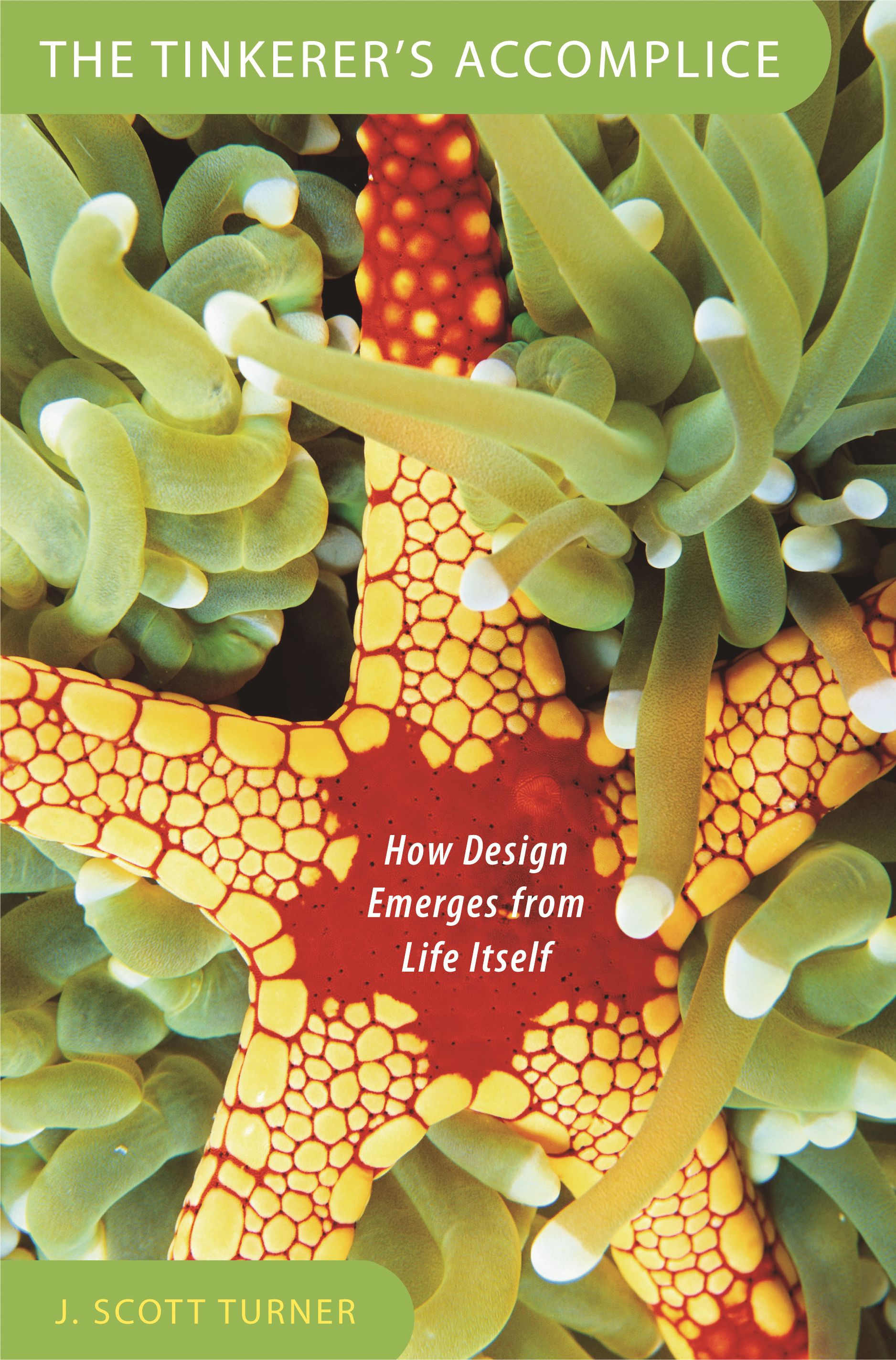
The tinkerer's accomplice
Physiologist Scott Turner argues eloquently that the apparent design we see in the living world only makes sense when we add to Darwin's towering achievement the dimension that much modern molecular biology has left on the gene-splicing floor: the dynamic interaction between living organisms and their environment. Only when we add environmental physiology to natural selection can we begin to understand the beautiful fit between the form life takes and the way life works.
eBook
Homeostasis as a fundamental principle for a coherent theory of brains
'Brains' may be considered to be computation engines, with neurons and synapses analogized to electronic components wired into networks that process information, learn and evolve. Alternatively, 'brains' are cognitive systems, which contain elements of intentionality, purposefulness and creativity that do not fit comfortably into a brain-as-computer metaphor. I address the question of how we may think most constructively about brains in their various forms—solid, liquid or fluid—and whether there is a coherent theory that unites them all. In this essay, I explore cognitive systems in the context of new understanding of life's distinctive nature, in particular the core concept of homeostasis, and how this new understanding lays a sound conceptual foundation for an expansive theory of brains.
This article is part of the theme issue 'Liquid brains, solid brains: How distributed cognitive architectures process information'.
Journal Article