
Catalogue Search | MBRL


Are you sure you want to remove the book from the shelf?

{{itemTitle}}
235
result(s) for
"Tyner, James"
Sort by:


Population geography I: Surplus populations
The subject of ‘population’ is undergoing a renaissance in geography; this is seen, for example, in the voluminous studies addressing ‘marginalized’ populations, including but not limited to refugees, internally displaced persons, and children. In short, scholarship has focused on those lives rendered ‘wasted’, ‘precarious’, or ‘superfluous’. Population geographers have made substantial contributions; however, more can be done. In this and the next two progress reports, I suggest that population geographers reflect more deeply on the spatiality and survivability of vulnerable populations. More specifically, population geographers should consider the politics of fertility, mortality, and mobility from the standpoint of a layered demographic question: within any given place, who lives, who dies, and who decides? In this first report, I resituate the concept ‘surplus population’ within the broader domain of population geography. In subsequent reports, I consider more closely population geography’s association with related subject areas (i.e. biopolitics and necropolitics). I maintain that, by addressing vulnerability and survivability, we join others in geography and allied fields who are writing about ‘populations’ not as biological, pre-given entities, but instead as political subjects at risk of premature death.
Journal Article

Violence in capitalism : devaluing life in an age of responsibility
\"What, James Tyner asks, separates the murder of a runaway youth from the death of a father denied a bone-marrow transplant because of budget cuts? Moving beyond our culture's reductive emphasis on whether a given act of violence is intentional--and may therefore count as deliberate murder--Tyner interrogates the broader forces that produce violence. His uniquely geographic perspective considers where violence takes place (the workplace, the home, the prison, etc.) and how violence moves across space. Approaching violence as one of several methods of constituting space, Tyner examines everything from the way police departments map crime to the emergence of \"environmental criminology.\" Throughout, he casts violence in broad terms--as a realm that is not limited to criminal acts, and one that can be divided into the categories \"killing\" and \"letting die.\" His framework extends the study of biopolitics by examining the state's role in producing (or failing to produce) a healthy citizenry. It also adds to the new literature on capitalism by articulating the interconnections between violence and political economy. Simply put, capitalism (especially its neoliberal and neoconservative variants) is structured around a valuation of life that fosters a particular abstraction of violence and crime\"-- Provided by publisher.
Book

The Alienated Subject
A timely and provocative discussion of alienation as an
intersectional category of life under racial capitalism and white
supremacy
From the divisiveness of the Trump era to the Covid-19 pandemic,
alienation has become an all-too-familiar contemporary concept. In
this groundbreaking book, James A. Tyner offers a novel framework
for understanding the alienated subject, situating it within racial
capitalism and white supremacy. Directly addressing current
economic trends and their rhetoric of xenophobia, discrimination,
and violence, The Alienated Subject exposes the universal
whitewashing of alienation.
Drawing insight from a variety of sources, including Marxism,
feminism, existentialism, and critical race theory, Tyner develops
a critique of both the liberal subject and the alienated subject.
Through an engagement with the recent pandemic and the Black Lives
Matter movement, he demonstrates how the alienated subject is
capable of both compassion and cruelty; it is a sadomasochist.
Tyner goes on to emphasize the importance of the particular places
we find the alienated subject and how the revolutionary
transformation of alienation is inherently a spatial struggle.
Returning to key interlocutors from Sartre to Fromm, he examines
political notions of distance and the spatial practices of everyday
life as well as the capitalist conditions that give rise to the
alienated subject.
For Tyner, the alienated subject is not the iconic, romanticized
image of Marx's proletariat. Here he calls for an affirmation of
love as a revolutionary concept, necessary for the transformation
of a society marred by capitalism into an emancipated, caring
society conditioned by socially just relations.
eBook


Violence in Capitalism
What, James Tyner asks, separates the murder of a runaway youth
from the death of a father denied a bone-marrow transplant because
of budget cuts? Moving beyond our culture's reductive emphasis on
whether a given act of violence is intentional-and may therefore
count as deliberate murder-Tyner interrogates the broader forces
that produce violence. His uniquely geographic perspective
considers where violence takes place (the workplace, the home, the
prison, etc.) and how violence moves across space.
Approaching violence as one of several methods of constituting
space, Tyner examines everything from the way police departments
map crime to the emergence of \"environmental criminology.\"
Throughout, he casts violence in broad terms-as a realm that is not
limited to criminal acts and one that can be divided into the
categories of \"killing\" and \"letting die.\" His framework extends
the study of biopolitics by examining the state's role in producing
(or failing to produce) a healthy citizenry. It also adds to the
new literature on capitalism by articulating the interconnections
between violence and political economy. Simply put, capitalism
(especially its neoliberal and neoconservative variants) is
structured around a valuation of life that fosters a particular
abstraction of violence and crime.
eBook

Population geography II
The geographic study of mortality is enjoying a renaissance. This is indicated by the growing number of studies on necropolitics, thanatopolitics, ‘deathscapes’, and the inequalities of premature death. Population geographers, however, have contributed little to the broader theoretical conceptualization – and spatiality – of mortality. Previously, I encouraged population geographers to reflect on the survivability of vulnerable populations. In this second progress report, I extend this focus through a reconsideration of mortality from the standpoint of survivability. As a discipline, population geography has long engaged with the concept of ‘premature’ death; here it is indicated how this concept is intimately bound to the modernist ordering of life that dominates our contemporary understanding of bodies and populations. First, I reflect on the embodiment of mortality, and this is followed by a critical engagement with the ‘bio-logics’ of life and death. I maintain that population geography is well positioned to contribute to ongoing debates regarding who lives, who dies, and who decides.
Journal Article

The apathy of empire : Cambodia in American geopolitics
What America’s intervention in Cambodia during the Vietnam War reveals about Cold War–era U.S. national security strategy The Apathy of Empire reveals just how significant Cambodia was to U.S. policy in Indochina during the Vietnam War, broadening the lens to include more than the often-cited incursion in 1970 or the illegal bombing after the Paris Peace Accords in 1973. This theoretically informed and thoroughly documented case study argues that U.S. military intervention in Cambodia revealed America’s efforts to construct a hegemonic spatial world order. James Tyner documents the shift of America’s post-1945 focus from national defense to national security. He demonstrates that America’s expansionist policies abroad, often bolstered by military power, were not so much about occupying territory but instead constituted the construction of a new normal for the exercise of state power. During the Cold War, Vietnam became the geopolitical lodestar of this unfolding spatial order. And yet America’s grand strategy was one of contradiction: to build a sovereign state (South Vietnam) based on democratic liberalism, it was necessary to protect its boundaries—in effect, to isolate it—through both covert and overt operations in violation of Cambodia’s sovereignty. The latter was deemed necessary for the former. Questioning reductionist geopolitical understandings of states as central or peripheral, Tyner explores this paradox to rethink the formulation of the Cambodian war as sideshow, revealing it instead as a crucial site for the formation of this new normal. Retail e-book files for this title are screen-reader friendly.
eBook
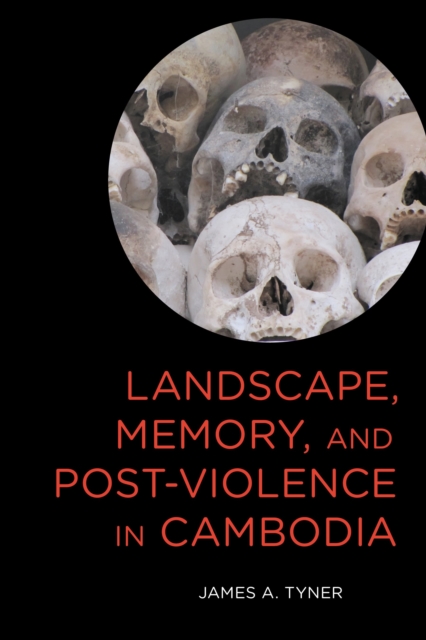
Landscape, memory, and post-violence in Cambodia
Between 1975 and 1979 the Khmer Rouge regime in Cambodia enacted a program of organized mass violence that resulted in the deaths of approximately one quarter of the country’s population. Over two million people died from torture, execution, disease and famine. From the commodification of the ‘killing fields’ of Choeung Ek to the hundreds of unmarked mass graves scattered across the country, violence continues to shape the Cambodian landscape.
Landscape, Memory, and Post-Violence in Cambodia explores the on-going memorialization of violence. As part of a broader engagement with war, violence and critical heritage studies, it explores how a legacy of organized mass violence becomes part of a cultural heritage and, in the process, how this heritage is ‘produced’. Existing literature has addressed explicitly the impact of war and armed conflict on cultural heritage through the destruction of heritage sites. This book inverts this concern by exploring what happens when sites of ‘heritage violence’ are under threat. It argues that the selective memorialization of Cambodia’s violent heritage negates the everyday lived experiences of millions of Cambodians and diminishes the efforts to bring about social justice and reconciliation. In doing so, it develops a grounded conceptual understanding of post-violence in conflict zones internationally.
eBook