
Catalogue Search | MBRL


Are you sure you want to remove the book from the shelf?

{{itemTitle}}
11
result(s) for
"UBL, RALPH"
Sort by:


Delacroix’s parade
The nineteenth century understood parade to refer to a small presentation announcing the actual spectacle in a theater or circus. Singers, actors, acrobats, and musicians would court the public's favor in front of the performance space. Their goal was to attract a paying audience through improvisational playacting and ostentatious addresses to people passing by. The parade thus seems to have scorned the autonomous work of art, which defined the development of drama, opera, and also painting at the time. Eugene Delacroix was clearly aware of this polemic relationship. In his early caricatures Italian Theater and Grand Opera, he refers to a parade so as to take the side of opera buffa in a dispute about this operatic genre. The tense relationship between artwork and parade also engaged Delacroix as an established artist who had made some of the most-discussed monumental works of the first half of the nineteenth century.
Journal Article

Images Without Objects and Referents?
In a little book published in 2014, we attempted to systematically introduce a field of scholarship that multiple disciplines — including philosophy, theology, and art history — have participated in developing: image theory. While engaging with the both rich and heterogeneous work in this field, we elaborated a theoretical model that unfolds through three basic concepts: image vehicle, image content, and image referent. With image vehicle, we understand a thing perceivable to the senses — such as a bundle of synthetic fibers, a reflective surface, or a painted wood panel — that allows another thing to be seen or recognized; for example, a bear in the bundle of synthetic fibers, spatial depth in the reflective surface, or a room in the painted panel. We call this other thing that the image vehicle makes visible or recognizable the image content; and it encompasses, in our view, objects and spaces that we call image objects and image spaces.'
Journal Article
Eugène Delacroix’s Jewish Wedding and the Medium of Painting
The white wall in the center of Eugène Delacroix’sA Jewish Wedding in Morocco(Figure 12.1) has always struck me as a color field announcing what modernist painting would be. Emerging from an exuberant surrounding of purple, green, red, and orange, it addresses us as forcefully as a figure or a gaze, although it is neither. The critical engagement with modernism has produced a set of categories, such as opticality, thickness, and facingness, which could be implemented to analyze this effect.¹ In proceeding this way, one would be continuing a tradition initiated by writers such as Charles Baudelaire, Paul Signac,
Book Chapter
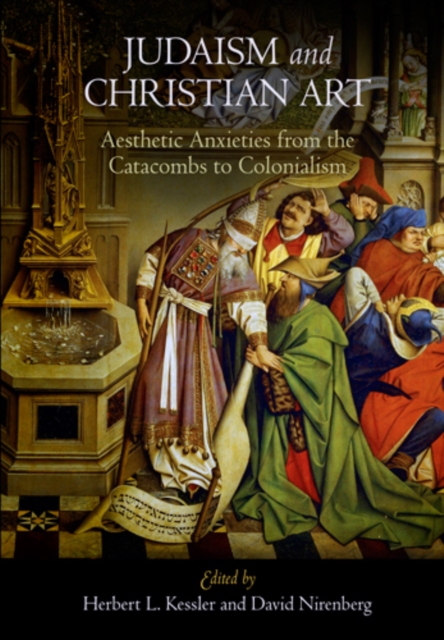
Judaism and Christian Art
Christian cultures across the centuries have invoked Judaism in order to debate, represent, and contain the dangers presented by the sensual nature of art. By engaging Judaism, both real and imagined, they explored and expanded the perils and possibilities for Christian representation of the material world.
The thirteen essays inJudaism and Christian Artreveal that Christian art has always defined itself through the figures of Judaism that it produces. From its beginnings, Christianity confronted a host of questions about visual representation. Should Christians make art, or does attention to the beautiful works of human hands constitute a misplaced emphasis on the things of this world or, worse, a form of idolatry (\"Thou shalt make no graven image\")? And if art is allowed, upon what styles, motifs, and symbols should it draw? Christian artists, theologians, and philosophers answered these questions and many others by thinking about and representing the relationship of Christianity to Judaism. This volume is the first dedicated to the long history, from the catacombs to colonialism but with special emphasis on the Middle Ages and the Renaissance, of the ways in which Christian art deployed cohorts of \"Jews\"-more figurative than real-in order to conquer, defend, and explore its own territory.
eBook


Signature Works
To catch an artwork by the tail, we learn, is no easy trick; it requires an operation by which the foundational authority of the symbolic order is dragged out from its transcendental hiding place, so that the phallus, for example, is presented as simply a prick, or even a monkey's tail-indeed, in Picabia's Natures mortes (Still Lifes) of 1920 (depicted on the ?cover of Baker's book), a monkey holds its own tail, emerging between the front of its legs, in its hand.
Magazine Article