
Catalogue Search | MBRL


Are you sure you want to remove the book from the shelf?

{{itemTitle}}
131
result(s) for
"Unwin, Timothy A"
Sort by:

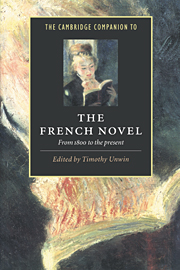
The Cambridge Companion to the French Novel
This volume offers a unique and valuable insight into the novel in French over the past two centuries. In a series of essays, acknowledged experts discuss a variety of topics including nineteenth-century realism, women and fiction, popular fiction, experiment and innovation, war and the Holocaust, the Francophone novel, and postmodern fiction. They offer a challenging reassessment of major figures, while deliberately reading traditional views of literary history against the grain. Theoretical discussion is combined with close reading of texts and exploration of context, comparison with other genres and other literatures, and reference to novels from earlier periods. This companionable introduction includes a chronology and guide to further reading. From it emerges a strong sense of the vitality and energy of the modern French novel, and of the debates surrounding it.
eBook

Joie de Vivre in French Literature and Culture
The apparent self-sufficiency of joie de vivre means that, despite the widespread use of the phrase since the late nineteenth century, the concept has rarely been explored critically. Joie de vivre does not readily surrender itself to examination, for it is in a sense too busy being what it is. However, as the essays in this collection reveal, joie de vivre can be as complex and variable a state as the more negative emotions or experiences that art and literature habitually evoke. This volume provides an urgently needed study of an intriguing and under-explored area of French literature and culture from the Middle Ages to the contemporary era. While the range and content of contributions embraces linguistics, literature, art, sport and politics, the starting point is, like that of the term joie de vivre itself, in French language and culture. This volume will be of special interest to researchers across the full range of French studies, from literature and language to cultural studies. It will be of direct appeal to specialist readers, university libraries, graduate and undergraduate students, and general readers with a lively interest in French literature and culture of the medieval, early modern and broad modern periods. This book's fresh perspectives on the theme of joie de vivre and its relation to questions of privacy, contemplation, voyeurism, feasting and nationhood will also be of relevance to researchers in comparative and cognate disciplines.
eBook

The Cambridge Companion to Flaubert
This volume brings together a series of essays by acknowledged experts on Flaubert. It offers a coherent overview of the writer's work and critical legacy, and provides insights into the very latest scholarly thinking. While a central place is given to Flaubert's most widely read texts, attention is also paid to key areas of the corpus that have tended to be overlooked. Close textual analyses are accompanied by discussion of broader theoretical issues, and by a consideration of Flaubert's place in the wider traditions that he both inherited and influenced. These essays provide not only a robust critical framework for readers of Flaubert, but also a fuller understanding of why he continues to exert such a powerful influence on literature and literary studies today. A concluding essay by the prize-winning author Mario Vargas Llosa examines Flaubert's legacy from the point of view of the modern novelist.
eBook


