
Catalogue Search | MBRL


Are you sure you want to remove the book from the shelf?

{{itemTitle}}
38
result(s) for
"Urrows, David Francis"
Sort by:
Music, narrative and the moving image : varieties of plurimedial interrelations
In extending the traditional field of Word and Music Studies to include research on film and other forms of moving visualizations, this volume focuses on innovative discussions of artistic works showing relationships between three individual communicative media. This trifocal, interdisciplinary perspective is reflected in seventeen essays that cover the historical space from the 19th to the 21st centuries and discuss a wide variety of individual genres in the represented media. These range from Parisian cabaret to 'revolutionary' Peking opera, from silent film to Holocaust narration, from documentary propaganda movies to opera film interludes, and more. The investigation of historical cases is broadened by reflections on theoretical and functional issues, primarily in film music, which show a remarkable breadth of technical and perceptual varieties. The essays here collected are of relevance to scholars and students of film studies, musicology, and literature, as well as readers generally interested in Intermediality Studies.
Book
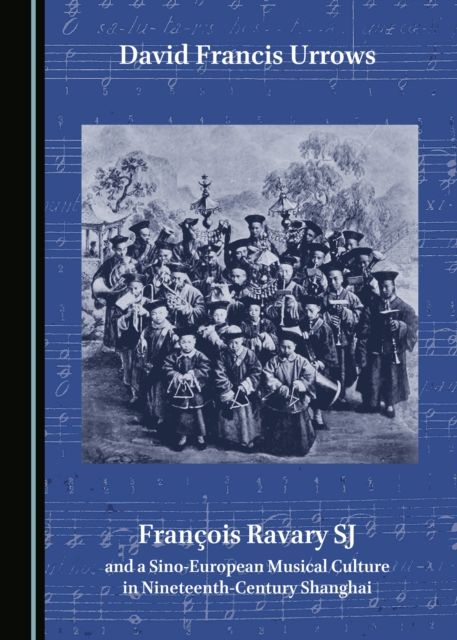
François Ravary SJ and a Sino-European Musical Culture in Nineteenth-Century Shanghai
This book reveals the story of François Ravary, Jesuit missionary, musician, and organ builder. The mastermind behind the construction of the bamboo organs of nineteenth-century Shanghai, Ravary's unpublished letters from China present a vivid picture of the excitement and crises surrounding the Roman Catholic mission in the often-violent integration of global space of this time. Focusing on an individual life, this study adds needed perspective to histories of the treaty-port era. By shifting the inquiry towards a nuanced, empirical, and refocused evaluation of the landscape, Ravary is revealed as a humanist in the Christian tradition, curious about Chinese society and culture, as well as the force behind China's first brass band, first school orchestra, and other landmarks of Sino-European musical convergence. This book is a must-read for anyone interested in nineteenth-century China studies, cultural histories, and the diffusion of Western art practices.
eBook

Music, Narrative and the Moving Image
By focusing on discussions of artistic works that show relationships between three individual communicative media, this volume adopts an innovative, trifocal interdisciplinary perspective: the traditional field of Word and Music Studies is here extended to include research on film and other forms of moving visualizations.
eBook

Word and Music Studies
The nine interdisciplinary essays in this volume were presented in 2003 in Berlin at the Fourth International Conference on Word and Music Studies, which was sponsored by The International Association for Word and Music Studies (WMA). The nine articles in this volume cover two areas: \"Surveying the Field\" and \"Music and the Spoken Word\". Topics include postmodernism, philosophy, German literary modernism, opera, film, the Lied, radio plays, and \"verbal counterpoint\". They cover the works of such philosophers, critics, literary figures, and composers as Argento, Beckett, Deleuze, Guattari, Feldman, Glenn Gould, Nietzsche, Schubert, Strauss, Wagner, and Wolfram. Three films are discussed: Casablanca, The Fisher King, and Thirty Two Short Films About Glenn Gould.
eBook


The Wind Qin
Late in the year of 1600, with only a few months to live, a Chinese official by the name of Wang Linheng (王臨亨, 1548–1601) put his brush to paper and wrote of an almost fantastic voyage. His story was an account of his visit the previous year to a place on the fringe of late Ming China, an enclave of “barbarians” calledAmagao. Wang found there to his surprise that these strangers, who had been occupying and trading on the narrow peninsula for nearly a century, were adept at many things of a technical nature. He wrote of the
Book Chapter

Text vs. Act The Bearbeitungsfrage and the 'Romantic Baroque'
When the Bach-Gesellschaft was founded in 1850, could its organizers have known that their 'objective' actions and intents would not be taken kindly by much of subjectively-minded musical Europe? Within the decade, a polemical public debate about the Bearbeitungsfrage (issue of arrangements and transcriptions) arose around the very nature and goals of the emerging discipline of musicology. Early editors such as Phillip Spitta and Friedrich Chrysander often found critical support for their work in progressive figures such as Joachim, Brahms, and Eduard Hanslick. The opposition was led by the composer Robert Franz, and supported by (among others) Franz Liszt. They derided the 'most recent alliance' of Spitta and Chrysander, characterizing them as mere 'archeologists', musical incompetents who were vandalizing great art and producing useless, unperformable editions. In the period 1860 to 1890, Franz's 'artistic' school (which included his acolytes, Julius Schaeffer, Albert Hahn, and Otto Dresel) published rival editions of Baroque works with full scores, vocal scores, and instrumental parts, some of which were still in print well into the 20th century. By the end of the 19th century, the debate had died down, along with its principal authors. But the issues raised remained, as the tensions surrounding performances in the past fifty years by Glenn Gould and Angela Hewitt may remind us. [PUBLICATION ABSTRACT]
Journal Article