
Catalogue Search | MBRL


Are you sure you want to remove the book from the shelf?

{{itemTitle}}
6
result(s) for
"Useem, Michael, author"
Sort by:


The Inner Circle
This book delineates the \"\"inner circle\"\" of top executives who play a leading role in the international corporate network by promoting a political environment favorable to all business
Book


Leadership Dispatches
On February 27, 2010, Chile was rocked by a violent earthquake five hundred times more powerful than the one that hit Haiti just six weeks prior. The Chilean earthquake devastated schools, hospitals, roads, and homes, paralyzing the country for weeks and causing economic damage that was equal to 18 percent of Chile's GDP. This calamity hit just as an incumbent political regime was packing its bags and a new administration was preparing to take office. For most countries, it would have taken years, if not decades, to recover from such an event. Yet, only one year later, Chile's economy had reached a six percent annual growth rate.
In Leadership Dispatches, Michael Useem, Howard Kunreuther, and Erwann Michel-Kerjan look at how the nation's leaders—in government, business, religion, academia, and beyond—facilitated Chile's recovery. They attribute Chile's remarkable comeback to a two-part formula consisting of strong national leadership on the one hand, and deeply rooted institutional practices on the other. Coupled with strategic, deliberative thinking, these levers enabled Chile to bounce back quickly and exceed its prior national performance. The authors make the case that the Chilean story contains lessons for a broad range of organizations and governments the world over.
Large-scale catastrophes of many kinds—from technological meltdowns to disease pandemics—have been on the rise in recent years. Now is the time to seek ideas and guidance from other leaders who have triumphed in the wake of a disaster. In this vein, Leadership Dispatches is both a remarkable story of resilience and an instructive look at how those with the greatest responsibility for a country, company, or community should lead.
eBook
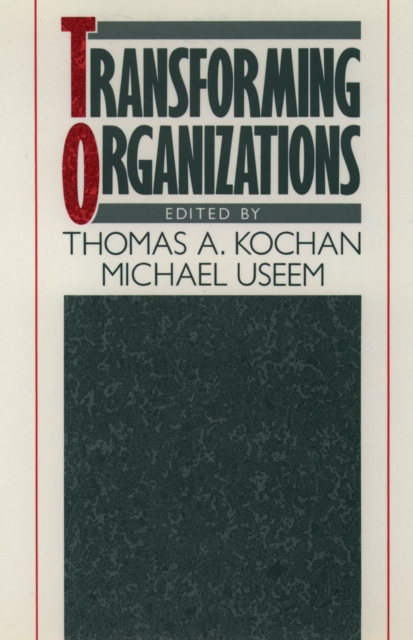
Transforming organizations
This is a contributed book on how organizations can and should adapt to global markets in a world economy. Its central argument is that merely changing parts of an organization will not be successful and that systemic changes across whole organizations will be required.
eBook

Change at Work
In this illuminating look at the realities of the American workplace, the contributors explain how the widespread restructuring of American firms--usually resulting in a reduction of the workforce to cut costs--has caused a far-reaching transformation in the relationship between employers and employees. The ensuing new relationships shift many of the risks of business from the firm to the employees and make employees responsible for developing their own skills and careers. In this work, Cappelli and company consider how individuals and employers need to adapt to the new arrangements as well as their implications for important policy issues. A timely look at issues facing all managers and workers, Change at Work is must reading for all interested in corporate organization, employer-employee relations, and the present and future state of the American workplace.
eBook