
Catalogue Search | MBRL


Are you sure you want to remove the book from the shelf?

{{itemTitle}}
42
result(s) for
"VAN DEN BERGH, HUUB"
Sort by:

The Production-Comprehension Relationship in the Acquisition of Prosodic Focus Marking: The Role of Age and Individual Differences
Central to the debate on the production–comprehension relationship in prosodic development is the acquisition of the focus-to-prosody mapping in West Germanic languages. Past research primarily examined the production–comprehension relationship in 4- to 5-year-old English and Dutch-speaking children and yielded evidence both for and against a production-precedes-comprehension asymmetry. Recent research shows a protracted developmental trajectory to adult-like use of the full range of prosodic means for focus marking in Dutch-speaking children, suggesting a comprehension-precedes-production asymmetry. Little is known about whether the production–comprehension relationship changes with age and differs between children. To elucidate the effect of age on the production–comprehension relationship and shed initial light on individual differences in this domain, we investigated production and comprehension of the focus-to-prosody mapping in SVO sentences by 71 Dutch-speaking children aged 4 to 8 years, using picture-based production and online comprehension tasks. Multilevel modelling showed that the children’s comprehension was predictive of their production in sentence-initial focus but not in sentence-final focus across ages. However, this predictive relationship between comprehension and production differed for different children depending on whether their comprehension was adult-like. In conclusion, we have found limited evidence that children’s comprehension of the focus-to-prosody mapping supports their use of prosody to mark focus in production. The stability of individual differences across development is similar to findings in other domains of language acquisition.
Journal Article

Effect of genre on the generalizability of writing scores
In the present study, aspects of the measurement of writing are disentangled in order to investigate the validity of inferences made on the basis of writing performance and to describe implications for the assessment of writing. To include genre as a facet in the measurement, the authors obtained writing scores of 12 texts in four different genres for each participating student. Results indicate that across raters, tasks and genres, only 10% of the variance in writing scores is related to individual writing skill. In order to draw conclusions about writing proficiency, students should therefore write at least three different texts in each of four genres rated by at least two raters. Moreover, when writing scores are obtained through highly similar tasks, generalization across genres is not warranted. Inferences based on text quality scores should, in this case, be limited to genre-specific writing. These findings replicate the large task variance in writing assessment as consistently found in earlier research and emphasize the effect of genre on the generalizability of writing scores. This research has important implications for writing research and writing education, in which writing proficiency is quite often assessed by only one task rated by one rater. (Verlag, adapt.).
Journal Article

Teaching argumentative synthesis writing through deliberative dialogues
Dialogical argumentation practice contributes positively to argumentative writing skills. Specifically, deliberative dialogues are effective in promoting argument and counterargument integration in students’ essays. However, the potential of dialogic activities may be increased if they are combined with instructional practices. The primary objective of this research is to compare the impact of four intervention programs, aimed at improving argumentative synthesis writing from conflicting sources. The four programs resulted from the combination of two instructional components (Explicit Instruction through video modelling —EI, or a Procedural Guideline—G), while Deliberative Dialogues—DD—were a constant element. We conducted a pre-post quasi-experimental study in which 186 Spanish third grade secondary school students (aged 14–15) participated. We evaluated the quality of the syntheses by examining the level of argumentative coverage (the total number of arguments included in the synthesis) and the level of integration (the type and frequency of the argumentative strategies used in the syntheses). The results showed that the effectiveness of the instructional methods varies according to the synthesis quality indicator. Explicit instruction, in combination with deliberative dialogues, was especially helpful in improving the level of integration of syntheses. The procedural guideline, in combination with deliberative dialogues, contributed significantly to the coverage of arguments. The combination of these two elements did not favor the writing of synthesis as expected, probably due to the conditions in which the intervention was carried out. The findings of this study revealed that the coverage of arguments and integration processes are of different nature, follow different learning paths and require different instructional processes.
Journal Article
Learning paths in synthesis writing: Which learning path contributes most to which learning outcome?
This paper presents a secondary analysis of data collected during an intervention study in which students learnt to synthesise pairs of texts presenting opposite views on controversial issues. The original intervention study included two treatments and examined the effects of two instruction conditions when instructional materials and tasks were held constant. The participants were 114 undergraduate psychology students. The object of the instruction was a guide on strategies for writing an argumentative synthesis text. However, the instruction varied between explicit strategy instruction, consisting of explaining each of the process’s four phases (exploring and identifying arguments and counterarguments, contrasting positions, drawing an integrative conclusion, and organising and revising the final draft), modelled via videos, versus self-study of the written strategy guide. After the initial instruction session, the students in both groups practiced collaboratively writing synthesis texts over two sessions with access to the strategy guide. The primary study compared the individually written pre- and posttest syntheses and found statistically significant differences favouring explicit instruction in both dependent variables: the argumentation coverage and the level of integration. The secondary analysis reported in the current paper involved scoring additional written syntheses produced during two practice sessions and then analysing the data for all time points (pretest, posttest, and the two practice sessions) using structural equation modelling (SEM) to test whether explicit instruction directly or indirectly affected the two indicators of good argumentative synthesis texts—argument coverage and integration—via the following collaborative practice. The results suggested two different learning paths for both dependent variables: explicit instruction is effective for both variables, while collaborative practice only has an additional indirect effect on argument coverage.
Journal Article
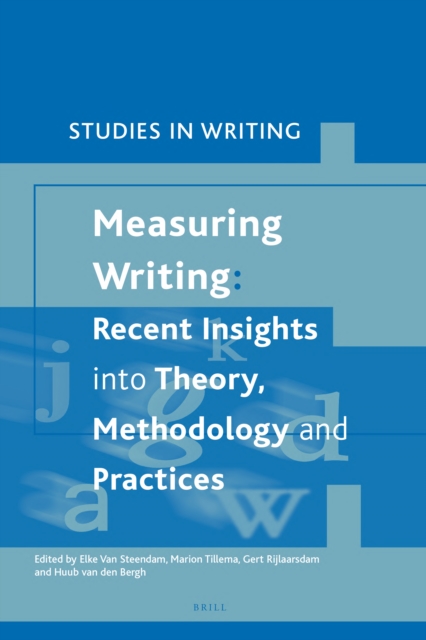
Measuring Writing: Recent Insights into Theory, Methodology and Practices
This volume provides a state-of-the-art overview of theory, methodology and practices in the assessment of writing. The focus throughout the book is on the construct of writing and its assessment: what constitutes writing ability and how can it be defined (in various contexts)? This question cannot be answered without looking into the methodological question of how to validate and measure the construct of writing ability. Throughout the book, therefore, discussions integrate theoretical and methodological issues. A number of chapters discusses whether varying definitions and varying operationalizations of writing ability are needed in various contexts, such as formative assessments versus summative assessments, large scale assessments versus individual assessments, different tasks, different genres, and different languages, but also different age groups. A range of rating methods is investigated and discussed in this book. The ongoing debate on holistic versus analytic ratings, and the different underlying conceptions of writing proficiency, is a pertinent matter, on which a number of chapters in this volume shed new light. The matter is discussed and analyzed from various angles, such as generalizability of judgements and usability in formative contexts. Another fundamental debate concerns computer scoring of written products. A nuanced discussion of its validity is presented in this volume.
eBook
Quantifying the quality difference between L1 and L2 essays: A rating procedure with bilingual raters and L1 and L2 benchmark essays
It is the consensus that, as a result of the extra constraints placed on working memory, texts written in a second language (L2) are usually of lower quality than texts written in the first language (L1) by the same writer. However, no method is currently available for quantifying the quality difference between L1 and L2 texts. In the present study, we tested a rating procedure for enabling quality judgments of L1 and L2 texts on a single scale. Two main features define this procedure: 1) raters are bilingual or near native users of both the L1 and L2; 2) ratings are performed with L1 and L2 benchmark texts. Direct comparisons of observed L1 and L2 scores are only warranted if the ratings with L1 and L2 benchmarks are parallel tests and if the ratings are reliable. Results showed that both conditions are met. Effect sizes (Cohen's d) indicate that, while score variances are large, there is a relatively large added L2 effect: in the investigated population, L2 text scores were much lower than L1 text scores. The tested rating procedure is a promising method for cross-national comparisons of writing proficiency. (Verlag).
Journal Article

A Meta-Analysis on the Effects of Text Structure Instruction on Reading Comprehension in the Upper Elementary Grades
In this meta-analysis, the authors synthesize results from 44 (quasi-) experimental studies on informational and narrative text structure interventions involving students in grades 4–6 in regular school settings. Findings show that text structure instruction had positive immediate effects on students’ reading comprehension but that effect sizes varied largely across outcome measures: questions (Hedges’ g = 0.25), summarization (g = 0.57), recall (g = 0.37), and knowledge about text structure (g = 0.38). However, students who received text structure instruction no longer outperformed control groups at delayed posttests. Content-related features, such as a focus on paragraph-level structure, active construction of graphic organizers, and teaching rule-based summarization techniques, moderated the effectiveness of text structure instruction, but these effects also varied across outcome measures. Instructional features moderated delayed effects: Interventions with opportunities for individual student practice resulted in higher delayed effects for comprehension questions. The authors argue that text structure instruction deserves a place in the primary school curriculum so the positive effects on reading will be maintained.
Journal Article

Source use and argumentation behavior in L1 and L2 writing: a within-writer comparison
The aim of this study was to test whether Cummins’ Linguistic Interdependence Hypothesis (LIH) might also apply to writing, by determining to what extent writers’ text quality, source use and argumentation behavior are related in L1 and L2, how effective writers’ behavior is and whether their L2 proficiency influenced the relations between them. To answer these questions, twenty students wrote four short argumentative source based essays each in L1 (Dutch) and four in L2 (English). A within-writer cross-linguistic comparison of their texts revealed that their L1 and L2 writing competencies appear to be related. Furthermore, writers’ source use behavior differed to some extent between languages, but the strong positive correlations found between source use features suggest that in most cases this was more a person than a language effect. Similarly, for argumentation behavior, results showed some learner specific features (e.g. inclusion of titles and reference lists), but differences between languages for others (e.g. the inclusion of both arguments and counter-arguments). Effects of the different source use and argumentation features studied on text quality were limited and no clear effect of L2 proficiency on writers’ behavior or their influence on text quality were found. Overall, in line with earlier research, these findings provide some additional support for Cummins’ LIH and the idea that writers might have a common underlying source for writing related knowledge and practices which they can apply in multiple languages.
Journal Article

Writing as a learning tool: Testing the role of students' writing strategies
The claim that writing facilitates students' learning, although widely accepted, has little support from empirical research. A possible explanation for the lack of empirical evidence is that writing-to-learn research has disregarded that students use different writing strategies. The purpose of the present experimental study is to test whether it is effective to adapt writing-to-learn tasks to different writing strategies when teaching literature. A course \"Learning to write argumentative texts about literature\" was developed in two different versions: one adapted to a planning writing strategy, the other to a revising writing strategy. Participants were 113 tenth-grade high school students in the Netherlands. Our hypothesis is an adaptation hypothesis: we expect that the more a student will use a planning writing strategy, the more the student will profit from the lessons in the planning condition, and that the more a student uses a revising writing strategy, the more beneficial the revising condition will be. However, results show that for improving literary interpretation skill, a course adapted to the planning writing strategy is more effective for almost all students. L'affirmation selon laquelle l'écriture favorise l'apprentissage chez les collégiens est largement acceptée mais peu soutenue par des résultats de recherches empiriques. Une explication possible à ce manque d'évidences empiriques tient au fait que la recherche relative à l'apprentissage de l'écrit a négligé l'étude des différentes stratégies d'écriture des collégiens. L'objectif de cette étude expérimentale est de voir s'il est efficace d'adapter une stratégie d'écriture réécrivant et une stratégie planifiant à des activités d'apprentissage de production écrite dans l'enseignement de la littérature. Un cours intitulé \"Apprendre à écrire un texte argumentatif sur la littérature\" a été proposé sous deux formes différentes: l'une pour la stratégie d'écriture planifiant, l'autre pour la stratégie réécrivant. Les participants étaient 113 collégiens en classe de troisième aux Pays-Bas. Notre hypothèse est une hypothèse d'adaptation: on s'attend à ce qu'un collégien ayant une stratégie d'écriture planifiant profitera davantage des leçons adaptées à cette stratégie et que les leçons de type sculptural seront bénéfiques pour les lycéens ayant une stratégie d'écriture réécrivant. Cependant, les résultats montrent que, pour améliorer la compétence d'interprétation littéraire, un cours adapté a une stratégie d'écriture planifiant est plus efficace pour quasiment tous les collégiens.
Journal Article

Measuring Writing
Provides an overview of theory, methodology and practices in the assessment of writing. This title discusses whether varying definitions and varying operationalizations of writing ability are needed in various contexts, such as formative assessments versus summative assessments, different tasks, different genres, and different languages.
eBook