
Catalogue Search | MBRL


Are you sure you want to remove the book from the shelf?

{{itemTitle}}
92
result(s) for
"VAN ENGEN, ABRAM"
Sort by:

City on a hill : a History of American exceptionalism
In this illuminating book, Abram Van Engen shows how the phrase \"City on a Hill,\" from a 1630 sermon by Massachusetts Bay governor John Winthrop, shaped the story of American exceptionalism in the twentieth century. By tracing the history of Winthrop's speech, its changing status throughout time, and its use in modern politics, Van Engen asks us to reevaluate our national narratives. He tells the story of curators, librarians, collectors, archivists, antiquarians, and often anonymous figures who emphasized the role of the Pilgrims and Puritans in American history, paving the way for the saving and sanctifying of a single sermon. This sermon's rags-to-riches rise reveals the way national stories take shape and shows us how those tales continue to influence competing visions of the country - the many different meanings of America that emerge from its literary past--Book jacket.
Book

Della's Rage: Race and Religion in Marilynne Robinson's Jack
This essay examines the racial politics of Marilynne Robinson's latest novel, Jack . Comparing it to her earlier ones, the essay argues that Robinson more explicitly addresses problems of structural racism. But in highlighting those problems, Robinson remains committed to a view of human persons defined first and foremost by a soul that transcends racial identity. The racial politics of Robinson comes shaped by religion, especially by a belief in the imago Dei . As a result, some readers celebrate her sense of shared human nature, while others will see in it a failure to recognize the power and force of race.
Journal Article
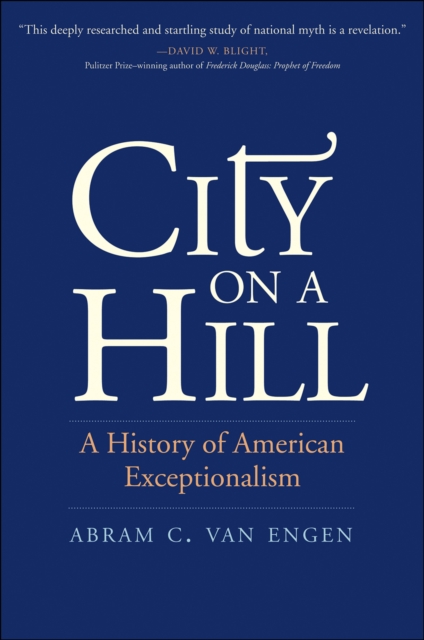
City on a Hill
A fresh, original history of America's national narratives, told through the loss, recovery, and rise of one influential Puritan sermon from 1630 to the present day In this illuminating book, Abram Van Engen shows how the phrase \"City on a Hill,\" from a 1630 sermon by Massachusetts Bay governor John Winthrop, shaped the story of American exceptionalism in the twentieth century. By tracing the history of Winthrop's speech, its changing status throughout time, and its use in modern politics, Van Engen asks us to reevaluate our national narratives. He tells the story of curators, librarians, collectors, archivists, antiquarians, and often anonymous figures who emphasized the role of the Pilgrims and Puritans in American history, paving the way for the saving and sanctifying of a single sermon. This sermon's rags-to-riches rise reveals the way national stories take shape and shows us how those tales continue to influence competing visions of the country-the many different meanings of America that emerge from its literary past.
eBook
Feeling Godly
In 1746, Jonathan Edwards described his philosophy on the process of Christian conversion in A Treatise Concerning Religious Affections. For Edwards, a strict Congregationalist, true conversion is accompanied by a new heart and yields humility, forgiveness, and love—affections that work a change in the person's nature. But, how did other early American communities understand religious affections and come to recognize their manifestation? Feeling Godly brings together well-known and highly regarded scholars of early American history and literature, Native American studies, African American history, and religious studies to investigate the shape, feel, look, theology, and influence of religious affections in early American sites of contact with and between Christians. While remaining focused on the question of religious affections, these essays span a wide range of early North American cultures, affiliations, practices, and devotions, and enable a comparative approach that draws together a history of emotions with a history of religion. In addition to the volume editors, this collection includes essays from Joanna Brooks, Kathleen Donegan, Melissa Frost, Stephanie Kirk, Jon Sensbach, Scott Manning Stevens, and Mark Valeri, with an afterword by Barbara H. Rosenwein.
eBook
Wonder and Care: A Christian Poetics for the Present Day
This article tries to draw this forum together in three ways. First, a Christian poetics has to do with hermeneutics, informed by a long tradition of biblical interpretation. Second, a Christian poetics takes up the discipline of wonder, which remains crucial to the scholarly work of research and teaching. Finally, a Christian poetics combines a sense of wonder with an emphasis on care. It asks how awe and action relate, seeking to understand the many ways texts not just transcend this world, but also transform it.
Journal Article

Origins and Last Farewells: Bible Wars, Textual Form, and the Making of American History
The Puritans never published John Winthrop's “city on a hill” sermon,
, which vanished in the seventeenth century. When it reappeared 200 years later, scholars relied on a dubious cover-note to proclaim its foundational significance. Demonstrating how the Geneva Bible gave shape to Winthrop's sermon–and how the manuscript's whims helped make sense of its meaning–this essay reveals the role of textual form in the construction of American history.
Journal Article

Three Questions for American Literature and Religion
Once upon a time, we had a very stable myth of religion's place in American literature. The Puritans left a legacy of Calvinism; that became Unitarianism; and Unitarianism finally gave birth to Transcendentalism and the American Renaissance, leading finally to later nineteenth-century attempts by some authors to replace religion altogether with literature. This story was mapped onto a narrative of secularization: the passing of Calvinism reflected the broader collapse of religion and the coming of a secular culture. It was a pleasing myth because it was so elegant and coherent, and because it \"did\" seem to explain certain select writers who were revered, in part, because they could be so well explained by this myth.
Journal Article
