
Catalogue Search | MBRL


Are you sure you want to remove the book from the shelf?

{{itemTitle}}
2
result(s) for
"Vargas, Pablo editor"
Sort by:
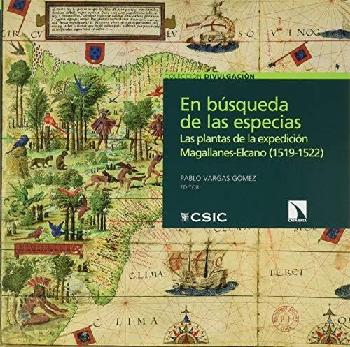
En búsqueda de las especias : las plantas de la expedición Magallanes-Elcano, 1519-1522
En la conmemoración de su quinto centenario, este libro pretende rendir tributo a la primera vuelta al mundo (1519-1522), centrando su interés en los descubrimientos botánicos de sus expedicionarios. Una empresa internacional con la participación de más de trescientas personas, que demostró la esfericidad de la Tierra, permitió conocer la configuración de océanos y continentes y fue el inicio de la globalización entendida como conexión entre diferentes regiones del globo terráqueo. Fue una expedición financiada por la Corona de Castilla, planificada y capitaneada por el portugués Fernando de Magallanes, finalizada gracias al liderazgo del capitán vasco Juan Sebastián Elcano y narrada con maestría por el cronista lombardo Antonio Pigafetta. Los objetivos de este primer viaje alrededor del mundo fueron fundamentalmente comerciales y botánicos: promover el descubrimiento de nuevas tierras y rutas impulsado por la búsqueda de especias tales como la nuez moscada, la canela, el jengibre, la pimienta y, sobre todo, el clavo de olor. A partir de la contribución de botánicos e historiadores procedentes de los países de donde comenzó la singladura y por donde fue haciendo escalas (España, Portugal, Argentina, Brasil, Chile y Filipinas), este libro propone un recorrido que, tomando las plantas como hilo conductor, describe los principales hitos de esta primera circunnavegación. Además se describen aspectos de la cartografía, la economía y la comunicación de la época, divulgando los resultados más notables de una expedición cuyas consecuencias han tenido incluso más relevancia que la mismísima llegada del ser humano a la Luna. [csic.es].
Invasion biology: hypotheses and evidence
There are many hypotheses describing the interactions involved in biological invasions, but it is largely unknown whether they are backed up by empirical evidence. This book fills that gap by developing a tool for assessing research hypotheses and applying it to twelve invasion hypotheses, using the hierarchy-of-hypotheses (HoH) approach, and mapping the connections between theory and evidence. In Part 1, an overview chapter of invasion biology is followed by an introduction to the HoH approach and short chapters by science theorists and philosophers who comment on the approach. Part 2 outlines the invasion hypotheses and their interrelationships. These include biotic resistance and island susceptibility hypotheses, disturbance hypothesis, invasional meltdown hypothesis, enemy release hypothesis, evolution of increased competitive ability and shifting defence hypotheses, tens rule, phenotypic plasticity hypothesis, Darwin's naturalization and limiting similarity hypotheses and the propagule pressure hypothesis. Part 3 provides a synthesis and suggests future directions for invasion research
eBook