
Catalogue Search | MBRL


Are you sure you want to remove the book from the shelf?

{{itemTitle}}
127
result(s) for
"Veth, Peter"
Sort by:

Morphometric classification of kangaroo bones reveals paleoecological change in northwest Australia during the terminal Pleistocene
Specimen identification is the backbone of archeozoological research. The challenge of differentiating postcranial skeletal elements of closely related wild animals in biodiverse regions can prove a barrier to understanding past human foraging behaviours. Morphometrics are increasingly being employed to classify paleozoological animal remains, however, the potential of these methods to discriminate between wild animal groups has yet to be fully realised. Here we demonstrate the applicability of a traditional morphometric approach to taxonomically classify foot and ankle bones of kangaroos, a large and highly diverse marsupial family. Using multiple discriminant analysis, we classify archaeological specimens from Boodie Cave, in northwest Australia and identify the presence of two locally extinct macropod species during the terminal Pleistocene. The appearance of the banded hare-wallaby and northern nail-tail wallaby in the Pilbara region at this time provides independent evidence of the ecological and human responses to a changing climate at the end of the last Ice Age. Traditional morphometrics provides an accessible, inexpensive, and non-destructive tool for paleozoological specimen classification and has substantial potential for applications to other diverse wild faunas.
Journal Article

Seed dispersal by Martu peoples promotes the distribution of native plants in arid Australia
Commensal relationships between wild plants and their dispersers play a key ecological and evolutionary role in community structure and function. While non-human dispersers are often considered critical to plant recruitment, human dispersers have received much less attention, especially when it comes to non-domesticated plants. Australia, as a continent historically characterized by economies reliant on non-domesticated plants, is thus a key system for exploring the ecological role of people as seed dispersers in the absence of agriculture. Here, we utilize a controlled observation research design, employing ecological surveys and ethnographic observations to examine how seed dispersal and landscape burning by Martu Aboriginal people affects the distribution of three preferred plants and one (edible, but non-preferred) control species. Using an information theoretic approach, we find that the three preferred plants show evidence of human dispersal, with the strongest evidence supporting anthropogenic dispersal for the wild bush tomato,
Solanum diversiflorum
.
Human dispersal of wild plants has received limited attention. Here, the authors combine ecological surveys and ethnographic observations to examine how Martu Aboriginal people’s seed dispersal and landscape burning impact plant distribution.
Journal Article

Isotopic Indications of Late Pleistocene and Holocene Paleoenvironmental Changes at Boodie Cave Archaeological Site, Barrow Island, Western Australia
This paper presents the first application of mammal tooth enamel carbonate stable isotope analysis for the purpose of investigating late Pleistocene–early Holocene environmental change in an Australian archaeological context. Stable carbon (δ13C) and oxygen (δ18O) isotope ratios were analyzed from archaeological and modern spectacled hare wallaby (Lagorchestes conspicillatus) and hill kangaroo (Osphranter robustus) tooth enamel carbonates from Boodie Cave on Barrow Island in Western Australia. δ18O results track the dynamic paleoecological history at Boodie Cave including a clear shift towards increasing aridity preceding the onset of the Last Glacial Maximum and a period of increased humidity in the early to mid-Holocene. Enamel δ13C reflects divergent species feeding ecology and may imply a long-term shift toward increasing diversity in vegetation structure. This study contributes new data to the carbonate-isotope record for Australian fauna and demonstrates the significant potential of stable isotope based ecological investigations for tracking paleoenvironment change to inter-strata resolution.
Journal Article

Karnatukul (Serpent’s Glen): A new chronology for the oldest site in Australia’s Western Desert
The re-excavation of Karnatukul (Serpent's Glen) has provided evidence for the human occupation of the Australian Western Desert to before 47,830 cal. BP (modelled median age). This new sequence is 20,000 years older than the previous known age for occupation at this site. Re-excavation of Karnatukul aimed to contextualise the site's painted art assemblage. We report on analyses of assemblages of stone artefacts and pigment art, pigment fragments, anthracology, new radiocarbon dates and detailed sediment analyses. Combined these add significantly to our understanding of this earliest occupation of Australia's Western Desert. The large lithic assemblage of over 25,000 artefacts includes a symmetrical geometric backed artefact dated to 45,570-41,650 cal. BP. The assemblage includes other evidence for hafting technology in its earliest phase of occupation. This research recalibrates the earliest Pleistocene occupation of Australia's desert core and confirms that people remained in this part of the arid zone during the Last Glacial Maximum. Changes in occupation intensity are demonstrated throughout the sequence: at the late Pleistocene/Holocene transition, the mid-Holocene and then during the last millennium. Karnatukul documents intensive site use with a range of occupation activities and different signalling behaviours during the last 1,000 years. This correlation of rock art and occupation evidence refines our understanding of how Western Desert peoples have inscribed their landscapes in the recent past, while the newly described occupation sequence highlights the dynamic adaptive culture of the first Australians, supporting arguments for their rapid very early migration from the coasts and northern tropics throughout the arid interior of the continent.
Journal Article

Early Holocene shell fish hooks from Lene Hara Cave, East Timor establish complex fishing technology was in use in Island South East Asia five thousand years before Austronesian settlement
Discovery of a well-stratified fish hook from a cave sequence on East Timor shows a fishing technology developed at least 5000 years before the Austronesian expansion through Island South East Asia and into the Pacific. The fish hook is fashioned from shell and has been radiocarbon dated to 9741 ± 60 b.p.
Journal Article

Rock Art In Arid Landscapes: Pilbara And Western Desert Petroglyphs
This paper develops a testable model for understanding rock art within archaeological phases of the arid northwest Pilbara and Western Desert bioregions. It also presents the first multivariate analysis of foundational recording work undertaken almost 50 years ago, and deploys more recently recorded assemblages from the Burrup Peninsula (Murujuga) and the Western Desert. It establishes a framework for testable hypotheses about how art production in these adjacent bioregions through deep-time reflects information systems, emergent territoriality, group identity and signalling behaviour against a backdrop of climatic oscillations, including the LGM (23-18 ka), Antarctic Cold Reversal (14.5-12.5 ka) and intensification of ENSO (3.8-2 ka). The Pilbara piedmont has clearly defined gorges with major water sources; the Western Desert has uncoordinated drainage punctuated by well-watered but subdued ranges. We argue that rock art has been used to negotiate social identity in both contexts since each was first colonised. The role that art may have played in the formation of social networks in these different landscapes through time is the key focus of this paper. We hypothesise that the episodic use of art as signalling behaviour in the Australian arid zone can be linked to behavioural correlates and major archaeological phases with discrete signatures that can be tested from myriad sites.
Journal Article
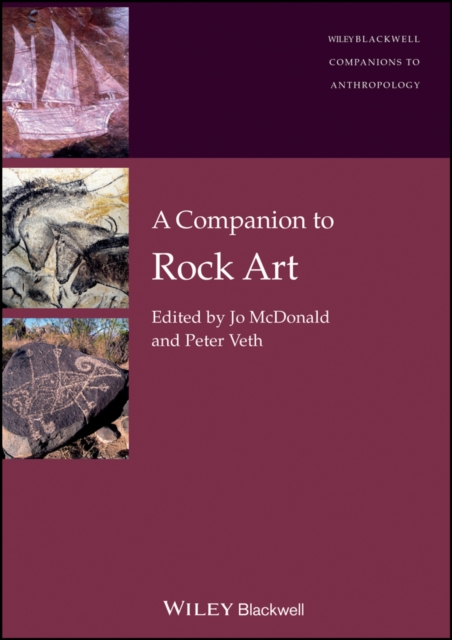
A Companion to Rock Art
This unique guide provides an artistic and archaeological journey deep into human history, exploring the petroglyphic and pictographic forms of rock art produced by the earliest humans to contemporary peoples around the world.
* Summarizes the diversity of views on ancient rock art from leading international scholars
* Includes new discoveries and research, illustrated with over 160 images (including 30 color plates) from major rock art sites around the world
* Examines key work of noted authorities (e.g. Lewis-Williams, Conkey, Whitley and Clottes), and outlines new directions for rock art research
* Is broadly international in scope, identifying rock art from North and South America, Australia, the Pacific, Africa, India, Siberia and Europe
* Represents new approaches in the archaeological study of rock art, exploring issues that include gender, shamanism, landscape, identity, indigeneity, heritage and tourism, as well as technological and methodological advances in rock art analyses
eBook
ROCK ART IN ARID LANDSCAPES: Pilbara and Western Desert petroglyphs
This paper develops a testable model for understanding rock art within archaeological phases of the arid northwest Pilbara and Western Desert bioregions. It also presents the first multivariate analysis of foundational recording work undertaken almost 50 years ago, and deploys more recently recorded assemblages from the Burrup Peninsula (Murujuga) and the Western Desert. It establishes a framework for testable hypotheses about how art production in these adjacent bioregions through deep-time reflects information systems, emergent territoriality, group identity and signalling behaviour against a backdrop of climatic oscillations, including the LGM (23—18 ka), Antarctic Cold Reversal (14.5—12.5 ka) and intensification of ENSO (3.8—2 ka). The Pilbara piedmont has clearly defined gorges with major water sources; the Western Desert has uncoordinated drainage punctuated by well-watered but subdued ranges. We argue that rock art has been used to negotiate social identity in both contexts since each was first colonised. The role that art may have played in the formation of social networks in these different landscapes through time is the key focus of this paper. We hypothesise that the episodic use of art as signalling behaviour in the Australian arid zone can be linked to behavioural correlates and major archaeological phases with discrete signatures that can be tested from myriad sites.
Journal Article