
Catalogue Search | MBRL


Are you sure you want to remove the book from the shelf?

{{itemTitle}}
87
result(s) for
"Victoria Haskins"
Sort by:

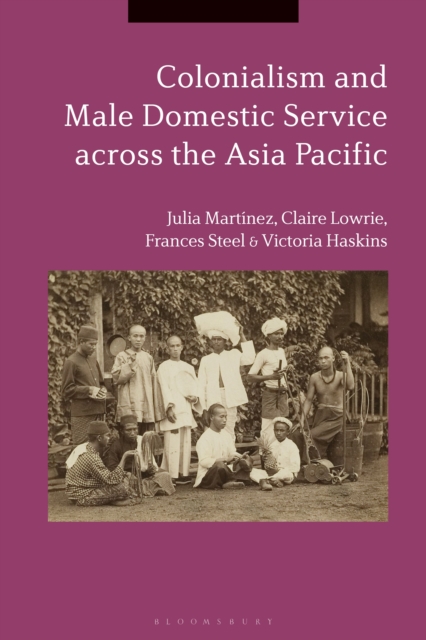
Colonialism and Male Domestic Service across the Asia Pacific
Examining the role of Asian and indigenous male servants across the Asia Pacific from the late-19th century to the 1930s, this study shows how their ubiquitous presence in these purportedly ‘humble’ jobs gave them a degree of cultural influence that has been largely overlooked in the literature on labour mobility in the age of empire. With case studies from British Hong Kong, Singapore, Northern Australia, Fiji and British Columbia, French Indochina, the American Philippines and the Dutch East Indies, the book delves into the intimate and often conflicted relationships between European and American colonists and their servants. It explores the lives of ‘houseboys’, cooks and gardeners in the colonial home, considers the bell-boys and waiters in the grand colonial hotels, and follows the stewards and cabin-boys on steamships travelling across the Indian and Pacific Oceans. This broad conception of service allows Colonialism and Male Domestic Service to illuminate trans-colonial or cross-border influences through the mobility of servants and their employers. This path-breaking study is an important book for students and scholars of colonialism, labour history and the Asia Pacific region.
eBook

Matrons and Maids
From 1914 to 1934 the US government sent Native American girls to work as domestic servants in the homes of white families.Matrons and Maidstells this forgotten history through the eyes of the women who facilitated their placements. During those two decades, \"outing matrons\" oversaw and managed the employment of young Indian women. In Tucson, Arizona, the matrons acted as intermediaries between the Indian and white communities and between the local Tucson community and the national administration, the Office of Indian Affairs.Based on federal archival records,Matrons and Maidsoffers an original and detailed account of government practices and efforts to regulate American Indian women. Haskins demonstrates that the outing system was clearly about regulating cross-cultural interactions, and she highlights the roles played by white women in this history. As she compellingly argues, we cannot fully engage with cross-cultural histories without examining the complex involvement of white women as active, if ambivalent, agents of colonization.Including stories of the entwined experiences of Indigenous and non-Indigenous women that range from the heart-warming to the heart-breaking,Matrons and Maidspresents a unique perspective on the history of Indian policy and the significance of \"women's work.\"
eBook

Domesticating Colonizers
The placement of Indigenous girls and young women in white homes to work as servants was a key strategy of official policy and practice in both the United States and Australia. Between the 1880s and the Second World War, under the outing programs in the U.S. and various apprenticeship and indenturing schemes in Australia, the state regulated and constructed relations between Indigenous and white women in the home. Such state intervention not only helped to define domesticity in a modern world, but was integral to the formation of the modern settler colonial nation in its claims to civilizing authority in the United States and Australia. In the context of settler colonialism, domesticity was not hegemonic in this period, but rather was precarious and uncertain. By prescribing and demanding from employers demonstrations of domesticity, the state was engaged in perfecting white women as well as Indigenous women, the latter as the colonized, to be domesticated, and the former as the colonizer, to domesticate.
Journal Article

To touch the infinity of a far horizon: A transnational history of transcultural appropriation in beth Dean's Corroboree (1954)
In 1954, a ballet inspired by and celebrating Aboriginal dance performance was presented to wide critical acclaim in Australia. The ballet's American choreographer, Beth Dean, danced the lead role of the Boy Initiate, reproducing dance steps and movements which she had recently learnt from Indigenous dancers in central and northern Australia, in combination with classical and contemporary dance steps. Rapturous reviews followed 'Miss Dean' told the story of an Aboriginal boy's 'torm ent ... on her mobile face and responsive body', wrote one reviewer. 'Look at her too long and one gains an unforgettable impression of the primitive, naturalistic fears of the aborigines.' Another reviewer 'saw not a dancer but a member of an ancient tribe'.
Journal Article

'The privilege of employing natives': the Quan Sing affair and Chinese-Aboriginal employment in Western Australia, 1889–1934
In September 1921, two permits to employ Aborigines were forwarded to the Western Australian Chief Protector of Aborigines, AO Neville. The permits allowed Miss Yuanho Quan Sing of Derby in north-western Western Australia to engage the services of two individuals: 'Bobbydol' and ‘Roebourne Annie’. The permits had been authorised by the Resident Magistrate and local Protector of Aborigines, William Hodge. ‘Miss Quan Sing was told... you could not grant her a permit to employ [A]boriginals', explained the covering note, 'but not withstanding this and the cancellation of her permit last year, she persists in her endeavour to obtain the privilege of employing natives'. Neville immediately directed Hodge to cancel the permits, telling him, 'Quan Sing and his family have made numerous efforts from time to time to employ natives, all of which have been frustrated'.
Journal Article

Introduction: Regulation and Domestic Service in Colonial Histories
This essay introduces the Special Theme on regulation and domestic service in colonial societies. It provides a brief overview of the key themes of domestic service and regulation in the history of colonial states, and reflects upon the ways in which the colonial past is deployed in contemporary calls for the regulation of domestic work by the state, to secure the rights and protections of present-day workers as modern, free subjects. We note that, while much more work needs to done on this subject, current scholarship suggests that the status of the domestic worker and the extent of regulation in colonial contexts was historically unclear and often ambivalent. The three articles that constitute the Special Theme are then discussed in turn, to highlight the important insights, both empirical and theoretical, they offer to our deeper understanding of this complex history.
Journal Article

Domestic Service and Frontier Feminism: The Call for a Woman Visitor to \Half-Caste\ Girls and Women in Domestic Service, Adelaide, 1925-1928
\"12 The home was to become a contested site of power for a curious mix of colonizers-white men and women, religious reformers and feminists. seeking to expand and exert their authority over Aboriginal people and particularly over those whose presence was so concerning, young Aboriginal women of mixed-descent, they competed with each other in these crucial years for state recognition of a role to \"protect\" these young women and to govern their relationships in the private arena. W. Bleakley (in support of appointing married men as protectors, he had stated that \"one good white woman in a district will have more restraining influence that all the Acts and Regulations\"),147 during the 19305 the federal government grew increasingly unreceptive to the whole Woman Protector project.148 At the 1937 State and Commonwealth Aboriginal Authorities' Conference on Aboriginal Welfare, the collective authorities resolved definitively that \"while the use of women protectors or inspectors for the supervision of female natives in populated areas may in places be desirable, the general appointment of women is not considered practicable, because of the very scattered nature of native camps, the difficulties of travel and the isolation.
Journal Article

“Strike Strike, We Strike”: Making Aboriginal Domestic Labor Visible in the Pilbara Pastoral Workers’ Strike, Western Australia, 1946–1952
Between 1946 and 1949, the Pilbara Walk-Off of Aboriginal pastoral workers in the Northwest of Western Australia came to symbolize the demand for Aboriginal rights and independence and is now recognized as a key event in the Aboriginal land rights movement. While the Pilbara strike has received attention from many historians, the involvement of Aboriginal domestic workers in the action has not. But the strike provided an unprecedented opportunity for Aboriginal domestic workers to mobilize and organize. This article examines the historical role and impact of Aboriginal domestic workers in the Pilbara strike. Drawing upon Aboriginal oral histories and correspondence of employers at the time as well as official records, this study argues that the involvement of the domestic workers made Aboriginal domestic labor visible, and in doing so challenged the racial and gender foundations of hierarchy and power that underpinned the pastoral economy of colonization.
Journal Article