
Catalogue Search | MBRL


Are you sure you want to remove the book from the shelf?

{{itemTitle}}
2
result(s) for
"Viscuso, Patrick Demetrios"
Sort by:
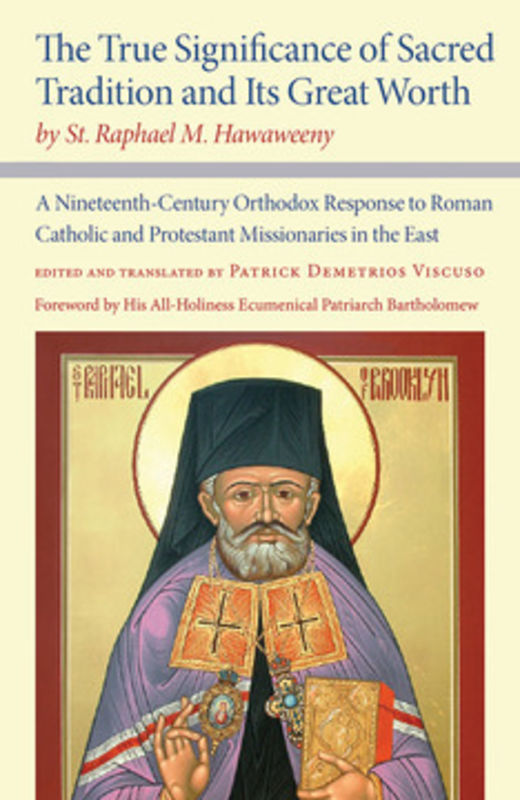
The True Significance of Sacred Tradition and Its Great Worth, by St. Raphael M. Hawaweeny
Never before published, the theological thesis of St. Raphael Hawaweeny (1860–1915) is a fascinating work that shows the intersection of Roman Catholicism, Protestantism, and Eastern Orthodoxy in the late nineteenth century. Canonized by the Orthodox Church in 2000, St. Raphael was the first Orthodox bishop consecrated in the western hemisphere. His thesis reflects the life of the Orthodox community under Ottoman rule and is an apologia for Orthodox tradition, acting as a response to arguments advanced by Roman Catholic and Protestant missionaries in the Middle East. Patrick Viscuso's introduction explains the complex historical and theological forces at work in St. Raphael's world.Since the sixteenth century, the Roman Catholic Church had launched major proselytization efforts toward Orthodox Christians in the Ottoman Empire, with the support of the great Western powers. In the late nineteenth century, the United States dominated Protestant efforts in the region. The powerful language in St. Raphael's thesis and his refutation of Roman Catholic and Protestant positions reflect an active dialogue with Western Christianity. The thesis, dated May 1, 1886 was written as part of the requirements for graduation from the Theological School of the Great Church of Christ, an institution of the Ecumenical Patriarchate located on the island of Halki in the Sea of Marmara, near present-day Istanbul. Patrick Viscuso's translation is based on his transcription of the handwritten Greek text. Viscuso provides this transcription, along with translations of the 1874 Regulations of the Theological School and a contemporary account of life at the school. This important volume will appeal to historians of the Ottoman Empire and Christianity, specialists interested in religious pluralism in America, and general readers interested in religion and Christian dialogue.
eBook

A Byzantine theology of marriage: The \Syntagma kata stoicheion\ of Matthew Blastares
There have been extensive studies of the Byzantine canon law of marriage and its development. However, up to the present, there has been no systematic presentation of a Byzantine theology of marriage. This dissertation presents the matrimonial theology derived from the Syntagma kata stoicheion of Matthew Blastares. The first chapter places the author and his work in their historical context. The Syntagma was composed ca. 1335 by Matthew Blastares, a fourteenth century monastic theologian. The work was a theological and legal handbook for Orthodox clerics, who during the reign of Andronikos III Palaeologos were given a large role in the Byzantine judicial system. The second chapter outlines the canon law of marriage as found in the hieromonk's work, and shows the main canonical and theological sources utilized. Blastares depends especially on the commentaries of the Byzantine canonist Theodore Balsamon. The third chapter is a presentation of Blastares' theology of marriage as derived from the examination of canon law. This theology includes his thought on sexuality, and pertinent questions of purity, defilement, and the relationship of nuptial relations and the married state to the Eucharist, Holy Orders, and celibacy. The nature of the nuptial union is shown to bear directly on the issue of kinship, the marital partnership on the question of dissolution, and the concept of matrimony as a communion of law on the issue of mixed marriage. The essential element in the formation of marriage is the sacerdotal blessing. Consent is a requirement for the reception of the benediction but not the factor which establishes the nuptial union. The reception of the Eucharist does not contribute to the formation of marriage. The fourth chapter examines the relationship of the Syntagma to present Orthodox theological thought and concludes that the position and influence of Blastares' matrimonial theology has diminished in the modern eparchy of the ecumenical patriarchate, the Greek Orthodox Archdiocese of North and South America. A translation of major portions of Blastares' work is provided in the appendix.
Dissertation