
Catalogue Search | MBRL


Are you sure you want to remove the book from the shelf?

{{itemTitle}}
13
result(s) for
"Vogman, Elena"
Sort by:

Dance of Values
Sergei Eisenstein's cinematic adaptation of Karl Marx's Capital was never realized, yet it has haunted the imagination of many filmmakers, historians, and philosophers to the present day.
eBook

Camering Fernand Deligny on Cinema and the Image
Fernand Deligny (1913-1996), 'poet and ethologist', is mostly known for his work with autistic children and for his influence on the revolutions in French post-war psychiatry. Though neither director nor a theorist of the image, cinema is constantly called into his social, pedagogical, and clinical experimentations. More interested in the processes of making, he distinguishes 'camering' from filming, thus emphasizing not the finished film but a 'film to come'. This volume provides Deligny's essential corpus on cinema and the image. It shows both the role of cameras in many of his experimental 'attempts' with delinquents and autistic children and his highly speculative reflections on image.
eBook
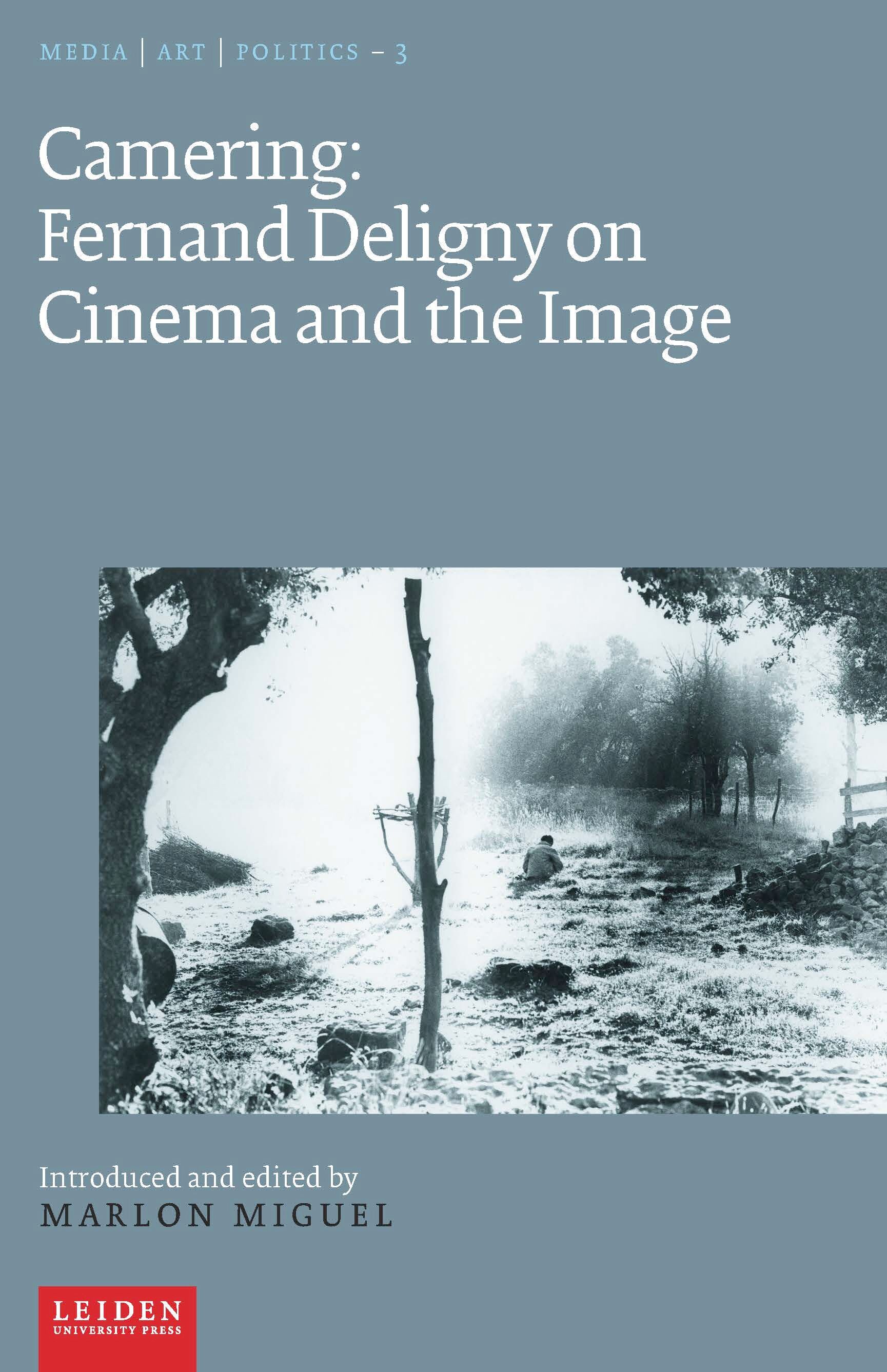
Camering: Fernand Deligny on Cinema and the Image
Fernand Deligny (1913-1996), 'poet and ethologist', is mostly known for his work with autistic children and for his influence on the revolutions in French post-war psychiatry. Though neither director nor a theorist of the image, cinema is constantly called into his social, pedagogical, and clinical experimentations. More interested in the processes of making, he distinguishes 'camering' from filming, thus emphasizing not the finished film but a 'film to come'. This volume provides Deligny's essential corpus on cinema and the image. It shows both the role of cameras in many of his experimental 'attempts' with delinquents and autistic children and his highly speculative reflections on image.
eBook

Dance of Values: Reading Eisenstein's Capital
\"The crisis of the democracy should be understood as crisis of the conditions of exposition of the political man.\" This is how Walter Benjamin, in 1935, describes the decisive political consequences of the new medial regime in the \"age of technological reproducibility\". The interrelation between capital's continuous expansion and exhibition value as mediated through technology constitutes the central matter of Sergei Eisenstein's unfulfilled Capital project. The planned film adaptation of Karl Marx's Capital stands as one of the most enigmatic and impactful projects in the history of cinema. Here, Vogman explores the internal logic of Eisenstein's choices in the Capital project. This protofilm--materially defined through its thematic and formal heterogeneity as well as its nonlinear, provisory flow--functions as a visual theorization of value. In this way, Eisenstein's Capital deals with a fundamental crisis of its political-medial situation, a present that extends from its contemporary context to today.
Journal Article
Postface. Minor Gestures, Minor Media
The architectural motif of the labyrinth appears at decisive junctures in Fernand Deligny's long essay The Arachnean, a text itself composed of detours, repetitions and associations of a heterogeneous nature—he draws on the fields of mythology, anthropology, philosophy and milieu theory, as well as on personal memories. It is a metaphor for endless complications followed by endless solutions: the path of Icarus on his way through the labyrinth, culminating in his tragic flight to the sun. Crucially, Deligny introduces the labyrinth as an analogy to the main figure of the text—the Arachnean, a spider's web, a network of trajectories of autistic children.To admit the persistence of the Arachnean would require such upheavals in the way the Man-that-we-are [l’homme-qui-nous-sommes] has organized themself that it is entirely reasonable to think that we will persist on the flight path that has become so ordinary and so powerful that it puts us in orbit, while hoping that what happened to Icarus won't happen to us, Icarus who was so preoccupied with escaping the detours of the labyrinth. And the Arachnean can truly be said to be rich in endless detours.According to the Greek myth, Icarus and his father Daedalus, the labyrinth's architect, are both imprisoned in the confusing structure on the island of Crete. In order to escape the labyrinth, Daedalus finds a solution—he fashions two pairs of wings out of wax and feathers for Icarus and himself. However, despite his father's warnings, Icarus cannot resist the pleasure of elevation and approaches the sun. The wax of his wings melts and he drowns in what is today the Icarian Sea.Interestingly, the myth serves Deligny as a paradigmatic image of the mode of human behaviour, the action put in parallel with a labyrinth and Icarus's flight as a properly humanist project. In other words, Icarus's tragic fate implicitly reflects upon the condition of the ‘Man-that-we-are’, its finality and its teleology.The labyrinth appears in this parallel as an obstacle, a challenge to be overcome in order to transition to the new level of the thrilling adventure where the hero once again faces his fate.
Book Chapter

Der Kubus und das Gesicht
Die Skulptur Der Kubus von Alberto Giacometti wirft in ihrer Ambivalenz vor allem Rätsel auf: Denn Cube ist kein Kubus, sondern ein Polyeder, und er trägt ein Gesicht.Giacometti nannte den Kubus seine einzig abstrakte Arbeit; er bezeichnete ihn sogar als gescheitert.
eBook

Sichtbarkeiten 3
Der Band fragt, ausgehend von konkreten Praktiken, nach den Eigenwegen der Zeichnung, die sich zwischen etablierten epistemischen und ästhetischen Praktiken und Randphänomenen der Zeichnung bahnen können.
eBook