
Catalogue Search | MBRL


Are you sure you want to remove the book from the shelf?

{{itemTitle}}
878
result(s) for
"WILLIAM B. QUANDT"
Sort by:


Camp David
In September 1978 William Quandt, a member of the White House National Security Council staff, spent thirteen momentous days at Camp David, the presidential retreat in Maryland, where three world leaders were holding secret negotiations. When U.S. President Jimmy Carter, Egyptian President Anwar Sadat, and Israeli Prime Minister Menachem Begin emerged from their talks, they announced a signal accomplishment: the first peace agreement between Israel and one of its Arab neighbors, Sadat's Egypt.
Quandt, drawing on what he saw and heard during the talks and on official documents, wroteCamp Davidin order to show how presidents negotiate difficult issues. His book has become, with time, a scholarly classic and, as Martin Indyk notes in his foreword, \"a model of critical, in-depth, fact-based, policy-relevant research.\"
Quandt's book is not only an eyewitness account but also a scholar's reconstruction of a milestone event in Middle East diplomacy, with insights into the people, politics, and policies. HisCamp Davidhas provided a comprehensive and lasting guide to the difficult negotiations surrounding the talks, including the fraught scenario leading up to the meetings at the presidential retreat and the talks and accord that would lead to Sadat and Begin jointly receiving the 1978 Nobel Peace Prize.
Praise forCamp David: Peacemaking and Politics\"The most authoritative account of a major historic event, written with scrupulous scholarship by a key behind-the-scenes participant.\" -Zbigniew Brzezinski, Adviser to the President for National Security Affairs, 1977-81
\"An excellent piece of work... will represent a major contribution to the academic literature on American Middle East policy during the Carter administration. No one but Bill Quandt could, in my view, write so knowledgeable, yet so judiciously balanced, an account.\" -Hermann Frederick Eilts, Director, Boston University Center for International Relations, and ambassador to Egypt, 1973-79
\"Quandt writes as a participant in the process and as a thoughtful, proven scholar, an expert on international diplomacy and on the Middle East.\" -Foreign Affairs
eBook
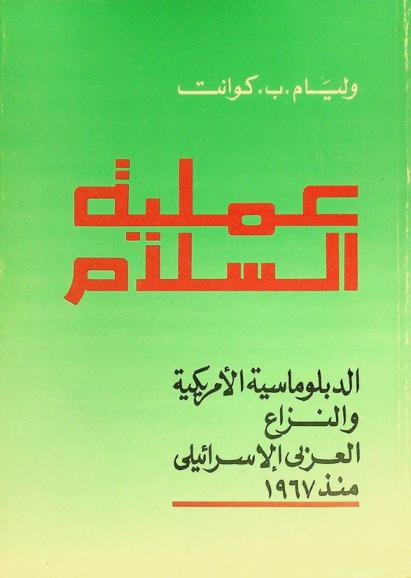
عملية السلام : الدبلوماسية الأمريكية والنزاع العربي الإسرائيلي منذ 1967
هذا الكتاب المهم هو بمثابة توسيع وتحديث لعمل كوانت الكلاسيكي الذي تضمن وصفا وتحليلا لسياسة الرؤساء الأميركيين الثلاثة : جونسون، ونيكسون، وفورد، تجاه المشكلة العربية – الإسرائيلية. ويقوم كوانت في هذا العمل بمراجعة كتاباته الأولى ويواصل بالطريقة نفسها معالجة سياسة إدارات الرؤساء كارتر وريغان وبوش. ويخصص الفصل الأخير للاستنتاجات التي توصل إليها، والتحديات والفرص التي تواجه إدارة الرئيس كلنتون، ويقدم بعض النصائح للتعامل معها.
BOOK

The Peace Puzzle
Each phase of Arab-Israeli peacemaking has been inordinately
difficult in its own right, and every critical juncture and
decision point in the long process has been shaped by U.S. politics
and the U.S. leaders of the moment. The Peace Puzzle tracks the
American determination to articulate policy, develop strategy and
tactics, and see through negotiations to agreements on an issue
that has been of singular importance to U.S. interests for more
than forty years.
In 2006, the authors of The Peace Puzzle formed the Study Group
on Arab-Israeli Peacemaking, a project supported by the United
States Institute of Peace, to develop a set of \"best practices\" for
American diplomacy. The Study Group conducted in-depth interviews
with more than 120 policymakers, diplomats, academics, and civil
society figures and developed performance assessments of the
various U.S. administrations of the post-Cold War period. This
book, an objective account of the role of the United States in
attempting to achieve a lasting Arab-Israeli peace, is informed by
the authors' access to key individuals and official archives.
eBook

أمريكا والعرب وإسرائيل : عشر سنوات حاسمة (1967-1976)
يتناول كتاب (أمريكا والعرب وإسرائيل : عشر سنوات حاسمة (1967-1976)) والذي قام بتأليفه (ويليام كوانت) ويقع في حوالي (447) صفحة من القطع المتوسط موضوع (النزاع العربي الإسرائيلي) مستعرضا المحتويات التالية : الفصل الأول : مقدمة، الفصل الثاني : الحرب العربية الإسرائيلية-يونية 1967، الفصل الثالث : مبادرات روجرز، الفصل الرابع : الأزمة الأردنية-سبتمبر 1970، الفصل الخامس : دبلوماسية الموقف (1971-1973)، الفصل السادس : حرب أكتوبر 1973 وغيرها من فصول وموضوعات الكتاب.
Book

On the Peace Process in the Middle East
Quandt describes the Israeli-Palestinian peace negotiation. He comments that the prospects seem dim because Hamas does not recognize Israel's right to exist, and both Israel and the US see Hamas as little more than a terrorist organization. He further expresses that the situation is unfortunate for Pres George W. Bush, whose grand design for transforming the Middle East is not going well.
Journal Article

الشرق الأوسط على حافة الهاوية : فرص التغيير في القرن الحادى والعشرين
في الشرق الأوسط، أصبحت اتفاقيات كامب ديفيد موضوعا لنقاش كبير. وينظر إليهم الكثيرون في العالم العربي، وحتى البعض في إسرائيل، بعين العداء. ويرى آخرون، وخاصة في الولايات المتحدة، في صيغة كامب ديفيد الأمل الوحيد للتوصل إلى حل ناجح للصراع العربي الإسرائيلي والإشادة السخية بالاتفاقات. لكن التأثير الواسع للاتفاقيات على الشرق الأوسط وعلى آفاق السلام لم يتم تحليله بشكل كامل من قبل المتخصصين في الشرق الأوسط أو الأمريكيين. ويقدم هذا العمل الجديد، الذي نشر بمناسبة الذكرى السنوية العاشرة للاتفاقات، التقييم الشامل اللازم لمناقشة الخطوات التالية في عملية السلام في الشرق الأوسط.
BOOK

ISLAM IS NOT THE PROBLEM
The Bush administration, as it proceeds with its grand strategy of reordering the Middle East, talks optimistically of bringing democracy and peace to a region that has known little of either. One wonders if those who put forward this vision really believe in it, or whether they hope it will convince Americans that the war against Iraq is moral. It is puzzling that many intellectuals who have been most influential in instructing the Bush crowd on the Middle East have maintained that there is something in Arab and Islamic culture that is profoundly hostile to democracy.
The issue of Islam
Book Chapter
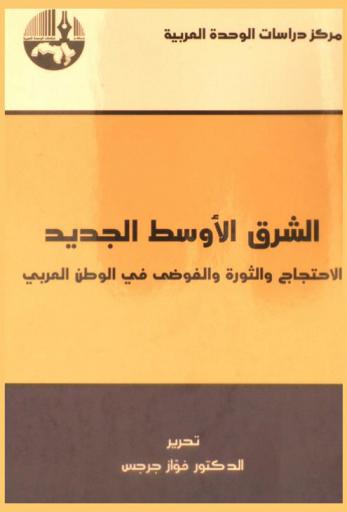
الشرق الأوسط الجديد : الاحتجاج والثورة والفوضى في الوطن العربي
يحتوي هذا الكتاب على مجموعة من البحوث المعمقة والقراءات المتأنية والدقيقة حول أسباب الإنتفاضات ومحركيها وتأثيراتها في الأوضاع السياسية العربية الداخلية والإقليمية الدولية فيعالج الإنتفاضات العربية كلا على حدة بأبعادها الداخلية ووفق آليات التعبئة الشعبية الذاتية في ظل أزمة السلطة السياسية في كل من تلك الحالات وفشل التنمية الاقتصادية لديها وفي ظل الأنواع الجديدة من التعبئة والنشاط التي أطرت تلك الإنتفاضات.
BOOK

Can the Two-State Solution be Salvaged?
After Chas W. Freeman, Jr.'s grim summation of the prospects for a two-state solution to the Israeli-Palestinian conflict, William B. Quandt argues that the two-state solution is a long shot & that it requires a renewed sense of urgency amid the current crisis. However, the crisis & new US leadership suggests opportunity. In this light, negatives & positives of the situation are outlined. Ali Abunimah begins with criticism regarding Israel's war in Gaza, asserting that it is not a response to Palestinian terrorism but an attempt to achieve Palestinian surrender. It is then argued that Israel faces a legitimacy problem that will require it to make a hard choice about whether to persist down the road toward international isolation & that there can be no return to \"business as usual\" for Israel. Asad Ghanem discusses democratic options for resolving the conflict, including the two-state & one-state (binational or liberal state) options. Attention is given to the significance of the war in Gaza & Palestinian politics. It is noted that Israel will likely be unable to implement an agreement & that the Palestinian national movement has failed. Alon Ben-Meir laments the biases voiced by Palestinians & Israelis on this issue & calls for an end to the \"blame game.\" It is also contended that the two-state solution is the only option & urges leadership from all key actors, including the US. A question-&-answer session ensues. D. Edelman. Adapted from the source document.
Journal Article