
Catalogue Search | MBRL


Are you sure you want to remove the book from the shelf?

{{itemTitle}}
4
result(s) for
"Walter, Barbara F., author"
Sort by:

How civil wars start : and how to stop them
\"A leading political scientist examines the dramatic rise in violent extremism around the globe and sounds the alarm on the increasing likelihood of a second civil war in the United States. Political violence rips apart several towns in southwest Texas. A far-right militia plots to kidnap the governor of Michigan and try her for treason. An armed mob of Trump supporters and conspiracy theorists storms the U.S. Capitol. Are these isolated incidents? Or is this the start of something bigger? Barbara F. Walter has spent her career studying civil conflict in places like Iraq and Sri Lanka, but now she has become increasingly worried about her own country. Perhaps surprisingly, both autocracies and healthy democracies are largely immune from civil war; it's the countries in the middle ground that are most vulnerable. And this is where more and more countries, including the United States, are finding themselves today. Over the last two decades, the number of active civil wars around the world has almost doubled. Walter reveals the warning signs-where wars tend to start, who initiates them, what triggers them-and why some countries tip over into conflict while others remain stable. Drawing on the latest international research and lessons from over twenty countries, Walter identifies the crucial risk factors, from democratic backsliding to factionalization and the politics of resentment. A civil war today won't look like America in the 1860s, Russia in the 1920s, or Spain in the 1930s. It will begin with sporadic acts of violence and terror, accelerated by social media. It will sneak up on us and leave us wondering how we could have been so blind. In this urgent and insightful book, Walter redefines civil war for a new age, providing the framework we need to confront the danger we now face-and the knowledge to stop it before it's too late\"-- Provided by publisher.
Book
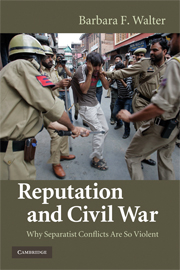
Reputation and Civil War
Of all the different types of civil war, disputes over self-determination are the most likely to escalate into war and resist compromise settlement. Reputation and Civil War argues that this low rate of negotiation is the result of reputation building, in which governments refuse to negotiate with early challengers in order to discourage others from making more costly demands in the future. Jakarta's wars against East Timor and Aceh, for example, were not designed to maintain sovereignty but to signal to Indonesia's other minorities that secession would be costly. Employing data from three different sources - laboratory experiments on undergraduates, statistical analysis of data on self-determination movements, and qualitative analyses of recent history in Indonesia and the Philippines - Barbara F. Walter provides some of the first systematic evidence that reputation strongly influences behavior, particularly between governments and ethnic minorities fighting over territory.
eBook

Language Variety in the South Revisited
Top linguists from diverse fields address language varieties in the South. Language Variety in the South Revisited is a comprehensive collection of new research on southern United States English by foremost scholars of regional language variation. Like its predecessor, Language Variety in the South: Perspectives in Black and White (The University of Alabama Press, 1986), this book includes current research into African American vernacular English, but it greatly expands the scope of investigation and offers an extensive assessment of the field. The volume encompasses studies of contact involving African and European languages; analysis of discourse, pragmatic, lexical, phonological, and syntactic features; and evaluations of methods of collecting and examining data. The 38 essays not only offer a wealth of information about southern language varieties but also serve as models for regional linguistic investigation.
eBook
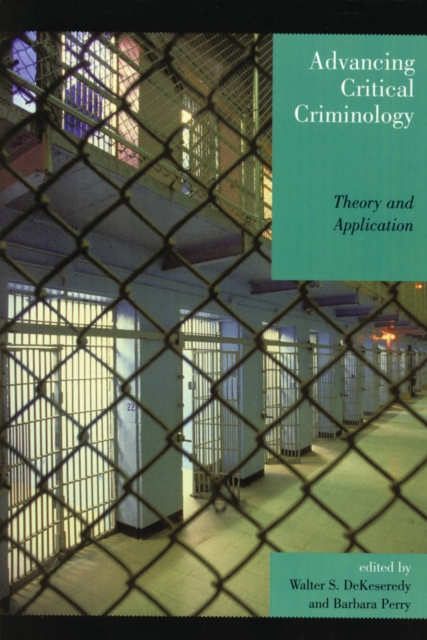
Advancing critical criminology
Advancing Critical Criminology constitutes a timely addition to the growing body of knowledge on critical criminology scholarship. DeKeseredy and Perry have assembled a volume that provides scholars with an in-depth review of the extant literature on several major branches of criminology as well as examples of how critical criminologists apply their theoretical perspectives to substantive topics, such as drugs, interpersonal violence, and rural crime. Accordingly, this work is divided into two main sections: overviews of theories and applications. Each chapter provides a summary of work in a specific area, along with suggestions for moving the field forward. This reader is unique in its choice of topics, which have often been overlooked in the past. An expert collection of international scholars, Advancing Critical Criminology is certain to stimulate lively debates and generate further critical social scientific work in this field.
eBook