
Catalogue Search | MBRL


Are you sure you want to remove the book from the shelf?

{{itemTitle}}
73
result(s) for
"Wansbeek, Tom"
Sort by:

A New Estimator for Standard Errors with Few Unbalanced Clusters
In linear regression analysis, the estimator of the variance of the estimator of the regression coefficients should take into account the clustered nature of the data, if present, since using the standard textbook formula will in that case lead to a severe downward bias in the standard errors. This idea of a cluster-robust variance estimator (CRVE) generalizes to clusters the classical heteroskedasticity-robust estimator. Its justification is asymptotic in the number of clusters. Although an improvement, a considerable bias could remain when the number of clusters is low, the more so when regressors are correlated within cluster. In order to address these issues, two improved methods were proposed; one method, which we call CR2VE, was based on biased reduced linearization, while the other, CR3VE, can be seen as a jackknife estimator. The latter is unbiased under very strict conditions, in particular equal cluster size. To relax this condition, we introduce in this paper CR3VE-λ, a generalization of CR3VE where the cluster size is allowed to vary freely between clusters. We illustrate the performance of CR3VE-λ through simulations and we show that, especially when cluster sizes vary widely, it can outperform the other commonly used estimators.
Journal Article

Unbiased estimation of the OLS covariance matrix when the errors are clustered
When data are clustered, common practice has become to do OLS and use an estimator of the covariance matrix of the OLS estimator that comes close to unbiasedness. In this paper, we derive an estimator that is unbiased when the random-effects model holds. We do the same for two more general structures. We study the usefulness of these estimators against others by simulation, the size of the t-test being the criterion. Our findings suggest that the choice of estimator hardly matters when the regressor has the same distribution over the clusters. But when the regressor is a cluster-specific treatment variable, the choice does matter and the unbiased estimator we propose for the random-effects model shows excellent performance, even when the clusters are highly unbalanced.
Journal Article
How measurement error affects inference in linear regression
Measurement error biases OLS results. When the measurement error variance in absolute or relative (reliability) form is known, adjustment is simple. We link the (known) estimators for these cases to GMM theory and provide simple derivations of their standard errors. Our focus is on the test statistics. We show monotonic relations between the t-statistics and R2s of the (infeasible) estimator if there was no measurement error, the inconsistent OLS estimator, and the consistent estimator that corrects for measurement error and show the relation between the t-value and the magnitude of the assumed measurement error variance or reliability. We also discuss how standard errors can be computed when the measurement error variance or reliability is estimated, rather than known, and we indicate how the estimators generalize to the panel data context, where we have to deal with dependency among observations. By way of illustration, we estimate a hedonic wine price function for different values of the reliability of the proxy used for the wine quality variable.
Journal Article

Optimal Selection for Direct Mail
Direct marketing (mail) is a growing area of marketing practice, yet the academic journals contain very little research on this topic. The most important issue for direct marketers is how to sample targets from a population for a direct mail campaign. Although some selection methods are described in the literature, there seems to be not a single paper discussing the analytical and statistical aspects involved. The objective of this paper is to introduce a comprehensive methodology for the selection of targets from a mailing list for direct mail. At least theoretically, this methodology leads to more efficient selection procedures than the existing ones. The latter are not based on an optimal selection strategy, whereas we explicitly take the profit function into account. By equating marginal costs and marginal returns we determine which households should receive a mailing in order to maximize expected profit. In the empirical part we show that our methodology has great predictive accuracy and generates higher net returns than traditional approaches.
Journal Article

Measurement Error in Earnings Data: Using a Mixture Model Approach to Combine Survey and Register Data
Survey data on earnings tend to contain measurement error. Administrative data are superior in principle, but are worthless in case of a mismatch. We develop methods for prediction in mixture factor analysis models that combine both data sources to arrive at a single earnings figure. We apply the methods to a Swedish data set. Our results show that register earnings data perform poorly if there is a (small) probability of a mismatch. Survey earnings data are more reliable, despite their measurement error. Predictors that combine both and take conditional class probabilities into account outperform all other predictors. This article has supplementary material online.
Journal Article
Utility Covariances and Context Effects in Conjoint MNP Models
Experimental conjoint choice analysis is among the most frequently used methods for measuring and analyzing consumer preferences. The data from such experiments have been typically analyzed with the Multinomial Logit (MNL) model. However, there are several problems associated with the standard MNL model because it is based on the assumption that the error terms of the underlying random utilities are independent across alternatives, choice sets, and subjects. The Multinomial Probit model (MNP) is well known to alleviate this assumption of independence of the error terms. Accounting for covariances in utilities in modeling choice experiments with the MNP is important because variation of the coefficients in the choice model may occur due to context effects. Previous research has shown that subjects' utilities for alternatives depend on the choice context, that is, the particular set of alternatives evaluated. Simonson and Tversky's tradeoff contrast principle describes the effect of the choice context on attribute importance and patterns of choice. They distinguish local contrast effects , which are caused by the alternatives in the offered set only, and background contrast effects , which are due to the influence of alternatives previously considered in choice experiments. These effects are hypothesized to cause correlations in the utilities of alternatives within and across choice sets, respectively.
The purpose of this study is to develop an MNP model for conjoint choice experiments. This model is important for a more detailed study of choice patterns in those experiments. In developing the MNP model for conjoint choice experiments, several hurdles need to be taken related to the identification of the model and to the prediction of holdout profiles. To overcome those problems, we propose a random coefficients (RC) model that assumes a multivariate normal distribution of the regression coefficients with a rank one factor structure on the covariance matrix of these regression coefficients. The parameters in this covariance matrix can be used to identify which attributes and levels of attributes are potentional sources of dependencies between the alternatives and choice sets in a conjoint choice experiment. We present several versions of this model. Moreover, for each of these models we allow utilities to be either correlated or independent across choice sets. The Independent Probit (IP) model is used as a benchmark. Given the dimensionality of the integrations involved in computing the choice probabilities, the models are estimated with simulated likelihood, where simulations are used to approximate the integrals involved in the choice probabilities.
We apply and compare the models in two conjoint choice experiments. In both applications, the random coefficients MNP model that allows choices in different choice sets to be correlated (RC) displays superior fit and predictive validity compared with all other models. We hypothesize that the difference in fit occurs because the RC model accommodates correlations among choice sets that are caused by background contrast effects, whereas the model that treats choice sets as independent (iRC) accounts for local contrast effects only. The iRC model shows superior model fit compared with the IP model, but its predictions are worse than those of the IP model. We find differences in the importance of local and background contrast effects for choice sets containing different numbers of alternatives: The background contrast effect may be stronger for smaller choice sets, whereas the local contrast effect may be stronger for bigger choice sets.
We illustrate the differences in simulated market shares that are obtained from the RC, iRC, and IP models in three hypothetical situations: product modification, product line extension, and the introduction of a me-too brand. In all of those situations, substantially different market shares are predicted by the three models, which illustrates the extent to which erroneous predictions may be obtained from the misspecified iRC and IP models.
Journal Article
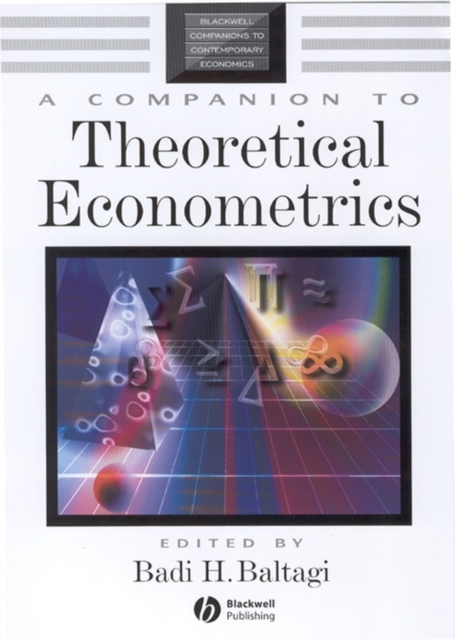
A companion to theoretical econometrics
A Companion to Theoretical Econometrics provides a comprehensive reference to the basics of econometrics. This companion focuses on the foundations of the field and at the same time integrates popular topics often encountered by practitioners. The chapters are written by international experts and provide up-to-date research in areas not usually covered by standard econometric texts. Focuses on the foundations of econometrics. Integrates real-world topics encountered by professionals and practitioners. Draws on up-to-date research in areas not covered by standard econometrics texts. Organized to provide clear, accessible information and point to further readings.
eBook


Correcting for Heteroskedasticity of Unspecified Form
Correcting for heteroskedasticity of unspecified form.
Journal Article