
Catalogue Search | MBRL


Are you sure you want to remove the book from the shelf?

{{itemTitle}}
235
result(s) for
"Ware, Alan"
Sort by:


Exceptionalism, Political Science and the Comparative Analysis of Political Parties
For more than four decades the analysis of party organizations in the European democracies has been completely separated from analyses of American party structures. The first part of this article examines how and why such a separation was to emerge in the aftermath of Duverger's and Epstein's path-breaking original work. It then goes on to outline how an analytic framework might be developed so that more wide-ranging comparative studies of party organizations in democratic regimes can be undertaken in future. Only with such research can the limitations of ‘exceptionalist’ and ‘regionalist’ explanations of party structure development and change be overcome.
Journal Article

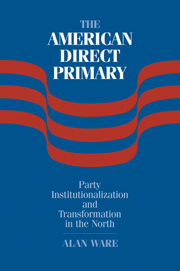
The American Direct Primary
This book rejects conventional accounts of how American political parties differ from those in other democracies. It focuses on the introduction of the direct primary and argues that primaries resulted from a process of party institutionalization initiated by party elites. It overturns the widely accepted view that, between 1902 and 1915, direct primaries were imposed on the parties by anti-party reformers intent on weakening them. An examination of particular northern states shows that often the direct primary was not controversial, and only occasionally did it involve confrontation between party 'regulars' and their opponents. Rather, the impetus for direct nominations came from attempts within the parties to subject informal procedures to formal rules. However, it proved impossible to reform the older caucus-convention system effectively, and party elites then turned to the direct primary - a device that already had become more common in rural counties in the late nineteenth century.
eBook

Inequality in Britain
\"This book provides a thorough and engaging analysis of inequality in Britain, including its long-term development and transformation since the beginning of the 20th century. The author argues that inequality is not what it used to be - no longer can policy makers consider it just in terms of status, wealth and income. Having resurfaced strongly as an issue after the financial crisis of 2007-8, a truly informed discussion of inequality must now be wide ranging and take account of a variety of interacting factors. They include both a radically different role for education in the labour market and the interests of future generations. Government policies, market failures and fundamental changes in British society and economy in earlier decades have all contributed to inequality's contemporary scope, intensity, and who it affects. Alan Ware traces and illuminates the altered nature of inequality in Britain, its consequences, and especially its political implications. It offers a timely, concise and illuminating examination that will be of interest to all those concerned about inequality and, more broadly, to scholars and students of sociology, social/public policy, contemporary British history, political sociology, and political theory\"-- Provided by publisher.
Book
Exceptionalism, Political Science and the Comparative Analysis of Political Parties1
For more than four decades the analysis of party organizations in the European democracies has been completely separated from analyses of American party structures. The first part of this article examines how and why such a separation was to emerge in the aftermath of Duverger's and Epstein's path‐breaking original work. It then goes on to outline how an analytic framework might be developed so that more wide‐ranging comparative studies of party organizations in democratic regimes can be undertaken in future. Only with such research can the limitations of ‘exceptionalist’ and ‘regionalist’ explanations of party structure development and change be overcome.
Journal Article

The Direct Primary in the United States: Party Institutionalization and Transformation in the American North
This book rejects conventional accounts of how American political parties differ from those in other democracies. It focuses on the introduction of the direct primary and argues that primaries resulted from a process of party institutionalization initiated by party elites. It overturns the widely accepted view that, between 1902 and 1915, direct primaries were imposed on the parties by anti-party reformers intent on weakening them. An examination of particular northern states shows that often the direct primary was not controversial, and only occasionally did it involve confrontation between party 'regulars' and their opponents. Rather, the impetus for direct nominations came from attempts within the parties to subject informal procedures to formal rules. However, it proved impossible to reform the older caucus-convention system effectively, and party elites then turned to the direct primary - a device that already had become more common in rural counties in the late nineteenth century.
eBook
Exceptionalism, Political Science and the Comparative Analysis of Political Parties 1
For more than four decades the analysis of party organizations in the European democracies has been completely separated from analyses of American party structures. The first part of this article examines how and why such a separation was to emerge in the aftermath of Duverger's and Epstein's path-breaking original work. It then goes on to outline how an analytic framework might be developed so that more wide-ranging comparative studies of party organizations in democratic regimes can be undertaken in future. Only with such research can the limitations of ‘exceptionalist’ and ‘regionalist’ explanations of party structure development and change be overcome.
Journal Article
Peter Mair (1951–2011)
Obituary is presented for a scholar in comparative politics, Peter Mair. Adapted from the source document.
Journal Article

Anti-Partism and Party Control of Political Reform in the United States: The Case of the Australian Ballot
This article examines critically an explanation, first propounded by Austin Ranney, as to the causes of party reform in the United States. Ranney argued that there is an ambivalent attitude to parties in the United States; while there is evidence of popular support for parties, the political culture is also infused by anti-party values. Periodically this has facilitated the enactment of legislation, promoted by anti-party reformers, constraining parties. Focusing on the Australian Ballot, the article argues that its rapid adoption in the United States resulted from its seeming to solve problems facing party elites in the 1880s – problems that arose from the erosion of a face-to-face society. Despite opposition from anti-party reformers, parties in most states legislated for types of ballot that preserved party control of the electorate. Moreover, during the Progressive era the parties generally continued to preserve a type of ballot that favoured them. The ability of parties to defend their interests against anti-party reformers was possible when it was clear where those interests lay. With other reforms, including the direct primary, this was much less evident, and it was then far more difficult for the parties to defend themselves.
Journal Article