
Catalogue Search | MBRL


Are you sure you want to remove the book from the shelf?

{{itemTitle}}
132
result(s) for
"Wattenberg, Martin P"
Sort by:

Mixed-Member Electoral Systems
Mixed-member electoral systems may well be the electoral reform of the 21st century. In the view of many electoral reformers, mixed systems offer the best of both the traditional British single-seat district system and PR systems. This book seeks to evaluate: why these systems have recently appealed to many countries with diverse electoral historie.
eBook

The Declining Relevance of Candidate Personal Attributes in Presidential Elections
This article examines sixty years of data from the American National Election Studies, and finds that the electorate's focus on candidate attributes has declined substantially. Whereas 80% of respondents had mentioned personal attributes in the past, in recent elections only about 60% have done so. Furthermore, such comments are now more tied to partisan identification and have less of an independent impact on voting behavior. The chances of presidential image makers successfully making a difference by emphasizing a president's personal character are now much less than in the era of Johnson, Nixon, and Reagan.
Journal Article

Where have all the voters gone?
In this timely book, Martin Wattenberg confronts the question of what low participation rates mean for democracy. At the individual level, turnout decline has been highest among the types of people who most need to have electoral decisions simplified for them through a strong party system--those with the least education, political knowledge, and life experience.
eBook
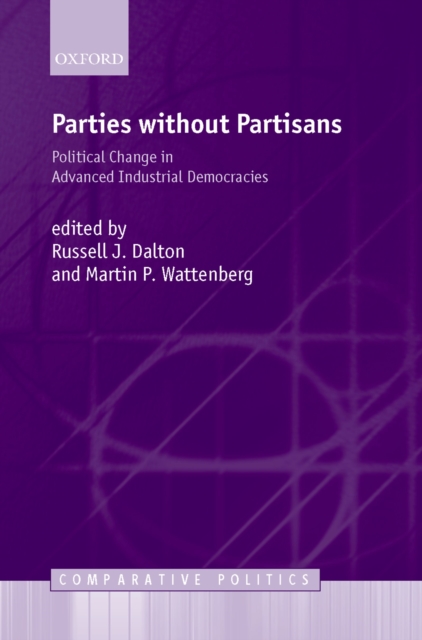
Parties without partisans : political change in advanced industrial democracies
This is a broad cross‐national study of the role of political parties in contemporary democracies. Leading scholars in the field assess the evidence for partisan decline or adaptation for 20 OECD nations. This book documents the broadscale erosion of the public's partisan identities in virtually all advanced industrial democracies. It demonstrates how political parties have adapted to partisan dealignment by strengthening their internal organizational structures and partially isolating themselves from the ebbs and flows of electoral politics. Centralized, professionalized parties with short time horizons have replaced the ideologically driven mass parties of the past. Parties without Partisans is the most comprehensive cross‐national study of parties in advanced industrial democracies in all of their forms—in electoral politics, as organizations, and in government.
eBook
A Policy-Oriented Electorate: Evaluations of Candidates and Parties in the Obama Elections Compared to the 1952-1980 Period
In a replication of Miller and Wattenberg's (1985) coding of American National Election Studies open-ended likes/dislikes questions, respondents' evaluations of candidates and parties are found to be especially policy oriented in 2008 and 2012. Compared to earlier elections without an incumbent, prospective policy evaluations were far more prevalent in 2008. Furthermore, voters' comments about the candidates in 2012 were more policy oriented than the elections of 1964 and 1972 in which challengers offered a stark policy choice to an incumbent president. We also find the public's likes and dislikes of the political parties focused heavily on policy considerations in the two Obama elections.
Journal Article

Negative Campaign Advertising: Demobilizer or Mobilizer?
As political campaigns become increasingly adversarial, scholars are giving some much-needed attention to the effect of negative advertising on turnout. In a widely recognized Review article and subsequent book, Ansolabehere and his colleagues (1994, 1995) contend that attack advertising drives potential voters away from the polls. We dispute the generalizability of this claim outside the experimental setting. Using NES survey data as well as aggregate sources, we subject their research to rigorous real-world testing. The survey data directly contradict their findings, yielding no evidence of a turnout disadvantage for those who recollected negative presidential campaign advertising. In attempting to replicate Ansolabehere et al.'s earlier aggregate results we uncover quite substantial discrepancies and inconsistencies in their data set. We conclude that their aggregate study is deeply flawed and that Ansolabehere et al. exaggerated the demobilization dangers posed by attack advertising, at least in voters' own context.
Journal Article
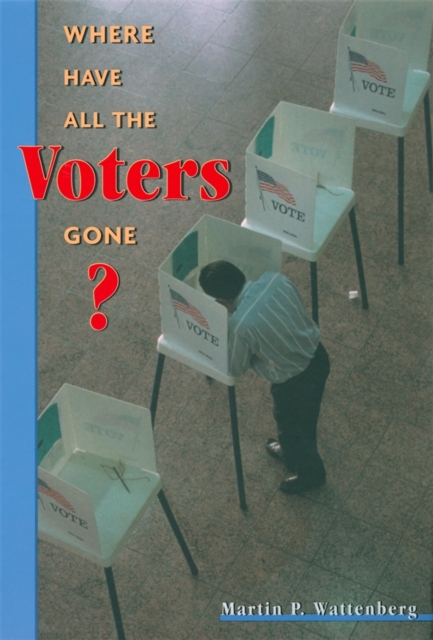
Where Have All the Voters Gone?
In this timely book, Martin Wattenberg confronts the question of what low participation rates mean for democracy. At the individual level, turnout decline has been highest among the types of people who most need to have electoral decisions simplified for them through a strong party system--those with the least education, political knowledge, and life experience.
eBook

Campaign Issue Knowledge and Salience: Comparing Reception from TV Commercials, TV News and Newspapers
The impact of media sources including televised political commercials, television news, and newspapers on candidate issue position knowledge and issue-based candidate evaluations is explored. From previous research, we expect that citizens who recall political TV commercials and are more attentive to newspaper political coverage will have greater knowledge of candidates' stances on issues than those watching political news on TV. Citizens recalling political ads and those reading the newspaper are also expected to be more likely to evaluate the candidates using substantive issues. Regression analysis of the 1992 American National Election Study data. Citizens recalling political advertising have the most accurate knowledge of the candidates' issue positions and are the most likely to use domestic and foreign issues to evaluate the presidential candidates. Consumption of negative advertising is also associated with greater issue knowledge and use of issues in evaluations late in the campaign.
Journal Article
