
Catalogue Search | MBRL


Are you sure you want to remove the book from the shelf?

{{itemTitle}}
106
result(s) for
"Webber, Jeffery R."
Sort by:

Contemporary Latin American Inequality
Weberian sociological approaches dominate the contemporary study of inequality in Latin America. Theoretically, the major works in the area suffer from a conflation of liberalism and democracy and offer flawed conceptions of capitalism, class, and other social relations of oppression. This article offers an exegesis and critique of several recent influential texts written within the Weberian tradition. It then proposes as an alternative a Marxian-decolonial theoretical framework for understanding inequality and the totalizing power of capital. It demonstrates how such a framework can better account for the complexity of class relations and other internally related forms of social oppression—such as gender, sexuality, and race—in Latin America today. Finally, the article shows the utility of the Marxist-decolonial framework by way, first, of a concrete investigation into the highly contested dynamics of twenty-first-century extractive capitalism in the region, and, second, through an exposition of the life story and activism of Luis Macas, an indigenous activist and intellectual in Ecuador. The core element of Macas’s political subjectivity is an underlying utopian-revolutionary dialectic through which he draws on elements of a precapitalist past in looking forward to an anticolonial and socialist future.
Journal Article

Evo Morales and the political economy of passive revolution in Bolivia, 2006-15
While the government of Evo Morales rules in the name of indigenous workers and peasants, in fact the country's political economy has since 2006 witnessed the on-going subjugation of these classes. If the logic of large capital persists, it is legitimated in and through petty indigenous capitalists. This article argues that Antonio Gramsci's conceptualisation of passive revolution offers a superior analytical point of departure for understanding contemporary Bolivian politics than does Álvaro García Linera's more widely accepted theory of creative tensions. However, the dominant manner in which passive revolution has been employed in contemporary Latin American debates has treated the socio-political and the ideological as relatively autonomous from the process of capital accumulation. What is necessary, instead, is a sharper appreciation of the base/superstructure metaphor as expressing a dialectical unity of internal relations between 'the economic' and 'the political', thus avoiding one determinism or another. Through a reading of Gramsci that emphasises such unity, this article interrogates the dynamics of 'extractive distribution', class contradictions of the 'plural economy', and transformations in the urban labour market which have characterised Bolivia's passive revolution under Evo Morales between 2006 and 2015.
Journal Article
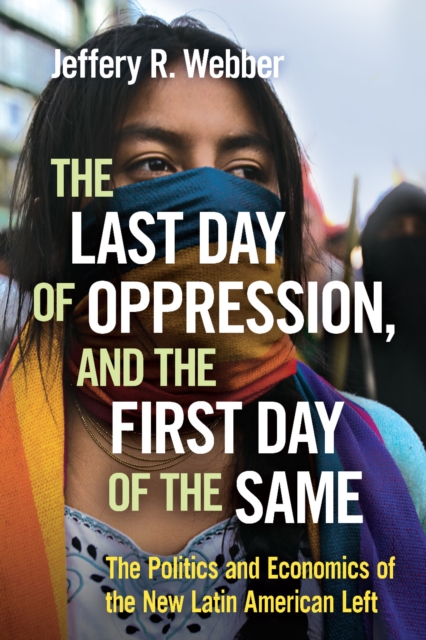
The Last Day of Oppression, and the First Day of the Same
Shortlisted for the 2018 Sussex International Theory PrizeThroughout the 2000s Latin America formed the leading edge of antineoliberal resistance. But what is left of the \"pink tide\" today? How have governments established in its wake related to a changing global economy and a right-wing resurgence? In this penetrating volume, Jeffery Webber traces evolving, often contradictory relationships between left-wing governments and the social movements that propelled them to power.
eBook
Imperialism and Resistance: Canadian mining companies in Latin America
David Harvey's concept of accumulation by dispossession is a useful framework for understanding the predatory activities of Canadian mining companies in Latin America. Capitalist imperialism is rooted in the logic of a socioeconomic system that is driven by the competitive pursuit of profit based on the exploitation of labour, and which is prone to over-accumulation. Capital, backed by state power, pursues a spatial fix to resolve the systematic crisis of over-accumulation. The creation of new spaces of accumulation is not an innocuous process; it inevitably involves the forceful and violent reorganisation of peoples' lives as they are subordinated to the whims of capital. Strategies of accumulation by dispossession by capital therefore commonly spawn popular resistance from the affected communities. The Canadian mining industry is the largest in the world, and much of its outward investment targets Latin America. The Canadian company share of the larger company exploration market in Latin America (and the Caribbean) has grown steadily since the early 1990s, up to 35% by 2004, the largest by far among all its competitors, with seven Canadian companies among the top 20 mineral exploration investors in the region from 1989 to 2001. This paper charts these trends of Canadian mining expansion in Latin America and then focuses on the community, environmental and worker resistance it is generating in the cases of Chile and Colombia.
Journal Article

The indigenous community as \living organism\: José Carlos Mariátegui, Romantic Marxism, and extractive capitalism in the Andes
This article explores the complex relationship between Marxism and Romanticism in the work of early-twentieth century Peruvian Marxist José Carlos Mariátegui. Following Michael Löwy, it argues that there is a utopian-revolutionary dialectic of the pre-capitalist past and socialist future running through Mariátegui's core works. The romantic thread of Mariátegui's thought was in many ways a response to the prevalent evolutionist and economistic Marxist orthodoxies of his time. An argument is made that the fruitful heresy embedded in the Mariáteguist framework might suggest the outlines for a theoretical research agenda to counter a novel orthodoxy emerging out of the state ideologies of the Andean New Left in an era of intensifying extractive capitalism. Deploying a certain Marxist idiom, figures such as Bolivian Vice President Álvaro García Linera defend as progressive the extension of large-scale mining, natural gas and oil extraction, and agro-industrial mono-cropping in alliance with multinational capital. Left and indigenous critics of this latest iteration of extractive capitalism in Latin America are condemned in this worldview as naive romantics, or worse, the useful idiots of imperialism. A creative return to Mariátegui allows us to read the opposition of Left and indigenous critique and activism in a different light. What is more, we can see in the biographies of activists such as Felipe Quispe in Bolivia a concrete realization of the Romantic Marxist critique of evolutionism and economism being discussed theoretically in our exploration of Mariátegui.
Journal Article

Crisis and contradiction : Marxist perspectives on Latin America in the global political economy
This volume focuses on changes to class formation and the state-form in Latin America. It explores the relationships between state and market in countries endowed with vast natural resource wealth such as Argentina, Bolivia, Brazil and Venezuela.
eBook

Complex Stratification in the World System
Scholarly debate on territorialized geopolitics and internationalized capitalist accumulation has reached an impasse. Advocates of empire and transnational class and state formation underestimate the staying power of nation–states in the contemporary global order and extend theoretical claims beyond what the evidence allows. State-centric theorists of U. S. supremacy, meanwhile, fail to appreciate the subordination of all states to the law of value, operating in and through the uneven, hierarchical, and hypercomplex world market. Finally, theorists of “dual logics” cannot grasp the dialectical integration of state and capital. A way out of the impasse lies through the notion of a complexly stratified world system, which stresses capitalist specificity, capitalist totality, the multiplicity of states and capitals, and the ordering of the world in an imperialist chain. Understanding the world as complexly stratified in this way has serious implications for the conceptualization of contemporary imperialism.
El debate académico sobre la geopolítica territorializada y la acumulación capitalista internacionalizada ha llegado a un impasse. Los abogados del imperio, la clase transnacionalizada y la formación estatal subestiman la permanencia de los estados nacionales en el orden global contemporáneo y estiran sus planteamientos teóricos más allá de donde la evidencia lo permite. Mientras tanto, los teóricos que ponen al estado en el centro explicativo de la supremacía de los Estados Unidos no aprecian la subordinación de todos los estados a la ley del valor, que opera en y a través de un mercado mundial desigual, jerárquico e hipercomplejo. Por último, los teóricos de la “lógica dual” no logran la integración dialéctica de estado y capital. Una salida a este impasse se vislumbra a través de la noción de un sistema mundial complejamente estratificado con énfasis en la especificidad capitalista, la totalidad capitalista, la multiplicidad de estados y capitales y el ordenamiento del mundo en una cadena imperialista. El concebir al mundo como un sistema mundial complejamente estratificado en esta forma tiene implicaciones serias para la conceptualización del imperialismo contemporáneo.
学术界关于领土地缘政治和国际化资本主义积累的争论已陷入僵局。主张 帝国论、跨国家阶级论和国家形成论的人低估了民族国家在当代国际秩序中的强 劲耐力,其理论主张已经超过证据所允许的范围。与此同时,以国家为中心的美 国霸权理论家们未能认识到所有国家都服从于价值规律,且都在不平衡的、等级 化的和高度复杂的世界市场中运作。最终,“二元逻辑”论者无法把握国家与资 本的辩证统一。跳出僵局的途径在于确定复杂的分层世界体系的概念,这个体系 强调资本主义的特殊性、资本主义的整体性、国家和资本的多重性以及处在帝国 主义链中的世界秩序。从复杂分层的视角解读当今世界,对理解当代帝国主义有 重要的意义。
Journal Article

Struggles against Accumulation by Dispossession in Bolivia: The Political Economy of Natural Resource Contention
David Harvey suggests that, compared with struggles waged by traditional political parties and labor unions, struggles to \"reclaim the commons\" typically result in a less focused political dynamic of social action, which is both a strength and a weakness. While these social movements draw strength from their embeddedness in daily life, not all manage to make the link between the struggle against accumulation by dispossession and the struggle for expanded reproduction that is necessary to meet the material needs of impoverished and repressed populations. Social movements in Bolivia have framed their demands differently in the struggles against the privatization of natural gas and water depending on the different roles these resources play in the region's political economy. Struggles against the privatization of natural gas pose a greater challenge to neoliberalism because of their macro frame and politics.
Journal Article

Red October : left-indigenous struggles in modern Bolivia
In the opening years of this century, a left-indigenous insurrectionary cycle in Bolivia mounted the most radical challenge to neoliberalism in the Western hemisphere. This book provides a Marxist and indigenous-liberationist analysis of this revolutionary epoch and is historical context.
eBook

From rebellion to reform in Bolivia : class struggle, indigenous liberation, and the politics of Evo Morales
Evo Morales rode to power on a wave of popular mobilizations against the neoliberal policies enforced by his predecessors. Yet many of his economic policies bare striking resemblance to the status quo he was meant to displace. Based in part on dozens of interviews with leading Bolivian activists, Jeffery R. Webber examines the contradictions of Morales' first term in office.
eBook