
Catalogue Search | MBRL


Are you sure you want to remove the book from the shelf?

{{itemTitle}}
91
result(s) for
"Weinstein, Jeremy M."
Sort by:
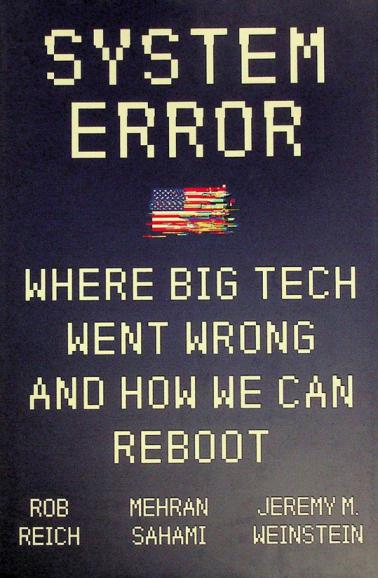
System error : where big tech went wrong and how we can reboot
A forward-thinking manifesto from three Stanford professors--experts who have worked at ground zero of the tech revolution for decades--which reveals how big tech's obsession with optimization and efficiency has sacrificed fundamental human values and outlines steps we can take to change course, renew our democracy, and save ourselves.
Book

Who Fights? The Determinants of Participation in Civil War
A range of seemingly rival theories attempt to explain why some individuals take extraordinary risks by choosing to participate in armed conflict. To date, however, competing accounts have typically not been grounded in systematic, empirical studies of the determinants of participation. In this article, we begin to fill this gap through an examination of the determinants of participation in insurgent and counterinsurgent factions in Sierra Leone's civil war. We find some support for all of the competing theories, suggesting that the rivalry between them is artificial and that theoretical work has insufficiently explored the interaction of various recruitment strategies. At the same time, the empirical results challenge standard interpretations of grievance-based accounts of participation, as poverty, a lack of access to education, and political alienation predict participation in both rebellion and counterrebellion. Factors that are traditionally seen as indicators of grievance or frustration may instead proxy for a more general susceptibility to engage in violent action or a greater vulnerability to political manipulation by elites.
Journal Article

Forced Displacement and Asylum Policy in the Developing World
Little theoretical or empirical work examines migration policy in the developing world. We develop and test a theory that distinguishes the drivers of policy reform and factors influencing the direction of reform. We introduce an original data set of de jure asylum and refugee policies covering more than ninety developing countries that are presently excluded from existing indices of migration policy. Examining descriptive trends in the data, we find that unlike in the global North, forced displacement policies in the global South have become more liberal over time. Empirically, we test the determinants of asylum policymaking, bolstering our quantitative results with qualitative evidence from interviews in Uganda. A number of key findings emerge. Intense, proximate civil wars are the primary impetus for asylum policy change in the global South. Liberalizing changes are made by regimes led by political elites whose ethnic kin confront discrimination or violence in neighboring countries. There is no generalizable evidence that developing countries liberalize asylum policy in exchange for economic assistance from Western actors. Distinct frameworks are needed to understand migration policymaking in developing versus developed countries.
Journal Article
Making Sense of Human Rights Diplomacy: Evidence from a US Campaign to Free Political Prisoners
Scholarship on human rights diplomacy (HRD)—efforts by government officials to engage publicly and privately with their foreign counterparts—often focuses on actions taken to “name and shame” target countries because private diplomatic activities are unobservable. To understand how HRD works in practice, we explore a campaign coordinated by the US government to free twenty female political prisoners. We compare release rates of the featured women to two comparable groups: a longer list of women considered by the State Department for the campaign; and other women imprisoned simultaneously in countries targeted by the campaign. Both approaches suggest that the campaign was highly effective. We consider two possible mechanisms through which expressive public HRD works: by imposing reputational costs and by mobilizing foreign actors. However, in-depth interviews with US officials and an analysis of media coverage find little evidence of these mechanisms. Instead, we argue that public pressure resolved deadlock within the foreign policy bureaucracy, enabling private diplomacy and specific inducements to secure the release of political prisoners. Entrepreneurial bureaucrats leveraged the spotlight on human rights abuses to overcome competing equities that prevent government-led coercive diplomacy on these issues. Our research highlights the importance of understanding the intersection of public and private diplomacy before drawing inferences about the effectiveness of HRD.
Journal Article

Liberal Displacement Policies Attract Forced Migrants in the Global South
Most forced migrants around the world are displaced within the Global South. We study whether and how de jure policies on forced displacement affect where forced migrants flee in the developing world. Recent evidence from the Global North suggests migrants gravitate toward liberal policy environments. However, existing analyses expect de jure policies to have little effect in the developing world, given strong presumptions that policy enforcement is poor and policy knowledge is low. Using original data on de jure displacement policies for 92 developing countries and interviews with 126 refugees and policy makers, we document a robust association between liberal de jure policies and forced migrant flows. Gravitation toward liberal environments is conditional on factors that facilitate the diffusion of policy knowledge, such as transnational ethnic kin. Policies for free movement, services, and livelihoods are especially attractive. Utility-maximizing models of migrant decision making must take de jure policy provisions into account.
Journal Article
Why Does Ethnic Diversity Undermine Public Goods Provision?
A large and growing literature links high levels of ethnic diversity to low levels of public goods provision. Yet although the empirical connection between ethnic heterogeneity and the underprovision of public goods is widely accepted, there is little consensus on the specific mechanisms through which this relationship operates. We identify three families of mechanisms that link diversity to public goods provision—what we term “preferences,” “technology,” and “strategy selection” mechanisms—and run a series of experimental games that permit us to compare the explanatory power of distinct mechanisms within each of these three families. Results from games conducted with a random sample of 300 subjects from a slum neighborhood of Kampala, Uganda, suggest that successful public goods provision in homogenous ethnic communities can be attributed to a strategy selection mechanism: in similar settings, co-ethnics play cooperative equilibria, whereas non-co-ethnics do not. In addition, we find evidence for a technology mechanism: co-ethnics are more closely linked on social networks and thus plausibly better able to support cooperation through the threat of social sanction. We find no evidence for prominent preference mechanisms that emphasize the commonality of tastes within ethnic groups or a greater degree of altruism toward co-ethnics, and only weak evidence for technology mechanisms that focus on the impact of shared ethnicity on the productivity of teams.
Journal Article

Inside Rebellion
Some rebel groups abuse noncombatant populations, while others exhibit restraint. Insurgent leaders in some countries transform local structures of government, while others simply extract resources for their own benefit. In some contexts, groups kill their victims selectively, while in other environments violence appears indiscriminate, even random. This book presents a theory that accounts for the different strategies pursued by rebel groups in civil war, explaining why patterns of insurgent violence vary so much across conflicts. It does so by examining the membership, structure, and behavior of four insurgent movements in Uganda, Mozambique, and Peru. Drawing on interviews with nearly two hundred combatants and civilians who experienced violence firsthand, it shows that rebels' strategies depend in important ways on how difficult it is to launch a rebellion. The book thus demonstrates how characteristics of the environment in which rebellions emerge constrain rebel organization and shape the patterns of violence that civilians experience.
eBook
Handling and Manhandling Civilians in Civil War
The toll of civil conflict is largely borne by civilian populations, as warring factions target non-combatants through campaigns of violence. But significant variation exists in the extent to which warring groups abuse the civilian population: across conflicts, across groups, and within countries geographically and over time. Using a new dataset on fighting groups in Sierra Leone, this article analyzes the determinants of the tactics, strategies, and behaviors that warring factions employ in their relationships with noncombatants. We first describe a simple logic of extraction which we use to generate hypotheses about variation in levels of abuse across fighting units. We then show that the most important determinants of civilian abuse are internal to the structure of the faction. High levels of abuse are exhibited by warring factions that are unable to police the behavior of their members because they are more ethnically fragmented, rely on material incentives to recruit participants, and lack mechanisms for punishing indiscipline. Explanations that emphasize the importance of local community ties and contestation do not find strong support in the data.
Journal Article
How Does Development Assistance Affect Collective Action Capacity? Results from a Field Experiment in Post-Conflict Liberia
Social cooperation is critical to a wide variety of political and economic outcomes. For this reason, international donors have embraced interventions designed to strengthen the ability of communities to solve collective-action problems, especially in post-conflict settings. We exploit the random assignment of a development program in Liberia to assess the effects of such interventions. Using a matching funds experiment we find evidence that these interventions can alter cooperation capacity. However, we observe effects only in communities in which, by design, both men and women faced the collective action challenge. Focusing on mechanisms, we find evidence that program effects worked through improvements in mobilization capacity that may have enhanced communities’ ability to coordinate to solve mixed gender problems. These gains did not operate in areas where only women took part in the matching funds experiment, possibly because they could rely on traditional institutions unaffected by the external intervention. The combined evidence suggests that the impact of donor interventions designed to enhance cooperation can depend critically on the kinds of social dilemmas that communities face, and the flexibility they have in determining who should solve them.
Journal Article

Can Development Aid Contribute to Social Cohesion after Civil War? Evidence from a Field Experiment in Post-Conflict Liberia
A field experiment in which villages in northern Liberia were randomly assigned to receive international development assistance provides evidence that the introduction of new local-level institutions can alter patterns of social cooperation in a way that persists after the program's conclusion. Villages exposed to a community-driven reconstruction program exhibit higher subsequent levels of social cooperation than those in the control group, as measured through a community-wide public goods game. Results suggest that changes in community cohesion can take place over a short period of time, can occur in response to outside intervention, and can develop without fundamental changes either to the structure of economic relations or to more macro-level political processes. Random assignment of communities to treatment provides confidence in the causal nature of the relationship, and the use of behavioral outcome measures reinforces the sense that the effects are real.
Journal Article