
Catalogue Search | MBRL


Are you sure you want to remove the book from the shelf?

{{itemTitle}}
52
result(s) for
"Weiss, Susan Forscher"
Sort by:


Troja: Jahrbuch fur Renaissance musik
Weiss discusses the periodical Troja: Jahrbuch fur Renaissance musik edited by Klaus Pietschmann, Katelijne Schiltz, and Nicole Schwindt. The journal began its life in 2001 and was published annually in printed form until 2012. Since 2013, it has been published once yearly online and is openly accessible via musiconn.publish. The essays are based on annual colloquia held in various locations in Germany and other European countries and the primary language is German, although some essays appear in English. These colloquia focus on the changing special aspects of research on music of the fifteenth and sixteenth centuries.
Journal Article


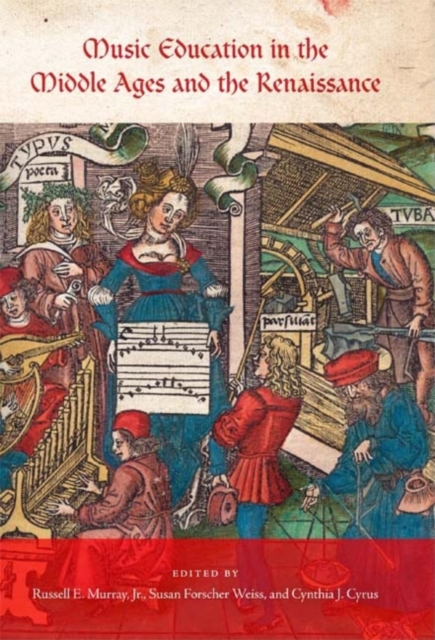
Music education in the Middle ages and the Renaissance
What were the methods and educational philosophies of music teachers in
the Middle Ages and the Renaissance? What did students study? What were the
motivations of teacher and student? Contributors to this volume address these topics
and other -- including gender, social status, and the role of the Church -- to
better understand the identities of music teachers and students from 650 to 1650 in
Western Europe. This volume provides an expansive view of the beginnings of music
pedagogy, and shows how the act of learning was embedded in the broader context of
the early Western art music tradition.
eBook

Perfect Beauty
Readers of the notational and theoretical treatises of the late fourteenth century experience musical compositions that were both feasts for the eyes and the ears. These examples of Augenmusik—what Richard Taruskin calls \"a phenomenal feat of calligraphy\"—represent a development that Ursula Günther in 1963 labeled the ars subtilior.2 Characterizing this so-called ars subtilior or \"subtler art,\" as it was practiced by \"the Avignon School\" for popes and wealthy aristocratic patrons in parts of southern France and northern Italy, were the concern for the expression of the beauty of musical sound and the lure of notating more sophisticated rhythms, such as those overheard in popular music and dance. Experiments with new note shapes are described in the anonymous Tractatus de diversis figuris, one of a set of musical treatises transcribed in Pavia in 1391 and held in the library of the Visconti family of Milan (now Newberry Library, MS 54.1).3 The prologue labels the style of writing that employs more variety of rhythm as an artem magis subtiliter. In what follows, I will draw connections between some of the ideals of beauty as seen and heard in late-fourteenth-century musical ideas inspired by an ancient rhetorician whose influence warrants investigation.
Journal Article



Disce manum tuam si vis bene discere cantum: Symbols of Learning Music in Early Modern Europe
In Greek and Roman times the art of memory was related to rhetoric and gave the orator places and images by which he could improve his ability to deliver long speeches with unfailing accuracy. Images of all sorts, from trees, ladders, theaters, temples, and hands began to appear in memory guides for many subjects, including grammar, rhetoric, computus, the learning of the ecclesiastical calendar, chiromancy, horseback riding, astronomy, architecture, and music. Some say musicians borrowed the image of a hand (most often the left one) adorned with symbols on the ringers and in the palm from almanac makers. The pedagogical device of an illustrated and annotated human hand is found not only in the Europe and the Americas, but also in sub-Saharan Africa and in many Eastern cultures, among them, China, Japan, and India. In some of these improvised traditions, model songs were used as points of mental reference, accompanying the hand as tools aimed to aid the younger or beginning learner. Hand signs went through several phases of evolution, from movements in the air — cheironomy — to a combination of written symbols recognized as stylized graphs of those movements, to the hand as a kind of reading board. The musical hand has been inextricably linked to the eleventh-century music theorist and pedagogue, Guido of Arezzo. While Guido is known to have developed a method of sight-singing by means of solmization, none of his extant writings contain the image of the hand. Prior studies of the musical hand, including those by Joseph Smits van Waesberghe, Karol Berger, Jane Stevens and others, have not distinguished between the variations in the pathways of inscriptions. Close examination of manuscript and print ed hands reveal differences in the trajectory of the inscriptions, with traditional images favoring the older Guidonian hexachord system and newer versions aimed at incorporating the octave species. Furthermore, Renaissance textbooks geared to teaching the rudiments of music in post-Reformation Europe tend to substitute other images for the hand or to eliminate it entirely from the discussion of solmization. This paper examines and evaluates a variety of hands in musical sources from the early Middle Ages through the nineteenth centuries, and offers insights into the association between the presence or absence of the symbolic image, the art of memory, pitch systems, and musical literacy in general.
Journal Article