
Catalogue Search | MBRL


Are you sure you want to remove the book from the shelf?

{{itemTitle}}
53
result(s) for
"Whisker, James Biser"
Sort by:

The Just War Doctrine in Catholic Thought
The just war theory is a doctrine, which is related to and at times interchangeable with such concepts as military tradition, military ethics, the doctrines of military leaders, conflict theology, ethical policy-making, and military tactics and strategy. The purpose of the just war doctrine is to attempt to guarantee that a war is morally justifiable through a series of criteria, all of which must be met for a war to be considered just. The criteria are split into two groups: right to go to war (jus ad bellum) and right conduct in war (jus in bello). The first concerns the morality of going to war, and the second the moral conduct within war. Recently there have been calls for the inclusion of a third category of just war theory known as jus post bellum that is concerned with the morality of post-war settlement and reconstruction. Just war theory postulates that war, while terrible, is made less so with the right conduct. It also assumes that war is not always the worst option. Important responsibilities, undesirable outcomes, or preventable atrocities may justify war. There is a just war tradition, a historical body of rules or agreements that have applied in various wars across the ages. The just war tradition consists primarily of the writings of various philosophers and legal experts through history. This tradition examines both their philosophical visions of war's ethical limits and whether their thoughts have contributed to the body of conventions that have evolved to guide war and warfare.
eBook

Slavery Throughout the Ages
Slavery has existed since the origins of written history and probably long before. It is discussed in the Hebrew Bible which set standards for enslaving persons and treatment of slaves. Excepting a few schools of philosophy, nearly all Greeks thought slavery was the natural condition of many human beings. Most important among those Greeks advocating slavery were two of humankind's greatest minds, Plato and Aristotle. Enslavement of one with a slave soul was considered just and freeing such a person was considered unjust. The Romans ignored the Greek philosophizing about slavery, but practiced it on a massive scale, frequently enslaving captives from various wars. Rome's greatest philosopher Cicero defended slavery. Rome was plagued by several servile revolts, the best known of which was led by Spartacus. Slavery was practiced throughout Europe and the Middle East following the fall of Rome. There was no racial dimension or consideration until Spain and Portugal began to enslave native aborigine in the newly discovered Western Hemisphere. To save these natives from involuntary servitude, the Church promoted importation of Africans. Following decades of profitable slave trade, England led the way in abolishing slavery. Other nations followed, including the United States, although that emancipation required a major internal war. Southern slave holders consistently defended the enslavement of presumed racial inferiors and claimed that slavery was beneficial to them. Southern slave holders produced volumes of literature supporting slavery, some of which referred to the Greek philosophers.
eBook
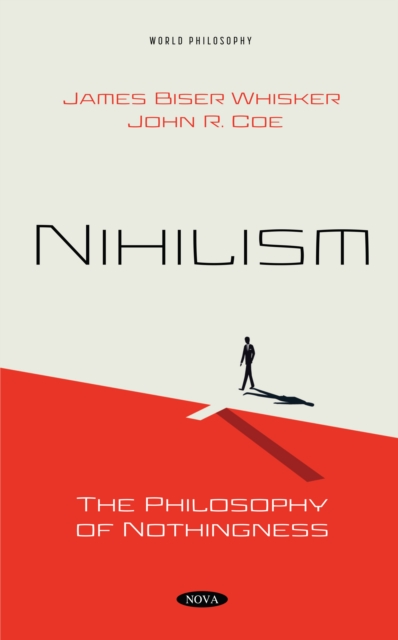
Nihilism: The Philosophy of Nothingness
Nihilism is a highly negative system of thought with roots in early Greek philosophy. It came into prominence as a major movement with Friedrich Nietzsche's unparalleled assault on Christianity and Christian morality. It became a dominant theme in the dark philosophical system known as existentialism, and thus became an important force in nineteenth century literature and in twentieth century ideologies. It seeks destruction of one or more aspects of society without offering a viable alternative, frequently assuming that the better world will automatically appear after the old world is obliterated. Loathing the building blocks of the present system, nihilism asserts that the better world will be composed of new, but unspecified, components. French philosophy during and after the French Revolution, and virtually all nineteenth century Russian literature, was dominated by nihilism. German Nazism had a nihilistic base which was carefully concealed by racist rantings. Marxism, with so many of its ideas stolen from Russian and French nihilists, proclaimed that faulty economics brought about misery and poverty which would be eradicated by the new but unspecified and undescribed socialist ethic. Revolutionary systems in the twentieth century have delved heavily into the rich trove of nihilist literature to promote, describe, and espouse revolutions which have marked much of that century. Few contemporary nihilists have offered any new insights into reality, choosing only to manipulate the basic concepts heretofore advanced. But the earlier nihilistic ideas have become an all-inspiring training primer for nihilists of future polities. To understand the philosophy of nihilism is to understand the revolutions that have continued to challenge modern societies.
eBook
