
Catalogue Search | MBRL


Are you sure you want to remove the book from the shelf?

{{itemTitle}}
171
result(s) for
"Whitmarsh, Tim"
Sort by:


Beyond the Second Sophistic
The \"Second Sophistic\" traditionally refers to a period at the height of the Roman Empire's power that witnessed a flourishing of Greek rhetoric and oratory, and since the 19th century it has often been viewed as a defense of Hellenic civilization against the domination of Rome. This book proposes a very different model. Covering popular fiction, poetry and Greco-Jewish material, it argues for a rich, dynamic, and diverse culture, which cannot be reduced to a simple model of continuity. Shining new light on a series of playful, imaginative texts that are left out of the traditional accounts of Greek literature, Whitmarsh models a more adventurous, exploratory approach to later Greek culture. Beyond the Second Sophistic offers not only a new way of looking at Greek literature from 300 BCE onwards, but also a challenge to the Eurocentric, aristocratic constructions placed on the Greek heritage. Accessible and lively, it will appeal to students and scholars of Greek literature and culture, Hellenistic Judaism, world literature, and cultural theory.
eBook

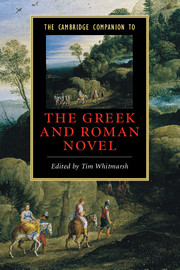
The Cambridge Companion to the Greek and Roman Novel
The Greek and Roman novels of Petronius, Apuleius, Longus, Heliodorus and others have been cherished for millennia, but never more so than now. The Cambridge Companion to the Greek and Roman Novel contains nineteen original essays by an international cast of experts in the field. The emphasis is upon the critical interpretation of the texts within historical settings, both in antiquity and in the later generations that have been and continue to be inspired by them. All the central issues of current scholarship are addressed: sexuality, cultural identity, class, religion, politics, narrative, style, readership and much more. Four sections cover cultural context of the novels, their contents, literary form, and their reception in classical antiquity and beyond. Each chapter includes guidance on further reading. This collection will be essential for scholars and students, as well as for others who want an up-to-date, accessible introduction into this exhilarating material.
eBook


Galen and the world of knowledge
\"This volume of new essays is based on a conference with the same title held at the University of Exeter in 2005. All those speaking on that occasion have written chapters in this volume, along with Riccardo Chiaradonna whose chapter has been specially prepared for the volume. The aim of this volume, like the conference on which it is based, is to contribute to the upsurge of new research on Galen by focusing on a topic that bridges the interests of specialists in ancient medical history and Classicists and philosophers more generally. The conference also represents the convergence of two current focuses of research in the Department of Classics and Ancient History at Exeter, on ancient medicine especially Galen and on Hellenistic and Imperial Greek culture more generally\"--Provided by publisher.
Book

LESS CARE, MORE STRESS: A RHYTHMIC POEM FROM THE ROMAN EMPIRE
This article considers a short text that was widely circulated in the mid- Roman Empire, in both a four-line and a six-line version, usually on gemstones. The text is a poem of sorts, but of a quite distinctive type. Part of it can be scanned according to the rules of classical (quantitative) metre, but more striking is the consistent rhythmic (stressed) pattern. Stressed poetry is not otherwise attested so early; this text may point to a substrate, now largely hidden from view, of popular verse that preceded the metrical revolutions of late antiquity and the Byzantine world. The poem is also a piece of visual artistry, designed to be looked at (particularly in its gemstone format). This hybrid status, between high art and popular culture, can also be detected in the content of the poem, which gestures towards both the poetics of intellectual elitism (using intertextual allusion, and dismissing the views of the masses) and a level of sexually aggressive assertion of embodied selfhood. It is a valuable witness to a form of middling literature (and a middling demographic), caught between aspirations to elite-style individuality and the mimetic imperative of an empire-wide consumer culture.
Journal Article

ATHEISTIC AESTHETICS: THE SISYPHUS FRAGMENT, POETICS AND THE CREATIVITY OF DRAMA
The famous Sisyphus fragment of a tragedy or satyr play is one of the best known documents of ancient atheism, proposing as it does a social-constructionist theory of the emergence of religion as a form of social control. This article argues that the fragment should be seen not just as a philosophical contribution to Presocratic and sophistic thought on the gods, but also as a work of theatrical poetics: it alludes to Hesiod's foundational role in the articulation of Greek theology, self-reflexively explores the role of the literary author in the creation of belief systems, and unpacks the specific role of the theatre in the manufacture of images of divinity, not just through acting but also through technical effects such as the bronteion.
Journal Article