
Catalogue Search | MBRL


Are you sure you want to remove the book from the shelf?

{{itemTitle}}
16
result(s) for
"Whybrow, Nicolas"
Sort by:

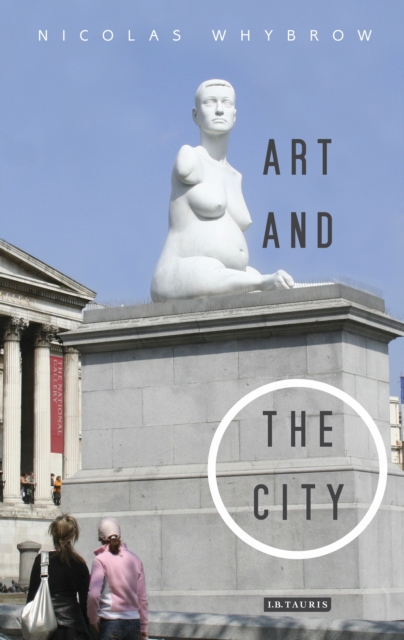
Art and the City
Henri Lefebvre predicted that the future of art was urban. Art and the City adopts this statement as its cue, taking into account the performative and relational 'turns' of art in more recent times. The book portrays what may be at stake in the emerging triangulation of art, the city and the rights of citizens, concentrating particularly on their mutual contingencies. It goes on to develop approaches to writing about artworks from the point of view of the spectator's first-hand encounter with them in urban contexts.In exploring how artworks present themselves as a means by which to navigate and plot the city for a writing interlocutor, Nicolas Whybrow discusses diverse examples, representing three key modern modalities of urban arts practice. The first, walking, involves works by Richard Wentworth, Francis Alys, Mark Wallinger and others. The second, play, includes art by Antony Gormley, Mark Quinn and Carsten Holler. The third, cultural memory, Whybrow addresses through the controversial urban holocaust memorial sites of Peter Eisenman's memorial in Berlin and Rachel Whiteread's in Vienna.
eBook


Folkestone perennial
Ostensibly contemporary art biennials seek to engage with the places that host them, yet frequently they are viewed critically as elitist ‘art world’ events that are disconnected from their localities. The aim of this article is to establish how public art works in a given context, both as part of a format prescribed by the art event and in its potential to intersect with the intricate, contingent and varied constellation of the urban location in question. It addresses this central tension by examining the case of Folkestone, a town on the south Kent coast in the United Kingdom that once enjoyed a thriving identity as both seaside resort and gateway to Europe. From the 1960s onwards, a gradual decline set in with the advent of mass global travel, culminating in the deathblow that was dealt by the nearby Eurotunnel’s inauguration towards century’s end, which signalled the end of the town’s ferry link to the continental mainland. A concerted attempt has been underway for a decade now to revitalise the town using the arts, creative industries and education as the drivers of regeneration. One of the main initiatives in this endeavour was the introduction in 2008 of the Folkestone Triennial, a 3-month summer event in which high-profile international artists were commissioned to produce sited artworks for the town, turning it into a form of urban gallery. With successive Triennials occurring in 2011 and 2014, and several works from all three being retained as permanent acquisitions, this article takes stock of the impact of these artistic engagements with the town, showing how, as an ensemble, they interact with one another and asking whether they have the capacity to contribute to a reconstituted identity for Folkestone in an integrated and lasting way.
Journal Article

‘The City of the Eye’: Urban Aesthetics and Surveillance in the City of Venice
Joseph Brodsky’s assertion in Watermark (1992) that Venice ‘is the city of the eye’, providing a sense of security and solace to inhabitants and visitors via the sheer aesthetic force of its surroundings, implicitly raises questions, in the context of the twenty-first-century city, about the performative nature of not only modern-day urban aesthetics but also surveillance in public space, both of which, as phenomena, are dependent on forms of visual observation. Taking into account contemporary Venice’s complex make-up in terms of its transient and permanent populations – tourists, economic migrants, and local residents – and the central issue facing the city of the gradual erosion of its historical infrastructure owing to excesses of commercialism and the material effects of flooding, in this article Nicolas Whybrow ponders the continuing role of aesthetics in an urban context. In particular, he considers how both Brodsky’s perception of the effects of the historical environment and contemporary instances of artistic intervention or engagement with the city – official (as part of the globally renowned Biennale) and unofficial (in the form of graffiti writing) – might position users of public space in the light of increased attempts to implement formal controls in the interests of security. Nicolas Whybrow is Associate Professor (Reader) and Head of Department in the School of Theatre, Performance, and Cultural Policy Studies at the University of Warwick. His most recent books are Art and the City (2011) and, as editor, Performing Cities (2014).
Journal Article
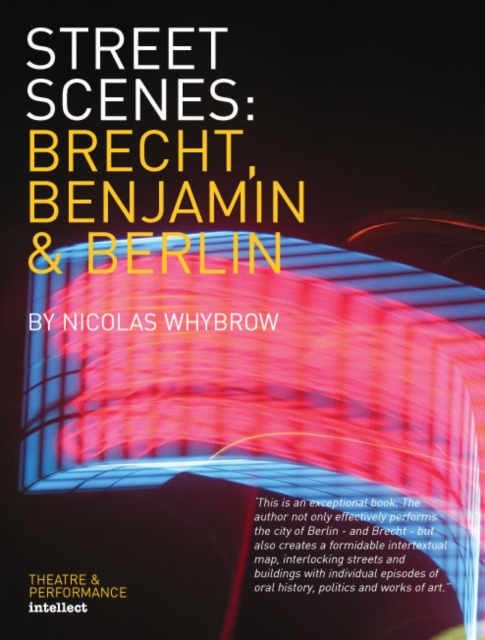
Street scenes
Always the focal point in modern times for momentous political, social and cultural upheaval, Berlin has continued, since the fall of the Wall in 1989, to be a city in transition. As the new capital of a reunified Germany it has embarked on a journey of rapid reconfiguration, involving issues of memory, nationhood and ownership. Bertolt Brecht, meanwhile, stands as one of the principal thinkers about art and politics in the 20th century. The 'Street Scene' model, which was the foundation for his theory of an epic theatre, relied precisely on establishing a connection between art's functioning and everyday life. His preoccupation with the ceaselessness of change, an impulse implying rupture and movement as the key characteristics informing the development of a democratic cultural identity, correlates resonantly with the notion of an ever-evolving city. Premised on an understanding of performance as the articulation of movement in space, Street Scenes interrogates what kind of 'life' is permitted to 'flow' in the 'new Berlin'. Central to this method is the flaneur figure, a walker of streets who provides detached observations on the revealing 'detritus of modern urban existence'. Walter Benjamin, himself a native of Berlin as well as friend and seminal critic of Brecht, exercised the practice in exemplary form in his portrait of the city One-Way Street.
eBook
Street Scene: Berlin's Strasse des 17 Juni and the Performance of (Dis)unity
One of Berlin's most prominent streets, named after the East German workers' uprising of 1953 (in which Brecht was controversially implicated), serves as the performative location for Nicolas Whybrow's topographical interrogation of the politics of German nationhood. Particular attention is given to the new parliament building, the Reichstag, which has been out of action for the majority of its troubled history. The article considers attempts to perform democracy and unity since the fall of the Wall through various mediations, including Norman Foster's refunctioning of the Reichstag, Christo's facilitation of its rebirth, and a permanent installation by Hans Haacke which rewrites the building's prominent inscription of 1916, ‘For the German People’. Finally, Whybrow places the annual ‘Love Parade’ in the context of the long history of mass marches and demonstrations on this particular street, and analyzes its claims to be a unifying political event. Based loosely on the Benjaminian flâneur figure's practice of a first-hand experience of the street, incorporating both subjective immersion and detached observation of the revealing ‘detritus of modern urban life’, various tensions and superimpositions are rendered visible as the city undergoes transformation since reunification. Nicolas Whybrow, whose book Street Scenes: Brecht, Benjamin, and Berlin is forthcoming, is Senior Lecturer in Theatre at De Montfort University, Leicester.
Journal Article