
Catalogue Search | MBRL


Are you sure you want to remove the book from the shelf?

{{itemTitle}}
24
result(s) for
"Whyte, Gregory P"
Sort by:

Fit in 5
The whys and hows of quick simple exercises, in easy, medium, and hard intensity levels, with and without exercise bands.
Book

Comparison of three current sets of electrocardiographic interpretation criteria for use in screening athletes
Background An increasing number of sporting bodies report unacceptably high levels of false-positive ECGs when undertaking pre-participation cardiac screening. To address this issue, modified ECG interpretation criteria have become available for use within athletes. Objective This study assessed the accuracy of the new 2014 ‘Refined Criteria’ against the 2013 Seattle Criteria and the 2010 European Society of Cardiology (ESC) recommendations in a cohort of Arabic, black and Caucasian athletes. Methods 2491 male athletes (1367 Arabic, 748 black and 376 Caucasian) undertook pre-participation screening including a 12-lead ECG, with further investigation(s) upon indication. Results Ten athletes (0.4%) were identified with cardiac pathology; seven with hypertrophic cardiomyopathy (HCM; five black and two Arabic) and three Arabs with Wolff–Parkinson–White syndrome (WPW). All three ECG criteria were 100% sensitive identifying all cases of HCM and WPW. The 2014 Refined Criteria reduced (p<0.0001) the prevalence of an abnormal ECG to 5.3% vs 11.6% (Seattle Criteria) and 22.3% (2010 ESC recommendations). The 2014 Refined Criteria significantly (p<0.0001) improved specificity (94.0%) across all ethnicities compared with the Seattle Criteria (87.5%) and ESC recommendations (76.6%). Black athletes continue to present a higher prevalence (p<0.0001) of abnormal ECGs compared with Arabic and Caucasian athletes (10% vs 3.6% and 2.1%). Conclusions The 2014 Refined Criteria for athlete ECG interpretation outperformed both the 2013 Seattle Criteria and the 2010 ESC recommendations by significantly reducing the number of false-positive ECGs in Arabic, black and Caucasian athletes while maintaining 100% sensitivity for serious cardiac pathologies.
Journal Article


ECG and morphologic adaptations in Arabic athletes: are the European Society of Cardiology's recommendations for the interpretation of the 12-lead ECG appropriate for this ethnicity?
Aims To examine the cardiac structure and function of Arabic athletes and to establish if the European Society of Cardiology (ESC) guidelines for the interpretation of an athlete's ECG are applicable to this ethnicity. Methods 600 high-level Arabic, 415 Black African, 160 Caucasian male athletes (exercising ≥6 h/week) and 201 Arabic controls presented for ECG and echocardiographic screening. Results 9 athletes (0.7%) were identified with a cardiac pathology associated with sudden cardiac death. Two Arabics (0.3%) and five Black Africans (1.2%) were diagnosed with hypertrophic cardiomyopathy; a prevalence four times greater in Black African compared to Arabic athletes. Arabic athletes had significantly greater (p<0.05) left ventricular (LV) end-diastolic diameters, maximal LV wall thicknesses and LV mass compared with controls; yet were significantly smaller than Black African and Caucasian athletes. The percentage of athletes demonstrating LV hypertrophy (≥12 mm) was comparable between Arabic, Black African and Caucasian populations (0.5%, 0.5% and 0.6%, respectively). There was no difference in the frequency of an uncommon and training-unrelated ECG between Arabic and Caucasian. However, Black Africans demonstrated a significantly greater prevalence than Arabic and Caucasian athletes (20% vs 8.4% and 6.9%, p<0.001); specifically more right/left atrial enlargement and T wave inversion. Conclusions Arabic athletes present significantly smaller cardiac dimensions than Black African and Caucasian athletes. There was no significant difference between the frequency of an uncommon and training-unrelated ECG between Arabic and Caucasian athletes. Therefore, the use of ESC guidelines for the interpretation of an athlete's ECG is clinically relevant and acceptable for use within Arabic athletes.
Journal Article

Challenges in Maintaining Emotion Regulation in a Sleep and Energy Deprived State Induced by the 4800Km Ultra-Endurance Bicycle Race; The Race Across AMerica (RAAM)
Multiday ultra-endurance races present athletes with a significant number of physiological and psychological challenges. We examined emotions, the perceived functionality (optimal-dysfunctional) of emotions, strategies to regulate emotions, sleep quality, and energy intake-expenditure in a four-man team participating in the Race Across AMerica (RAAM); a 4856km continuous cycle race. Cyclists reported experiencing an optimal emotional state for less than 50% of total competition, with emotional states differing significantly between each cyclist over time. Coupled with this emotional disturbance, each cyclist experienced progressively worsening sleep deprivation and daily negative energy balances throughout the RAAM. Cyclists managed less than one hour of continuous sleep per sleep episode, high sleep latency and high percentage moving time. Of note, actual sleep and sleep efficiency were better maintained during longer rest periods, highlighting the importance of a race strategy that seeks to optimise the balance between average cycling velocity and sleep time. Our data suggests that future RAAM cyclists and crew should: 1) identify beliefs on the perceived functionality of emotions in relation to best (functional-optimal) and worst (dysfunctional) performance as the starting point to intervention work; 2) create a plan for support sufficient sleep and recovery; 3) create nutritional strategies that maintain energy intake and thus reduce energy deficits; and 4) prepare for the deleterious effects of sleep deprivation so that they are able to appropriately respond to unexpected stressors and foster functional working interpersonal relationships. Key PointsCompleting the Race Across AMerica (RAAM); a 4856km continuous cycle race associated with sleep disturbance, an energy-deficient state, and experiencing intense unwanted emotions.Cyclists reported experiencing an optimal emotional state for less than 50% of total competition and actual sleep and sleep efficiency was better maintained during longer rest periods.We suggest that future RAAM cyclists and crew should:Identify individual beliefs on the perceived functionality of emotional states in relation to best (optimal) and worst (dysfunctional) performance as the starting point to identifying if emotion regulation strategies should be initiated.Plan for enhanced sleep and recovery not just plan and train for maintaining a high average velocity;Create nutritional strategies that maintain energy intake and thus reduce energy deficits;Psychologically prepare cyclists and crew for the deleterious effects of sleep deprivation so that they both are able to appropriately respond to unexpected stressors and foster functional interpersonal working relationships.
Journal Article
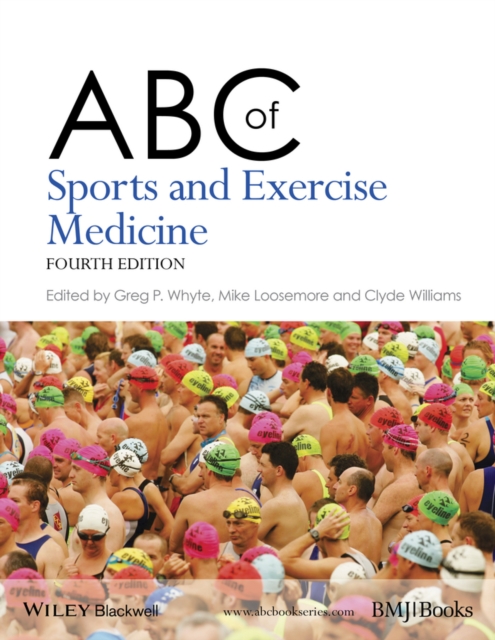
ABC of Sports and Exercise Medicine
The ABC of Sports and Exercise Medicine provides general practitioners with a comprehensive overview of the field of sports medicine. This highly illustrated and thoroughly revised and updated new edition: • Reflects new developments and current practice • Includes new chapters on medical care at sporting events, environmental factors of sports and exercise, benefits of exercise in health and disease, nutrition and ergogenic supplements, and the use of drugs in sport • Covers the benefits of exercise among special populations such as the disabled, obese, pregnant, children and the elderly Covering the latest topics and including case studies of common sports and exercise medicine conditions, the ABC of Sports and Exercise Medicine is an essential practical guide for general practitioners, family physicians, junior doctors, medical students, physiotherapists, and all health professionals dealing with the treatment and prevention of sports-related injuries.
eBook