
Catalogue Search | MBRL


Are you sure you want to remove the book from the shelf?

{{itemTitle}}
69
result(s) for
"Wick, Laura"
Sort by:

Midwifery and quality care: findings from a new evidence-informed framework for maternal and newborn care
In this first paper in a series of four papers on midwifery, we aimed to examine, comprehensively and systematically, the contribution midwifery can make to the quality of care of women and infants globally, and the role of midwives and others in providing midwifery care. Drawing on international definitions and current practice, we mapped the scope of midwifery. We then developed a framework for quality maternal and newborn care using a mixed-methods approach including synthesis of findings from systematic reviews of women's views and experiences, effective practices, and maternal and newborn care providers. The framework differentiates between what care is provided and how and by whom it is provided, and describes the care and services that childbearing women and newborn infants need in all settings. We identified more than 50 short-term, medium-term, and long-term outcomes that could be improved by care within the scope of midwifery; reduced maternal and neonatal mortality and morbidity, reduced stillbirth and preterm birth, decreased number of unnecessary interventions, and improved psychosocial and public health outcomes. Midwifery was associated with more efficient use of resources and improved outcomes when provided by midwives who were educated, trained, licensed, and regulated. Our findings support a system-level shift from maternal and newborn care focused on identification and treatment of pathology for the minority to skilled care for all. This change includes preventive and supportive care that works to strengthen women's capabilities in the context of respectful relationships, is tailored to their needs, focuses on promotion of normal reproductive processes, and in which first-line management of complications and accessible emergency treatment are provided when needed. Midwifery is pivotal to this approach, which requires effective interdisciplinary teamwork and integration across facility and community settings. Future planning for maternal and newborn care systems can benefit from using the quality framework in planning workforce development and resource allocation.
Journal Article

Maternal and child health in the occupied Palestinian territory
The Countdown to 2015 intervention coverage indicators in the occupied Palestinian territory are similar to those of other Arab countries, although there are gaps in continuity and quality of services across the continuum of the perinatal period. Since the mid 1990s, however, access to maternity facilities has become increasingly unpredictable. Mortality rates for infants (age ≤1 year) and children younger than 5 years have changed little, and the prevalence of stunting in children has increased. Living conditions have worsened since 2006, when the elected Palestinian administration became politically and economically boycotted, resulting in unprecedented levels of Palestinian unemployment, poverty, and internal conflict, and increased restrictions to health-care access. Although a political solution is imperative for poverty alleviation, sustainable development, and the universal right to health care, women and children should not have to wait. Urgent action from international and local decision makers is needed for sustainable access to high-quality care and basic health entitlements.
Journal Article

Perceived physical and psychosocial adaptations during the perinatal period in Palestinian women and men in a remote West Bank village: a qualitative study
Coverage and quality of postnatal care in the occupied Palestinian territory, and information about morbidities and challenges that families might face, remain inadequate despite its centrality to ensure maternal and infant health. In our planning of a postnatal home-visiting programme, we explored rural women's and men's views about physical and psychosocial adaptations before, during, and after childbirth in the Beit Liqya village situated in Area C (60% of the West Bank placed under undivided Israeli security and infrastructural control).
We undertook four focus groups with married women and one with married men of different ages in 2012, using an open-ended guide. Participants included 44 women (aged 21–70 years; nine were pregnant, four were childless, 31 were not pregnant and already had at least one child) and nine men (aged 24–71 years). Ethical approval was obtained and participants provided verbal consent. Data were analysed with thematic analysis.
The diversity of participants provided a rich perspective on societal changes. Five main themes emerged: transitions in men's paternal and spousal roles and women's lifestyles; the institutionalisation of childbirth; formally trained midwives and physicians replacing the village daya (a traditional birth attendant skilled through apprenticeship); psychosocial adaptation after birth; and views about health services. Nowadays, men participate more in pregnancy, childbirth, and post-partum family life than they previously did. However, the diet of women is reduced in nutrition; they are not as active during pregnancy because of reduced agricultural labour and are more focused on medical controls, such as frequent antenatal visits and laboratory tests. As noted by a woman that “[there are] too many antenatal visits, women do not eat breakfast, although there are many available options in houses these days, they eat unhealthy junk food”. The postpartum period was viewed as a crucial time for recovery with a need for strong family support. Female participants expressed a preference for female health-care providers.
Findings deepened our understanding of rural women's and families' needs and views regarding pregnancy, birth, and postpartum. Changes in the experiences of Palestinian women and men during the perinatal period should inform changes to policy and practices to tailor accessible and effective community programmes that are responsive to these families' needs and of those in other marginalised populations.
The Theodor-Springmann Foundation.
Journal Article

A cross sectional study of maternal ‘near-miss’ cases in major public hospitals in Egypt, Lebanon, Palestine and Syria
Background
The maternal near-miss approach has been increasingly used as a tool to evaluate and improve the quality of care in maternal health. We report findings from the formative stage of a World Health Organization (WHO) funded implementation research study that was undertaken to collect primary data at the facility level on the prevalence, characteristics, and management of maternal near-miss cases in four major public referral hospitals - one each in Egypt, Lebanon, Palestine and Syria.
Methods
We conducted a cross sectional study of maternal near-miss cases in the four contexts beginning in 2011, where we collected data on severe maternal morbidity in the four study hospitals, using the WHO form (Individual Form HRP A65661). In each hospital, a research team including trained hospital healthcare providers carried out the data collection.
Results
A total of 9,063 live birth deliveries were reported during the data collection period across the four settings, with a total of 77 cases of severe maternal outcomes (71 maternal near-miss cases and 6 maternal deaths). Higher indices for the maternal mortality index were found in both Al Galaa hospital, in Egypt (8.6 %) and Dar Al Tawleed hospital in Syria (14.3 %), being large referral hospitals, compared to Ramallah hospital in Palestine and Rafik Hariri University hospital in Lebanon. Compared to the WHO’s Multicountry Survey using the same data collection tool, our study’s mortality indices are higher than the index of 5.6 % among countries with a moderate maternal mortality ratio in the WHO Survey. Overall, haemorrhage-related complications were the most frequent conditions among maternal near-miss cases across the four study hospitals. In all hospitals, coagulation dysfunctions (76.1 %) were the most prevalent dysfunction among maternal near-miss cases, followed by cardiovascular dysfunctions. The coverage of key evidence-based interventions among women experiencing a near-miss was either universal or very high in the study hospitals.
Conclusions
Findings from this formative stage confirmed the need for quality improvement interventions. The high reported coverage of the main clinical interventions in the study hospitals would appear to be in contradiction with the above findings as the level of coverage of key evidence-based interventions was high.
Journal Article
Health in the Occupied Palestinian Territory 2 Maternal and child health in the occupied Palestinian territory
The Countdown to 2015 intervention coverage indicators in the occupied Palestinian territory are similar to those of other Arab countries, although there are gaps in continuity and quality of services across the continuum of the perinatal period. Since the mid 1990s, however, access to maternity facilities has become increasingly unpredictable. Mortality rates for infants (age ≤1 year) and children younger than 5 years have changed little, and the prevalence of stunting in children has increased. Living conditions have worsened since 2006, when the elected Palestinian administration became politically and economically boycotted, resulting in unprecedented levels of Palestinian unemployment, poverty, and internal conflict, and increased restrictions to health-care access. Although a political solution is imperative for poverty alleviation, sustainable development, and the universal right to health care, women and children should not have to wait. Urgent action from international and local decision makers is needed for sustainable access to high-quality care and basic health entitlements. [PUBLICATION ABSTRACT]
Journal Article
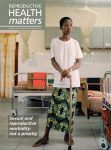
No safe place for childbirth: women and midwives bearing witness, Gaza 2008–09
Abstract Women seek to give birth in a place where they feel safe, protected and secure. However, in conflict settings, many are forced to give birth in dangerous and frightening situations, where even the most rudimentary help and protection is unavailable. This study, based on interviews with women who gave birth and midwives during the 22-day Israeli attack on Gaza in December 2008 – January 2009, illustrates the vulnerability and trauma women experience when there is no safe place for childbirth. They recounted their overwhelming fear of not knowing when they would go into labour, not reaching a hospital or skilled attendant during the bombing, complications in labour without emergency care, and fear for the safety of their families and being separated from them. Most of the midwives were unprepared both materially and psychologically to attend births outside a hospital setting, while physicians were overwhelmed with severely injured patients. The capacity of midwifery care to keep birth normal whenever possible is particularly crucial in situations of political instability, conflict, poverty and disaster. Planning for emergency care by mapping the location of midwives, supplying them with basic equipment and medications, and legitimizing their profession with an appropriate scope of practice, licensing, back-up, and incentives would facilitate their ability to respond to birthing women's needs.
Journal Article

Evoking the Guardian Angel: Childbirth Care in a Palestinian Hospital
The purpose of this study was to assess the quality of maternity care in a large, public, Palestinian referral hospital, as a first step in developing interventions to improve safety and quality of maternity care. Provider interviews, observation and interviews with women were used to understand the barriers to improved care and prepare providers to be receptive to change. Some of the inappropriate practices identified were forbidding female labour companions, routine use of oxytocin to accelerate labour, restriction of mobility during labour and frequent vaginal examinations. Magnesium sulfate was not used for pre-eclampsia or eclampsia, and post-partum haemorrhage was a frequent occurrence. Severe understaffing of midwives, insufficient supervision and lack of skills led to inadequate care. Use of evidence-based practices which promote normal labour is critical in settings where resources are scarce and women have large families. The report of this assessment and dissemination meetings with providers, hospital managers, policymakers and donors were a reality check for all involved, and an intervention plan to improve quality of care was approved. In spite of the ongoing climate of crisis and whatever else may be going on, women continue to give birth and to want kindness and good care for themselves and their newborns. This is perhaps where the opportunity for change should begin.
Cette étude souhaitait évaluer la qualité des soins obstétricaux dans un grand hôpital public palestinien, pour préparer des interventions destinées à améliorer la sécurité et la qualité des soins obstétricaux. Des entretiens avec le personnel de santé, l'observation et des entretiens avec des femmes ont permis de cerner les obstacles à l'amélioration des soins et de préparer les prestataires à être réceptifs au changement. L'interdiction des accompagnantes pendant l'accouchement, l'utilisation généralisée d'ocytocine pour accélérer le travail, la restriction de la mobilité de la parturiente et la fréquence des examens vaginaux figuraient au nombre des pratiques impropres. Le sulfate de magnésium n'était pas utilisé pour la pré-éclampsie ni pour l'éclampsie, et les hémorragies du post-partum étaient fréquentes. Une grave pénurie de sages-femmes, la supervision insuffisante et le manque de compétences conduisaient à des soins inadaptés. L'utilisation de pratiques à base factuelle qui encouragent le travail normal est essentielle dans les milieux pauvres en ressources et où les femmes ont de nombreux enfants. Le rapport de cette évaluation et les réunions avec les prestataires de soins, les administrateurs hospitaliers, les décideurs et les donateurs ont montré la réalité à toutes les parties prenantes, et un plan d'intervention pour améliorer la qualité des soins a été approuvé. En dépit du climat actuel de crise, et quels que soient les événements qui les entourent, les femmes continuent d'accoucher et de vouloir des soins de qualité, à l'écoute des mères et des nouveau-nés. C'est peut-être là que doit commencer le changement.
El propósito de este estudio fue evaluar la calidad de la atención de maternidad en un importante hospital público de referencia palestino, como el primer paso para formular intervenciones a fin de mejorar la seguridad y calidad de la atención de maternidad. Se realizaron entrevistas con los prestadores de servicios, observaciones y entrevistas con las mujeres para entender las barreras a una mejor atención y preparar a los prestadores de servicios para estar abiertos al cambio. Algunas de las prácticas indebidas encontradas fueron la prohibición de acompañantes durante el parto, el uso rutinario de oxitocina para acelerar el parto, la restricción de movilidad durante el parto y exámenes vaginales frecuentes. No se utilizó el sulfato de magnesio para preeclampsia o eclampsia, y la hemorragia posparto fue una complicación frecuente. La gran escasez de parteras, supervisión insuficiente y falta de habilidades propiciaron una prestación de atención inadecuada. El uso de prácticas basadas en evidencia que promuevan el parto normal es fundamental en lugares donde escasean los recursos y las mujeres tienen familias grandes. El informe de esta evaluación y las reuniones de difusión con prestadores de servicios, administradores de hospitales, formuladores de políticas y donantes fueron una revisión de la realidad para todas las partes implicadas, y se aprobó el plan de intervención para mejorar la calidad de la atención. Pese al clima continuo de crisis y los demás factores implícitos, las mujeres continúan dando a luz y desean recibir una atención amable y de calidad para ellas y sus recién nacidos. He aquí donde debe comenzar la oportunidad para realizar cambios.
Journal Article

The limitations on choice: Palestinian women's childbirth location, dissatisfaction with the place of birth and determinants
Background: Analysing the Palestinian Central Bureau of Statistics (PCBS) Demographic and Health Survey 2004 (DHS-2004) data, this article focuses on the question of where women living in the Occupied Palestinian Territory give birth, and whether it was the preferred/place of choice for delivery. We further identify some of the determinants of women's dissatisfaction with childbirth location. Methods: A total of 2158 women residing in the West Bank and Gaza Strip were included in this study. Regression analysis established the association between dissatisfaction with the place of birth and selected determinants. Results: A total of 3.5% of women delivered at home, with the rest in assisted facilities. Overall, 20.5% of women reported that their childbirth location was not the preferred place of delivery. Women who delivered at home; in governmental facilities; in regions other than the central West Bank; who had sudden delivery or did not reach their preferred childbirth location because of closures and siege; because of costs/the availability of insurance; or because there were no other locations available, were significantly more likely to be dissatisfied with their childbirth location compared to those who birthed in private facilities, the central West Bank, and in locations with better and more available services. Conclusion: The findings demonstrate that Palestinian women's choice of a place of birth is constrained and modified by the availability, affordability, and limited access to services induced by continuing closures and siege. These findings need to be taken into consideration when planning for maternity services in the Occupied Palestinian Territory.
Journal Article

In search of health: quality of life among postpartum Palestinian women
Objectives: The postpartum period is a very important period for the health of the mother and the newborn. Despite its importance, research on this period is limited and tends to be more focused on biomedical aspects of the postpartum period. In the Occupied Palestinian Territory, little is known regarding women's postpartum wellbeing. This study utilizes the Maternal Postpartum Quality-of-Life instrument to assess Palestinian women's postpartum quality of life and the factors associated with variations in their quality-of-life scores. Methods: A cross-sectional survey utilizing the adapted Maternal Postpartum Quality-of-Life Questionnaire was completed in the Occupied Palestinian Territory with a final sample size of 1020 women. Results: The mean overall quality-of-life score for the sample was 21.53 (maximum = 30), suggesting that women are slightly satisfied with their lives in the postpartum period. Main variations in quality-of-life scores were associated with regional district, refugee status, the loss of a relative due to Israeli occupation violence, standard of living and pregnancy wantedness. Conclusion: The results of this study highlight the diversity and complexity of the social context, in particular the region where women live, and the issue of pregnancy wantedness in postpartum quality of life. They also call into question the services currently offered to postpartum women.
Journal Article

Health sector reform in the Occupied Palestinian Territories (OPT): targeting the forest or the trees?
Since the signing of the Oslo Peace Accords and the establishment of the Palestinian Authority in 1994, reform activities have targeted various spheres, including the health sector. Several international aid and UN organizations have been involved, as well as local and international non-governmental organizations, with considerable financial and technical investments. Although important achievements have been made, it is not evident that the quality of care has improved or that the most pressing health needs have been addressed, even before the second Palestinian Uprising that began in September 2000. The crisis of the Israeli re-invasion of Palestinian-controlled towns and villages since April 2002 and the attendant collapse of state structures and services have raised the problems to critical levels. This paper attempts to analyze some of the obstacles that have faced reform efforts. In our assessment, those include: ongoing conflict, frail Palestinian quasi-state structures and institutions, multiple and at times inappropriate donor policies and practices in the health sector, and a policy vacuum characterized by the absence of internal Palestinian debate on the type and direction of reform the country needs to take. In the face of all these considerations, it is important that reform efforts be flexible and consider realistically the political and economic contexts of the health system, rather than focus on mere narrow technical, managerial and financial solutions imported from the outside.
Journal Article