
Catalogue Search | MBRL


Are you sure you want to remove the book from the shelf?

{{itemTitle}}
395
result(s) for
"Wickham, Chris"
Sort by:

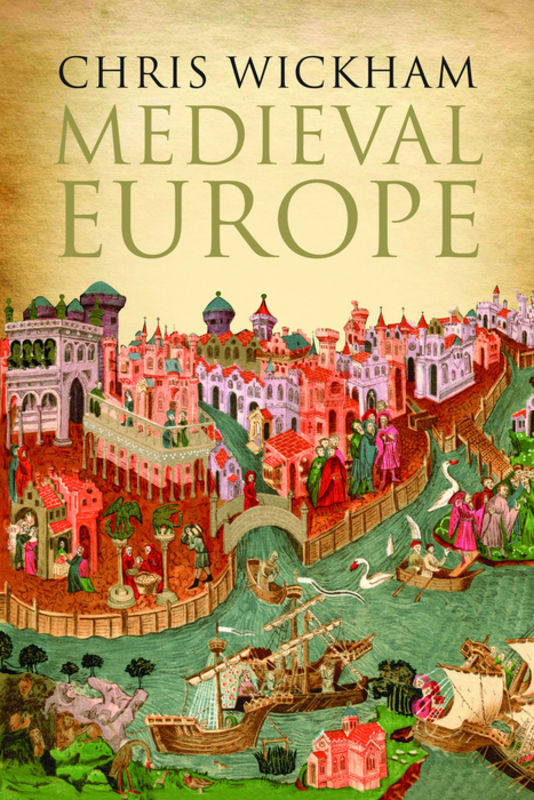
Medieval Europe
A spirited history of the changes that transformed Europe during the 1,000-year span of the Middle Ages: \"A dazzling race through a complex millennium.\"— Publishers Weekly
The millennium between the breakup of the western Roman Empire and the Reformation was a long and hugely transformative period—one not easily chronicled within the scope of a few hundred pages. Yet distinguished historian Chris Wickham has taken up the challenge in this landmark book, and he succeeds in producing the most riveting account of medieval Europe in a generation.
Tracking the entire sweep of the Middle Ages across Europe, Wickham focuses on important changes century by century, including such pivotal crises and moments as the fall of the western Roman Empire, Charlemagne's reforms, the feudal revolution, the challenge of heresy, the destruction of the Byzantine Empire, the rebuilding of late medieval states, and the appalling devastation of the Black Death. He provides illuminating vignettes that underscore how shifting social, economic, and political circumstances affected individual lives and international events—and offers both a new conception of Europe's medieval period and a provocative revision of exactly how and why the Middle Ages matter.
\"Far-ranging, fluent, and thoughtful—of considerable interest to students of history writ large, and not just of Europe.\"— Kirkus Reviews, (starred review)
Includes maps and illustrations
eBook

Sleepwalking into a new world : the emergence of Italian city communes in the twelfth century
Sleepwalking into a new world reveals how the development of the autonomous city-state took place, which would in the end make possible the robust civic adventure of the renaissance.
Book
Risposta
Questo contributo risponde ai commenti e alle critiche al mio libro L’asino e il battello da parte di Fabio Saggioro, Andrea Augenti, Philippe Sénac, Giuseppe Petralia e Sergio Tognetti. Il testo intende sviluppare la discussione, tra gli altri temi, sull’uso dei dati archeologici per la storia economica e sulle principali linee di sviluppo economico medievale.
Journal Article

Medieval Europe
\"The millennium between the breakup of the western Roman Empire and the Reformation was a long and hugely transformative period--one not easily chronicled within the scope of a few hundred pages. Yet distinguished historian Chris Wickham has taken up the challenge in this landmark book, and he succeeds in producing the most riveting account of medieval Europe in a generation. Tracking the entire sweep of the Middle Ages across Europe, Wickham focuses on important changes century by century, including such pivotal crises and moments as the fall of the western Roman Empire, Charlemagne's reforms, the feudal revolution, the challenge of heresy, the destruction of the Byzantine Empire, the rebuilding of late medieval states, and the appalling devastation of the Black Death. He provides illuminating vignettes that underscore how shifting social, economic, and political circumstances affected individual lives and international events. Wickham offers both a new conception of Europe's medieval period and a provocative revision of exactly how and why the Middle Ages matter\"-- Provided by publisher.
Book

The Power of Property: Land Tenure in Fāṭimid Egypt
Abstract
Egyptian land tenure in the Fāṭimid period (969-1171) is often assumed to have been based on state ownership of agricultural land and tax-farming, as was in general the case in the Mamlūk period which followed it, and as many Islamic legal theorists rather schematically thought. This article aims to show that this was not the case; Arabic paper and parchment documents show that private landowning was normal in Egypt into the late eleventh century and later. Egypt emerges as more similar to other Mediterranean regions than is sometimes thought. The article discusses the evidence for this, and the evidence for what changed after 1100 or so, and, more tentatively, why it changed.
Journal Article

The Peasant Mode of Production Twenty Years Later: A Reply
In this brief critical response, Chris Wickham revisits the peasant mode for the first time since FEMA and discusses its continuing utility as a theoretical tool in the light of the arguments, revisions and challenges counterposed here.
Journal Article

THE ‘FEUDAL REVOLUTION’ AND THE ORIGINS OF ITALIAN CITY COMMUNES
This article takes two major moments of social change in central medieval Europe, the ‘feudal revolution’ in France and the origins of Italian city communes, in order to see what they have in common. They are superficially very different, one rural one urban, and also one whose analysts focus on the breakdown of political power and the other on its construction or reconstruction; but there are close parallels between the changes which took place in France around 1000 or 1050 and those which took place in Italy around 1100. The contrast in dates does not matter; what matters is that in each case larger-scale political breakdown (whether at the level of the kingdom or the county) was matched by local recomposition, the intensification or crystallisation of local power structures which had been much more ad hoc before, and which would be the basic template for local power henceforth. In Italy, the main focus of the article, the different experiences of Pisa and Genoa are compared, and the development of urban assemblies first, consular collectives second, communal institutions third, are all analysed from this perspective, as guides to how the city communes of the peninsula developed, however haltingly and insecurely. The article finishes with a brief comment on the sociology of Pierre Bourdieu.
Journal Article
El modo de producción campesino veinte años después: una respuesta crítica
En esta breve respuesta crítica, Chris Wickham revisita el modo campesino por primera vez desde FEMA y analiza su continua utilidad como herramienta teórica a la luz de los argumentos, revisiones y desafíos que se contraponen en este monográfico.
Journal Article
Intervista a Chris Wickham. A cura di Maria Elena Cortese e Charles West
L’intervista ripercorre la formazione, la carriera accademica, i rapporti con la comunità scientifica internazionale, i principali temi che caratterizzano l’ampia produzione storiografica di Chris Wickham, nonché il suo impegno politico e le sue esperienze nel campo della valutazione della ricerca e dell’editoria scientifica.
Journal Article