
Catalogue Search | MBRL


Are you sure you want to remove the book from the shelf?

{{itemTitle}}
6
result(s) for
"Wilcox, Sherman author"
Sort by:


Ten lectures on cognitive linguistics and the unification of spoken and signed languages
In Ten Lectures on Cognitive Linguistics and the Unification of Spoken and Signed Languages Sherman Wilcox suggests that rather than abstracting away from the material substance of language, linguists can discover the deep connections between signed and spoken languages by taking an embodied view.
eBook

The Phonetics of Fingerspelling
We now know that natural signed languages such as American Sign Language, French Sign Language, British Sign Language and others are fully independent languages. But natural signed languages are only one way of conveying language in the visual/gestural modality. Signed languages also have mechanisms for representing the material of oral languages. Fingerspelling is one example of such a representational system. This book examines fingerspelling from a phonetic perspective. Several studies of the kinematics of fingerspelling articulators are reported. From these detailed analyses of articulator timings and velocities, conclusions are drawn which suggest that, like speech, fingerspelling may be explained in terms of coordinative structures and task dynamics. The thrust of the book is to explore the notion that signed and spoken languages can be compared not only as abstract linguistic systems but also at the physical level as dynamically structured articulations. An implication of these studies is that a common basis in gesture can be found for the production, perception, and neural organization of signed and spoken languages.
eBook
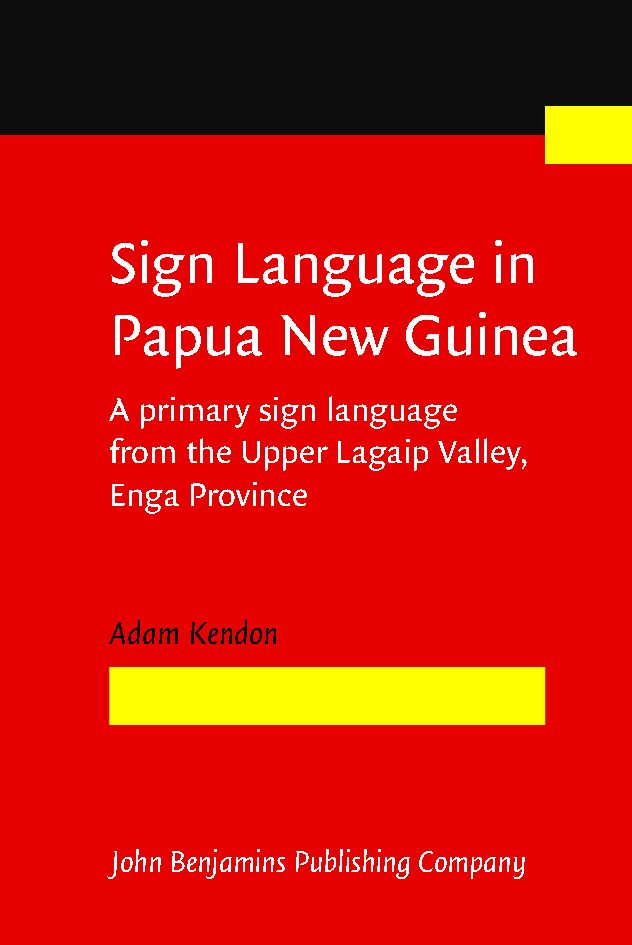
Sign Language in Papua New Guinea
This book presents in revised form and as a single monograph three papers on a sign language from the Enga Province of Papua New Guinea. Originally published in 1980, for more than twenty years these papers remained the only report of a sign language from that part of the world. The detailed descriptive analyses that the author provided are still fresh today, and in some respects they anticipate insights into the nature of sign languages that were not further explored until much more recently. The monograph is accompanied by two essays: Sherman Wilcox comments on value and relevance of the author's work in the light of much more recent work on the linguistics of sign languages. An essay by Lauren Reed and Alan Rumsey provides an up to date survey of what is now known about sign languages in Papua New Guinea. Information about sign languages in the Solomon Island is also included.
eBook
Cultural, psychological and typological issues in cognitive linguistics : selected papers of the bi-annual ICLA meeting in Albuquerque, July 1995
Cognitive linguistics is nothing if not an interdisciplinary and comparative enterprise. This collection addresses both the implications OF and the implications FOR cognitive linguistics of psycholinguistic, computational, neuroscientific, cross-cultural and cross-linguistic research.
eBook

The Cambridge Handbook of Language Policy
Over the last 50 years, language policy has developed into a major discipline, drawing on research and practice in many nations and at many levels. This is the first Handbook to deal with language policy as a whole and is a complete 'state-of-the-field' survey, covering language practices, beliefs about language varieties, and methods and agencies for language management. It provides a historical background which traces the development of classical language planning, describes activities associated with indigenous and endangered languages, and contains chapters on imperialism, colonialism, effects of migration and globalization, and educational policy. It also evaluates language management agencies, analyzes language activism and looks at language cultivation (including reform of writing systems, orthography and modernized terminology). The definitive guide to the subject, it will be welcomed by students, researchers and language professionals in linguistics, education and politics.
eBook