
Catalogue Search | MBRL


Are you sure you want to remove the book from the shelf?

{{itemTitle}}
20
result(s) for
"Willmot, Helen"
Sort by:

Family futures : childhood and poverty in urban neighbourhoods
Family futures is about family life in areas of concentrated poverty and social problems where surrounding conditions make bringing up children more difficult and family life is more fraught and limited. This book is based on a longitudinal study of more than 200 families interviewed annually over the last decade. It answers three important questions in the works of families themselves: What challenges face families in poor areas? How are the challenges being met? Have government efforts helped or hindered progress over the past decade?--From cover, [p]. 4.
Book

A more equal society?
This major new book provides, for the first time, a detailed evaluation of policies on poverty and social exclusion since 1997, and their effects. Bringing together leading experts in the field, it considers the challenges the government has faced, the policies chosen and the targets set in order to assess results. Drawing on research from the Centre for Analysis of Social Exclusion, and on external evaluations, the book asks how children, older people, poor neighbourhoods, ethnic minorities and other vulnerable groups have fared under New Labour and seeks to assess the government both on its own terms - in meeting its own targets - and according to alternative views of social exclusion.
eBook

The processes of implementing and sustaining an intensive volunteer one-to-one support (doula) service for disadvantaged pregnant women
'Doulas' (lay women who are trained to support other women during pregnancy, birth and postnatally) can improve outcomes for disadvantaged mothers and babies. This 'realistic evaluation' study uses qualitative interviews to explore the views of staff, commissioners and local champions about the processes of implementing and sustaining five volunteer doula support projects in England. The six key factors in their successful implementation are: meeting local commissioning priorities; staff commitment, expertise and skills; networking with other agencies; defining and marketing the doula role; providing strong support for volunteers; and having some costs absorbed by others. The four key factors in sustaining the projects are: finding ways to balance the numbers of referrals and volunteers; shaping the service to local service drivers; ongoing networking; and responding creatively to funding shortfalls. It is a constant challenge to balance the rate of referrals and the number of trained volunteers within tight budgets and timescales.
Journal Article
Bringing up families in poor neighbourhoods under New Labour
The Social Exclusion Unit (SEU) recognised the centrality of area conditions in holding back families and particularly children and young people from opportunities; it advocated a broad set of targets to reduce deprivation within disadvantaged areas and most importantly it recognised the complexities and interlocking problems of the worst areas.
As the range of area initiatives multiplied and hit the ground, there were complaints from local authorities and within Whitehall that 'initiativitis' had got out of control, which has led to a scaling back in area-specific programmes. This makes it crucial for us to understand what is really happening within areas, whether programmes and interventions really matter and whether mothers and their children - arguably the most vulnerable to any failures - benefit or not. This is the focus of our chapter.
The chapter begins by examining two areas of government action targeted at the population at large, but with potentially greater impact in the most disadvantaged areas where the problems are most severe (see also Chapter Six of this volume): employment and education (see also Chapters Two and Three of this volume). We then look at three initiatives that are targeted at deprived areas, although sometimes they can also apply more generally: New Deal for Communities and Sure Start (see also Chapter Seven); community policing and neighbourhood wardens; and community participation and empowerment (see also Chapter Five). There are many problems we have not discussed, such as social exclusion as a process in and of itself. We chose areas of government action with directly visible outcomes to see whether the families recognised and valued these interventions.
Book Chapter
Families, education and the 'participatory imperative'
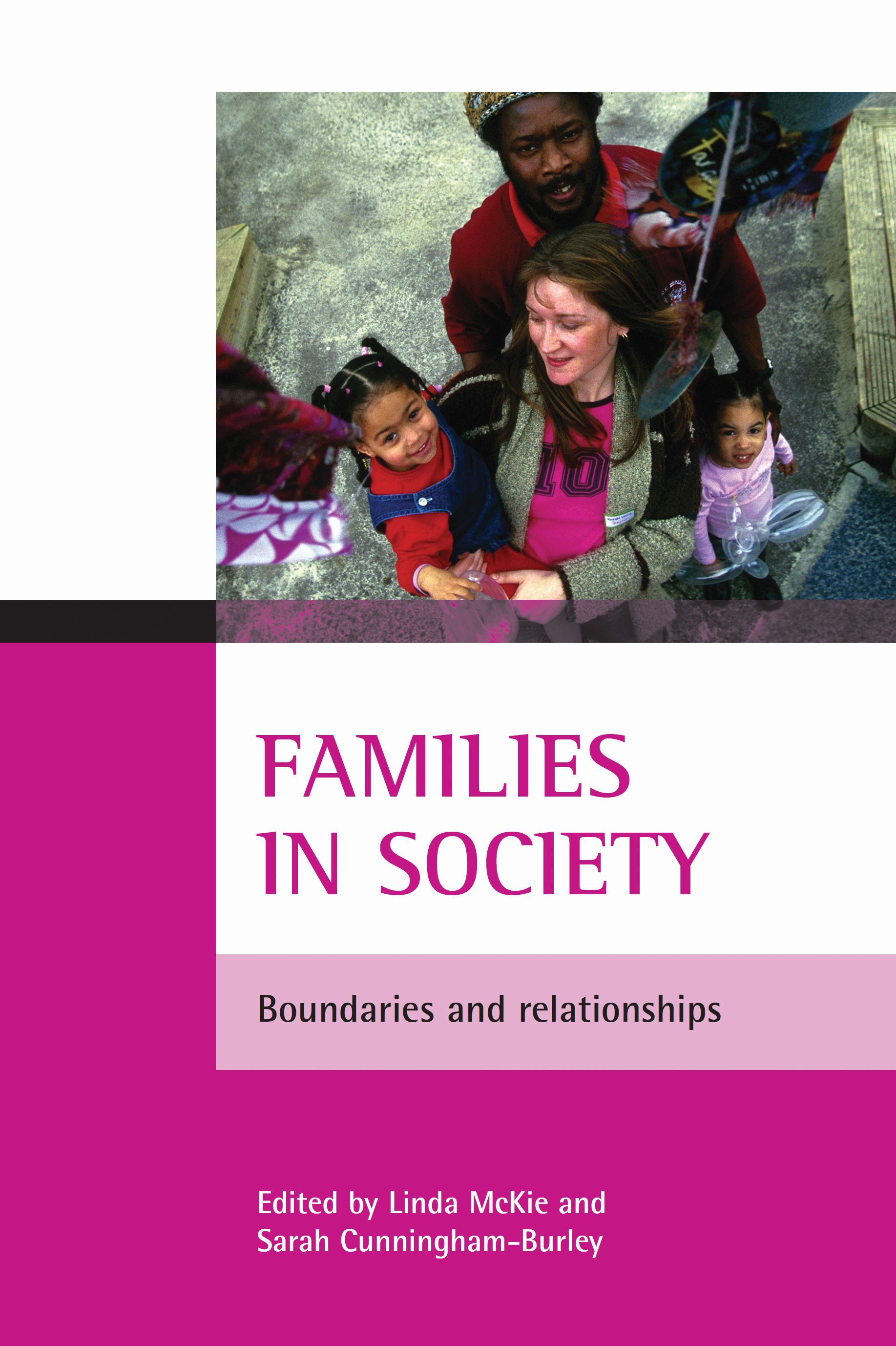
This chapter takes up the boundary metaphor through an exploration of the relationships between families and education services. It explores the 'push and pull' around the boundaries between families and professional educators. The study involved 19 adult members of working-class families. Based on the study, this chapter considers how boundaries between school and home have shifted seemingly in respect of the school's power to dictate aspects of childrearing, domestic timetables and parenting practices. However, parents still reserved a space around the boundary where they felt free to demand appropriate standards of care and concern for their child; for example, on issues of bullying or healthcare. Boundaries between families and school have often been identified as crucial elements in educational and related social policies.
Book Chapter

Bringing up families in poor neighbourhoods under New Labour
For five years, the lives of the 200 families in four of the most deprived areas in the country have been traced. Every year, the authors of this chapter visit the families and record their changing views and experiences on child-raising in difficult and unpopular neighbourhoods. The four areas, two in East London and two in Yorkshire were chosen from the twelve representative deprived areas that were examined in an attempt to understand the changing fortunes of such places. Three of the four places were rapidly changing and becoming more ethnically diverse while the other area comprises almost entirely white large council estates in Leeds. After the ascension to office of New Labour in 1997, the new Prime Minister introduced a new approach to the joined up problems by calling up for joined up solutions. Under the Prime Minister, a new unit that tackled social exclusion was set up. The Social Exclusion Unit (SEU) recognised the centrality of area conditions in holding back families and particularly children and young people from opportunities, and advocated broad targets that would reduce deprivation within disadvantaged areas. However, as the area of initiatives multiplied, complaints from local authorities and within Whitehall emerged. This chapter focuses on what is really happening within the four deprived areas, whether programmes and interventions really matter, and whether mothers and their children benefit or not from the policies targeted at deprived and marginalised groups. The first section discusses the two areas of government action targeted at the entire population, but with greater emphasis on deprived areas where the problems are most severe: education and employment. The succeeding sections focus on the three initiatives that are specifically targeted at deprived areas: New Deal for Communities and Sure Start; community participation and empowerment; and community policing and neighbourhood wardens.
Book Chapter
