
Catalogue Search | MBRL


Are you sure you want to remove the book from the shelf?

{{itemTitle}}
11
result(s) for
"Wilson, H. James, author"
Sort by:

Human + machine : reimagining work in the age of AI
Artificial intelligence (AI) is transforming how we work right now. Are you ready? In the past, robots were typically large pieces of machinery, sectioned off from human workers to perform precise, mechanical tasks on an assembly line. But now, bots and other AI technologies go far beyond this in augmenting human capabilities--not just robots on the factory floor of an auto plant, but algorithms in the back office of a healthcare insurer and chatbots interacting with retail customers. Unlike any software tool or service that's come before, artificial intelligence has the power to profoundly change the very nature of work itself--and this is happening in all kinds of enterprises and across all functions of the organization. There's a current and growing imperative: businesses that understand how to harness AI can surge ahead, while those who neglect it are in danger of being left behind. In Human + Machine, Accenture technology leaders H. James Wilson and Paul R. Daugherty vividly illustrate how AI is redefining work and the economy. At the core of this paradigm shift is the transformation of business processes--all the step-by-step tasks that take place within an organization, from operations to customer service to workers' own personal productivity habits. As humans and smart machines collaborate ever more closely, work processes become more fluid and adaptive, enabling companies to change them on the fly--or completely reimagine them.-- Provided by publisher
BOOK

Religion and American politics : from the colonial period to the present
How do religion and politics interact in America? How has that relationship changed over time? Why have American religious and political thought sometimes developed along a parallel course while at other times they have moved in opposite directions? These are among the many questions addressed in this volume. Originally published in 1990 as Religion and American Politics: From The Colonial Period to the 1980s, this book offers a survey of the relationship between religion and politics in America. It features scholars including Richard Carwardine, Nathan Hatch, Daniel Walker Howe, George Marsden, Martin Marty, Harry Stout, John Wilson, Robert Wuthnow, and Bertram Wyatt-Brown. Since its publication, the influence of religion on American politics—and, therefore, interest in the topic—has grown exponentially. For this new edition, the editors offer a completely new introduction, and have also commissioned several new pieces, eliminating those that are now out of date. The resulting book offers a historically grounded approach to one of the most divisive issues of our time.
eBook
The new entrepreneurial leader
In years past, the keywords for leaders were confidence, single-minded purpose, and strategic planning. But today's vastly complex, globalized, and fast-evolving world requires a different kind of leadership. This game-changing book details a new approach—entrepreneurial leadership—developed at Babson College, the number-one school for entrepreneurship in the world. Entrepreneurial leadership is inspired by, but is separate from, entrepreneurship. It can be applied in any organizational situation, not just start-ups. Based on two years of extensive research, it embraces three principles that add up to a fundamentally new worldview of business and a new logic of decision making. First, rapid change and increasing uncertainty require leaders to be “cognitively ambidextrous,” able to shift between traditional “prediction logic” (choosing actions based on analysis) and “creation logic” (taking action despite considerable unknowns). Guiding this different way of thinking and acting is a new view of business, where simultaneous creation of social, environmental, and economic value is the order of the day. Finally, entrepreneurial leaders leverage their understanding of themselves and their social context to guide effective action. Each chapter offers concrete examples of how educators across all disciplines are integrating these ideas into their courses—and even their entire curricula. The New Entrepreneurial Leader lays out a comprehensive new paradigm for reinventing management education in order to mold leaders who will shape social and economic opportunity.
eBook


THE FIRST KREMLINOLOGIST
The wisdom that Krizhanich prescribes is largely secular and practical, derived more from the contemporary experience of other rulers than from the classical or Christian past. If he wants a mercantilist national control over foreign trade, he advocates far greater decentralization and reliance on market forces internally. He sees generating an agricultural surplus as a key ingredient in economic development, but he attaches the greatest importance of all to Russia's human resources and the need to acquire knowledge from ''dead advisors'' (books) and skills from live ones (foreign masters); he insists that ''the time has come for our nation to study.'' To free the Russian people from their lethargy, drunkenness and penchant for lying (all pungently described) they need better laws and more responsible intermediate authorities between czar and people. Russia must not succumb to the ''Polish illness'' of diluting royal authority (blamed on German influences); but, after a czar dies, a national assembly should review all laws and privileges extended in his reign before pledging allegiance to the new czar.
Book Review

LIBERAL CZAR
Tolstoy wrote ''War and Peace'' about this era, and Russians in the late imperial period remained fascinated by the figure of [ALEXANDER], who was referred to as an ''angel'' in his lifetime and was believed by many to have lived on after ostensibly dying at 48, to become a wandering holy man, Fyodor Kuzmich, in the deep interior of Russia. But modern historians have generally treated Alexander unkindly, at least since the publication of N.K. Shilder's still basic four-volume biography at the turn of the century. They have tended to echo, often unintentionally, the verdict of Metternich that Alexander was a liberal dilettante who ''stirred up everything and built nothing.'' The titles of recent biographies abound in phrases like ''enigmatic,'' ''mystic'' and now, to cite the original subtitle of Henri Troyat's newly translated account, ''the sphinx of the north.'' Mr. [Troyat] argues that Alexander's ''real passion'' was politics, and he depicts a leader skilled at using, but unable long to endure, a series of strong advisers with fixed ideas, like Michael Speransky or Capodistria. He is at his best with a zoom lens focusing in on the colorful details of imperial ritual. Occasionally he widens his field of vision, describing, for example, the effects of Napoleon's continental blockade and of Moscow's cultural rivalry with St. Petersburg between descriptions of Alexander's first and second meetings with Napoleon. For a more coherent overall understanding of Alexander as a historical figure, readers would do well to consult the thoughtful argument advanced in Allen McConnell's more modest but more solid l970 biography, ''Tsar Alexander the First: Paternalistic Reformer,'' that Alexander the statesman may not have been so enigmatic after all. He may rather have been just a little more haunted by the murder of his father and a little more cautious and ''paternalistic'' in his approach to reform throughout his adult life than the sphinxologists have acknowledged.
Book Review

Red and Blue Nation?: Consequences and Correction of America's Polarized Politics
America's polarized politics are largely disconnected from mainstream public preferences. This disconnect poses fundamental dangers for the representativeness and accountability of government, as well as the already withering public trust in it. As the 2008 presidential race kicks into gear, the political climate certainly will not become less polarized. With important issues to address -including immigration policy, health care, and the funding of the Iraq war -it is critical that essential policies not be hostage to partisan political battles. Building upon the findings of the first volume of Red and Blue Nation? (Brookings, 2006), which explored the extent of political polarization and its potential causes, this new volume delves into the consequences of the gulf between \"red states\" and \"blue states.\" The authors examine the impact of these political divisions on voter behavior, Congressional law-making, judicial selection, and foreign policy formation. They shed light on hotly debated institutional reform proposals -including changes to the electoral system and the congressional rules of engagement -and ultimately present research-supported policies and reforms for alleviating the underlying causes of political polarization. While most discussion of polarization takes place in separate spheres of journalism and academia, Red and Blue Nation? brings together a unique set of voices with a wide variety of perspectives to enrich our understanding of the issue. Written in a broad, accessible style, it is a resource for anyone interested in the future of electoral politics in America. Contributors include Marc Hetherington and John G. Geer (Vanderbilt University), Deborah Jordan Brooks (Dartmouth College), Martin P. Wattenberg (University of California, Irvine), Barbara Sinclair and Joel D. Aberbach (UCLA), Christopher H. Foreman (University of Maryland), Keith Krehbiel (Stanford University), Sarah A. Binder, Benjamin Wittes, Jonathan Rauch, and William A. Galston (Brookings), Martin Shapiro (University of California-Berkeley), Peter Beinart (Council on Foreign Relations), James Q. Wilson (Pepperdine University), John Ferejohn and Larry Diamond (Hoover Institution), Laurel Harbridge (Stanford University), Andrea L. Campbell (MIT), and Eric M. Patashnik (University of Virginia).
eBook
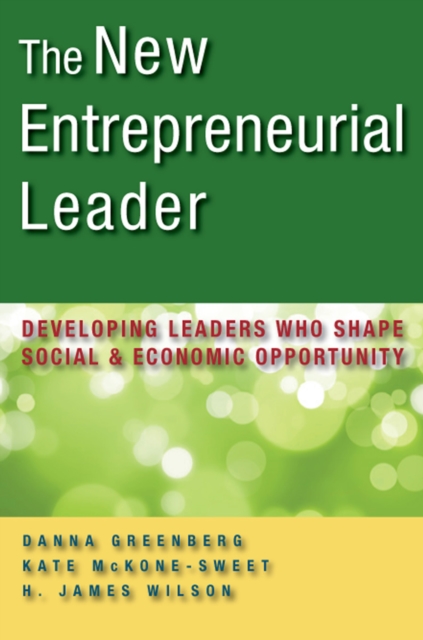
The new entrepreneurial leader
Our economic crisis has shown that we need a fundamentally new kind of business leader--able to make ethical decisions in the face of strategic unknowns, serve the environment and society while also serving the needs of investors and shareholders, and understand how their personality and the social context in which they operate impacts their leadership. This book lays out a compelling model for creating and developing these new entrepreneurial leaders.
eBook