
Catalogue Search | MBRL


Are you sure you want to remove the book from the shelf?

{{itemTitle}}
21
result(s) for
"Wiltse, Ed"
Sort by:


‘A Whole Other World than What I Live in’: Reading Chester Himes, on Campus and at the County Jail
This essay first briefly examines African American novelist Chester Himes’ genre-defying position as prison writer turned detective writer, whose influence is clear not only in the usual suspects such as Walter Mosley but also in the Blaxploitation films of the early 1970s, and in the urban fiction tradition from Donald Goines and Iceberg Slim on down through today’s Triple Crown books and others. I then look at how Himes’ work has been received by the college students and incarcerated people who each spring for the past 20 years have worked together in reading groups set at the local county jail in a project linked to a class I teach, in order to raise questions about genre, audience and pedagogy. The two groups of readers, who may come to see each other as one group over the series of meetings, often develop readings of Himes’ novel that push back against the analysis I present in the classroom.
Journal Article

Doing Time in College
Taking stock of ten years of a service learning project that brings together small groups of college students and prisoners in jailhouse classrooms to discuss literary representations of crime and punishment, this essay finds in project participants' reading journals some remarkable trends. Complex dynamics of authenticity and authority emerge in the groups' weekly meetings, as participants negotiate their own and their groups' identities and commitments with respect to each other and to the literary texts, in the absence of professors, corrections officers, or other guardians of discipline. These dynamics are investigated in light of participants' discussions of a range of works, before looking in greater detail at responses to Sherman Alexie's 1996 novel Indian Killer, which are found to complicate stable notions of pedagogical authority and the object(s) of literary study.
Journal Article
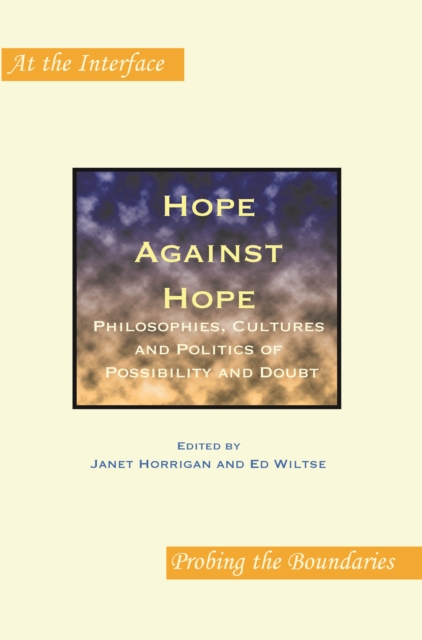
Hope Against Hope
In September 2006, when 45 scholars and activists from 19 countries around the world gathered amid the spires and gargoyles of Oxford for a conference entitled, \"Hope: Probing the Boundaries,\" complex dialectics of hope and despair circulated through the meeting rooms by day, and the conversations in quadrangles and pubs late into the night. On the one hand, the remarkable social and political openings and possibilities of the previous decade, from Berlin to Johannesburg, Leningrad to the Lacandon jungle of Chiapas, seemed to be ever-more constrained by political and economic forces as brutal as those that preceded them, but, on the other hand, there were (and are) the Zapatistas and a thousand other movements persisting in the belief that, to echo the mantra of the World Social Forums, \"another world is possible,\" and there we were from around the world, to do the work of theorizing, describing, and enacting the persistence of individual and collective hope despite grim realities. The essays developed from that conference and collected here reflect both the theoretical and philosophical underpinnings and the cultural and political praxes of \"hope against hope.\".
eBook


Teaching Howards End to the Basts; Class Markers in the Classroom, and in the Bourgeois Novel
At our next meeting, I circulated a brief handout that simply describes demographic and lifestyle characteristics (parents' educational levels and careers, housing location and type, and a few details to suggest degree of economic security) for \"five Nazareth College students I've known,\" carefully selected and presented to suggest typical class fractions and backgrounds, so my students are likely to recognize versions of themselves and their friends somewhere on the list. In responding to that earlier version of this essay, the board member readers for Radical Teacher rightly suggested that an essay like this one would benefit from more direct quotation of student voices, a suggestion I've mostly been unable to address, because the idea of writing about this particular teaching experience only came to me some months after completing the semester. [...]for all the (necessary) deflation of one's dreams of radical and radicalizing pedagogy that such comments inevitably provoke, for me the larger feeling evoked by the experience of teaching Howards End to the Basts is hopeful. Since that somewhat fumbling effort to help students understand ideologies of class using the example of ideologies of gender, I've become a bit more conscious and controlled in my efforts to work through, or around, student resistance to thinking about class, in literature and our lives. NOTES: 1 This essay began as a presentation at the Modern Language Association's 2001 Radical Caucus panel on teaching the bourgeois novel; I'm grateful to the organizers of that panel, the other panelists and the audience, as well as to Radical Teacher's board member readers, for suggestions about the paper.
Journal Article
Teaching Howards End to the Basts: Class Markers in the Classroom, and in the Bourgeois Novel1
At our next meeting, I circulated a brief handout that simply describes demographic and lifestyle characteristics (parents' educational levels and careers, housing location and type, and a few details to suggest degree of economic security) for \"five Nazareth College students I've known,\" carefully selected and presented to suggest typical class fractions and backgrounds, so my students are likely to recognize versions of themselves and their friends somewhere on the list. Even for those students willing to admit (to themselves or to the class) that their backgrounds were working class, I found that they, like most Americans today, saw themselves, today and into the future, as solidly middle class, entirely irrespective of their actual living conditions. all of the standard American mythology about mobility and a classless society stood in the way of our discussion of class's structuring role in the lives of Forsters characters, and in our own, making it hard to even approach the questions I had begun with, about the ideological underpinnings of Forsters characterization. [...]for all the (necessary) deflation of one's dreams of radical and radicalizing pedagogy that such comments inevitably provoke, for me the larger feeling evoked by the experience of teaching Howards End to the Basts is hopeful. Since that somewhat fumbling effort to help students understand ideologies of class using the example of ideologies of gender, I've become a bit more conscious and controlled in my efforts to work through, or around, student resistance to thinking about class, in literature and our lives. 7 stand each year upon six hundred pounds, and Helen upon the same...and all our thoughts are the thoughts of six-hundred-pounders\" NOTES: 1 This essay began as a presentation at the Modern Language Associations 2001 Radical Caucus panel on teaching the bourgeois novel; I'm grateful to the organizers of that panel, the other panelists and the audience, as well as to Radical Teachers board member readers, for suggestions about the paper.
Journal Article
