
Catalogue Search | MBRL


Are you sure you want to remove the book from the shelf?

{{itemTitle}}
23
result(s) for
"Wlodarski, Amy"
Sort by:


Art Outside the Lines
This collection of essays, written by leading scholars in the fields of East German art, film, literature, music, and museum studies, seeks to renegotiate the artistic legacy of the German Democratic Republic. Combining a range of theoretical and practical perspectives, the volume challenges the narrow frameworks of totalitarianism and Ostalgie that have dominated discussions of art produced in the GDR. It explores the diversity of art produced in the state and contests the long-held perception that socialist realism and artistic innovation were mutually exclusive. Crucially, the collection puts art itself to the fore; GDR art is considered not simply as a political by-product, as is so often the case, but as an entity of innovation and aesthetic value in its own right.
eBook

The Repercussions of George Rochberg's Rubble Rhetoric
During the Second World War, the American composer George Rochberg served as an infantryman with the US Army in Europe. There, he witnessed first hand the aftermath caused by massive firebombing of the French countryside by both Allied and Axis bombers, an image that would remain with him for the remainder of his life. In his post-war writings, the rubbled city of Saint-Lô soon became a metaphor for the precarious state of Western culture, which he believed had suffered a grave injury. This article considers how Rochberg reconstructed his wartime sketches – short miniatures composed during the European campaign – into material for his Sixth Symphony (1986). I argue that Rochberg clearly conceived of musical reconstruction as a means by which to symbolically confront the modernist forces he believed accountable for the decline of Western culture that he increasingly perceived towards the end of his life. The article ends with a cautionary epilogue to this time-worn narrative of rubble, reconstruction, and redemption that challenges Rochberg's false sense of moral superiority and the motivations of ‘rubble narratives’ more generally.
Journal Article

George Rochberg's Road to Ars Combinatoria, 1943–63
George Rochberg often attributed his postmodern shift to the death of his son in 1964. Accordingly, the literature has described his practice of ars combinatoria (“art of combination”) as an “abrupt about-face”—a sudden rejection of modernist aesthetics. But the composer's unpublished essays, diaries, correspondence, and musical sketchbooks suggest that the road to ars combinatoria had well-laid roots in two of his least considered biographical periods: his service during World War II and his serial period. During these two decades, Rochberg actively sought positive models for humanistic composition, historical figures who rose to the level of musical heroes in that they served humanity through their art. But as the war had taught him, heroes are necessarily defined by their struggle against nemeses in ethical conflicts. Correspondingly, he constructed the other side of the artistic world as a realm of vain egoists who sought self-promotion and seemed unconcerned with humanistic modes of expression. As his ideas matured, Rochberg assigned different figures to these archetypes, but the guiding ethical criteria remained fairly consistent throughout. I therefore argue that ars combinatoria was less a sudden aesthetic reversal than it was the result of a longer cumulative process of self-assessment and compositional maturation.
Journal Article


The Testimonial Aesthetics of Different Trains
Often praised as an exceptional artistic response to the Holocaust, Steve Reich's Different Trains adopts a documentary approach to Holocaust representation in which Reich assembled short excerpts from three survivor testimonies and published transcriptions of their accounts in his libretto for the work. This article explores the consequences that arise when fragments from very emotional testimonies are recast as purportedly unmediated documentary. The authority attributed to this sort of historical narrative has come under scrutiny in the field of Holocaust studies, in which it is called “secondary witness”—an intellectual interpretation of survivor testimonies advanced without the author revealing his or her own subjective standpoint or scholarly agenda. I argue that Reich's use of the voices of the survivors, Paul, Rachel, and Rachella, constitutes a form of secondary witness. Analysis of the original sources reveals that as Reich worked with extracts from the testimonies, in some cases his composition took on the aesthetics of the original testimonies, yet in other cases, he altered meaning and tone and even misheard certain phrases, producing transcription errors that reframed key moments by substituting his account of the Holocaust for that of the primary witness. Such revelations prompt reevaluation of the moral and political success that has been claimed for Different Trains, since the compositional process could never have been as objective and self-effacing as Reich and his critics suggest.
Journal Article
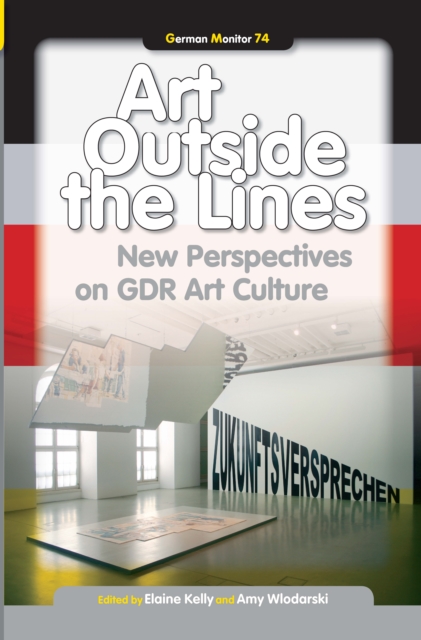
Art Outside the Lines
This collection of essays, written by leading scholars in the fields of East German art, film, literature, music, and museum studies, seeks to renegotiate the artistic legacy of the German Democratic Republic. Combining a range of theoretical and practical perspectives, the volume challenges the narrow frameworks of totalitarianism and Ostalgie that have dominated discussions of art produced in the GDR. It explores the diversity of art produced in the state and contests the long-held perception that socialist realism and artistic innovation were mutually exclusive. Crucially, the collection puts art itself to the fore; GDR art is considered not simply as a political by-product, as is so often the case, but as an entity of innovation and aesthetic value in its own right.
eBook

The total work of art
For two centuries, Gesamtkunstwerk—the ideal of the \"total work of art\"—has exerted a powerful influence over artistic discourse and practice, spurring new forms of collaboration and provoking debates over the political instrumentalization of art. Despite its popular conflation with the work of Richard Wagner, Gesamtkunstwerk's lineage and legacies extend well beyond German Romanticism, as this wide-ranging collection demonstrates. In eleven compact chapters, scholars from a variety of disciplines trace the idea's evolution in German-speaking Europe, from its foundations in the early nineteenth century to its manifold articulations and reimaginings in the twentieth century and beyond, providing an uncommonly broad perspective on a distinctly modern cultural form.
eBook
The Testimonial Aesthetics ofDifferent Trains
Often praised as an exceptional artistic response to the Holocaust, Steve Reich'sDifferent Trainsadopts a documentary approach to Holocaust representation in which Reich assembled short excerpts from three survivor testimonies and published transcriptions of their accounts in his libretto for the work. This article explores the consequences that arise when fragments from very emotional testimonies are recast as purportedly unmediated documentary. The authority attributed to this sort of historical narrative has come under scrutiny in the field of Holocaust studies, in which it is called “secondary witness”—an intellectual interpretation of survivor testimonies advanced without the author revealing his or her own subjective standpoint or scholarly agenda. I argue that Reich's use of the voices of the survivors, Paul, Rachel, and Rachella, constitutes a form of secondary witness. Analysis of the original sources reveals that as Reich worked with extracts from the testimonies, in some cases his composition took on the aesthetics of the original testimonies, yet in other cases, he altered meaning and tone and even misheard certain phrases, producing transcription errors that reframed key moments by substituting his account of the Holocaust for that of the primary witness. Such revelations prompt reevaluation of the moral and political success that has been claimed forDifferent Trains, since the compositional process could never have been as objective and self-effacing as Reich and his critics suggest.
Journal Article
