
Catalogue Search | MBRL


Are you sure you want to remove the book from the shelf?

{{itemTitle}}
14
result(s) for
"Wodon, Quentin, editor"
Sort by:

Climate change and migration
Climate change is a major source of concern in the Middle East and North Africa (MENA) region, and migration is often understood as one of several strategies used by households to respond to changes in climate and environmental conditions, including extreme weather events. This study focuses on the link between climate change and migration. Most micro-level studies measure climate change either by the incidences of extreme weather events or by variation in temperature or rainfall. A few studies have found that formal and informal institutions as well as policies also affect migration. Institutions that make government more responsive to households (for example through public spending) discourage both international and domestic migration in the aftermath of extreme weather events. Migration is often an option of last resort after vulnerable rural populations attempting to cope with new and challenging circumstances have exhausted other options such as eating less, selling assets, or removing children from school. This study is based in large part on new data collected in 2011 in Algeria, Egypt, Morocco, Syria, and the Republic of Yemen. The surveys were administered by in-country partners to a randomly selected set of 800 households per country. It is also important to emphasize that neither the household survey results nor the findings from the qualitative focus groups are meant to be representative of the five countries in which the work was carried, since only a few areas were surveyed in each country. This report is organized as follows: section one gives synthesis. Section two discusses household perceptions about climate change and extreme weather events. Section three focuses on migration as a coping mechanisms and income diversification strategy. Section four examines other coping and adaptation strategies. Section five discusses perceptions about government and community programs.
eBook

Early childhood education and development in Indonesia
Since the early 2000s, Indonesia has taken a number of steps to prioritize early childhood development – ranging from the inclusion of Early Childhood Development (ECD) in the National Education System Law No. 20 in 2003 to a Presidential Declaration on Holistic and Integrated ECD and the launch of the country's first ever ECD Census in 2011. These policy milestones have occurred in parallel with sustained progress on outcomes included in the Millennium Development Goals, including for child malnutrition, child mortality and universal basic education. Additional progress could be achieved by strengthening ECD policies further. This report presents findings from an assessment of ECD policies and programs in Indonesia based on two World Bank tools: the ECD module of the Systems Approach for Better Education Results (SABER) and a guide on essential interventions for investing in young children. Results from the application of both tools to Indonesia are used to suggest a number of policy options for consideration.
eBook

Water and sanitation in Uganda
This World Bank Study provides a basic diagnostic of access to safe water and sanitation in Uganda and their relationship with poverty. The analysis relies on a series of nationally representative household surveys for the period 2002–13, as well as on qualitative data collection. The study first relies on household surveys to analyze trends in access to safe water and some of the constraints faced by households for access. The issue of the cost of water for households without a connection to the piped water network is discussed. This includes a discussion of public stand pipes. Next, qualitative data are presented on the obstacles faced by households in accessing safe water. The next two chapters are devoted to sanitation. The focus is again first on analyzing household survey data about sanitation, including with respect to toilets, bathrooms, waste disposal, and hand washing, and next on an analysis of qualitative data from focus groups and key informants. Finally, the study reviews some of the policies and programs that have been implemented in order to improve access to safe water and sanitation for the poor as well as options going forward.
eBook
Residential piped water in Uganda
This World Bank Study provides a basic diagnostic of residential piped water coverage and affordability in Uganda and its relationship with poverty using a series of nationally representative household surveys for the period 2002–13. The study fi rst analyzes trends in piped water coverage using both administrative and survey data. Demand-side and supply-side factors reducing the take-up of piped water service by households in areas where the service is available are estimated. The study also documents the extent to which piped water coverage enables households to shift time use away from domestic tasks toward market work, and the benefi cial effect that this may have on poverty. The targeting performance to the poor of water subsidies is estimated and results obtained for Uganda are compared with estimates for other countries. Finally, the study analyzes issues related to affordability—including the impact of the tariff increase of 2012 on household consumption, poverty, and piped water affordability—as well as the cost for households to connect to the piped water network.
eBook
The changing wealth of nations 2018
Countries regularly track gross domestic product (GDP) as an indicator of their economic progress, but not wealth—the assets such as infrastructure, forests, minerals, and human capital that produce GDP. In contrast, corporations routinely report on both their income and assets to assess their economic health and prospects for the future. Wealth accounts allow countries to take stock of their assets to monitor the sustainability of development, an urgent concern today for all countries. The Changing Wealth of Nations 2018: Building a Sustainable Future covers national wealth for 141 countries over 20 years (1995–2014) as the sum of produced capital, 19 types of natural capital, net foreign assets, and human capital overall as well as by gender and type of employment. Great progress has been made in estimating wealth since the fi rst volume, Where Is the Wealth of Nations? Measuring Capital for the 21st Century, was published in 2006. New data substantially improve estimates of natural capital, and, for the first time, human capital is measured by using household surveys to estimate lifetime earnings. The Changing Wealth of Nations 2018 begins with a review of global and regional trends in wealth over the past two decades and provides examples of how wealth accounts can be used for the analysis of development patterns. Several chapters discuss the new work on human capital and its application in development policy. The book then tackles elements of natural capital that are not yet fully incorporated in the wealth accounts: air pollution, marine fisheries, and ecosystems. This book targets policy makers but will engage anyone committed to building a sustainable future for the planet.
eBook
Investing in early childhood development
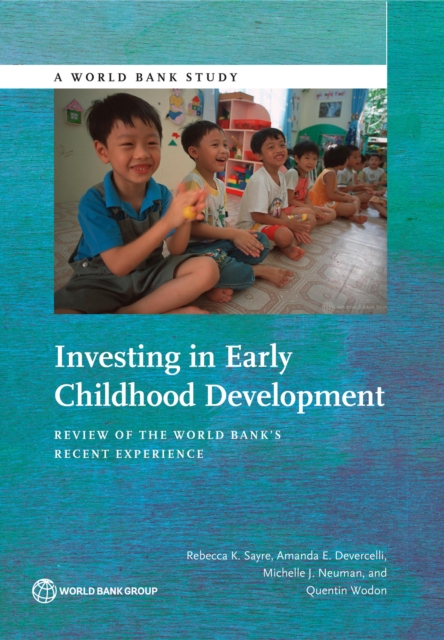
This study provides an overview of Bank investments in Early Childhood Development (ECD) from 2000-2013 within the Education, Health, Nutrition and Population, and Social Protection and Labor practices. The study summarizes trends in operational and analytical investments in early childhood, including lending and trust funded operations at the country, regional, and global levels. Findings are presented on the overall level of finance during this thirteen-year period, the number of ECD investments, and regional and sectoral trends. A series of case studies are presented to highlight lessons learned to inform future Bank support to ECD and to promote better planning across sectors and regions. Trends in analytical and advisory activities are also discussed, including economic sector work, technical assistance, partnership activities, impact evaluations, programmatic approaches, and knowledge products. Finally, the study discusses recent new approaches to support ECD within the World Bank and in client countries. The study benefited from support from the Children Investment Fund Foundation.
eBook

Emerging evidence on vouchers and faith-based providers in education : case studies from Africa, Latin America, and Asia
Unlock the potential of public-private partnerships in education. This groundbreaking study offers fresh empirical evidence on the effectiveness and cost of various educational models in developing countries across Africa, Latin America, and Asia.
Delve into rigorous case studies examining voucher programs and faith-based schools, uncovering key insights into school performance, targeting, and cost-effectiveness. Discover how these partnerships impact student achievement, literacy, and numeracy, and learn what factors drive success or failure.
Emerging Evidence on Vouchers and Faith-Based Providers in Education is essential reading for policymakers, researchers, and practitioners seeking innovative solutions to improve educational outcomes and promote social mobility in developing nations. Explore the challenges and opportunities of these partnerships and gain a deeper understanding of how to create more effective and equitable education systems.
eBook