
Catalogue Search | MBRL


Are you sure you want to remove the book from the shelf?

{{itemTitle}}
96
result(s) for
"Wray, Alison"
Sort by:


What Do We (Think We) Know About Formulaic Language? An Evaluation of the Current State of Play
This article briefly summarizes key developments in formulaic language research over the past 5 years, before exploring certain assumptions typically made, regarding the coherence of formulaicity as a phenomenon, the significance of frequency as a property, and the location of subtypes of formulaic language along various continua. It is argued that we do not yet have the full measure of how different features associated with formulaicity fit together. The challenge lies in reconciling the range of evidence types within an explanation that is rooted not only in usage itself, but in the underlying motivations that determine usage.
Journal Article
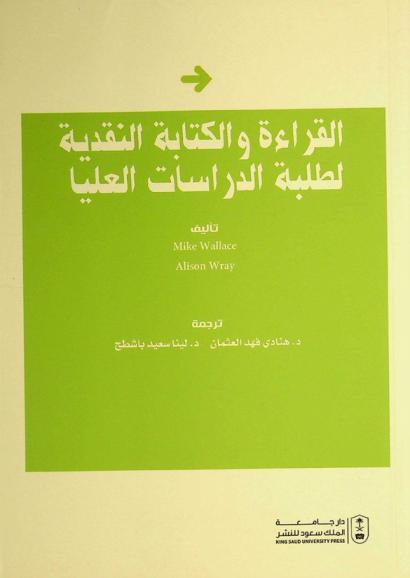
القراءة والكتابة النقدية لطلبة الدراسات العليا
يعد كتاب القراءة والكتابة النقدية لطلبة الدراسات العليا الذي يتبني منظورا تأمليا نقديا في الكتابة العلمية، من الكتب المرجعية في مجال البحث العلمي والكتابة الأكاديمية. يمثل هذا الكتاب دليلا عمليا لطلبة الدراسات العليا، الباحثين والأكاديميين يتكون الكتاب من ثلاثة أجزاء رئيسة تتضمن ثمانية عشر فصلا، ويركز بشكل خاص على ثلاثة مواضيع رئيسية وهي : اكتساب مهارات القراءة والكتابة النقدية الذاتية، والتحليل المتعمق للأدبيات، وتوظيف المراجعات النقدية للأدبيات.
Book

Formulaic language
Creating a timeline for formulaic language is far from simple, because several partially independent lines of research have contributed to the emerging picture. Each exhibits cycles of innovation and consolidation over time: domains take a leading role in developing new knowledge and then fall back, while another area comes to the fore. Thus, some of the first observations about formulaic language, back in the nineteenth century, were in the clinical domain of aphasia studies. By the early to mid twentieth century it was theories of language structure that had most to say, until eclipsed by the Chomskian model, which saw little significance in lexicalised units larger than the word (an issue discussed by Jackendoff 2002; see table entry). Meanwhile, changes in language teaching methodology in the mid to late twentieth century increasingly urged teachers to ask how adult learners could best master multiword strings to improve fluency and idiomaticity – a question still asked today. By the end of the twentieth century, new technological advances revealed frequency in usage as a probable agent of formulaicity, and these chimed with new models of lexical knowledge based on neural pathways and networks that could be strengthened by repeated exposure. Drawing on these models, we have seen, as we move into the twenty-first century, the development of new approaches to modelling language as a system – emergent grammars, including Construction Grammar – that are more accommodating of large, internally complex units. And finally, as we gradually understand more about how the brain accesses and retrieves linguistic material, we are seeing a resurgence of interest in formulaic language in neurological and clinical contexts.
Journal Article

Second‐hit DEPDC5 mutation is limited to dysmorphic neurons in cortical dysplasia type IIA
Focal cortical dysplasia (FCD) causes drug‐resistant epilepsy and is associated with pathogenic variants in mTOR pathway genes. How germline variants cause these focal lesions is unclear, however a germline + somatic “2‐hit” model is hypothesized. In a boy with drug‐resistant epilepsy, FCD, and a germline DEPDC5 pathogenic variant, we show that a second‐hit DEPDC5 variant is limited to dysmorphic neurons, and the somatic mutation load correlates with both dysmorphic neuron density and the epileptogenic zone. These findings provide new insights into the molecular and cellular correlates of FCD determining drug‐resistant epilepsy and refine conceptualization of the epileptogenic zone.
Journal Article

Leaving No Stone Unturned: Flexible Retrieval of Idiomatic Expressions from a Large Text Corpus
Idioms are multi-word expressions whose meaning cannot always be deduced from the literal meaning of constituent words. A key feature of idioms that is central to this paper is their peculiar mixture of fixedness and variability, which poses challenges for their retrieval from large corpora using traditional search approaches. These challenges hinder insights into idiom usage, affecting users who are conducting linguistic research as well as those involved in language education. To facilitate access to idiom examples taken from real-world contexts, we introduce an information retrieval system designed specifically for idioms. Given a search query that represents an idiom, typically in its canonical form, the system expands it automatically to account for the most common types of idiom variation including inflection, open slots, adjectival or adverbial modification and passivisation. As a by-product of query expansion, other types of idiom variation captured include derivation, compounding, negation, distribution across multiple clauses as well as other unforeseen types of variation. The system was implemented on top of Elasticsearch, an open-source, distributed, scalable, real-time search engine. Flexible retrieval of idioms is supported by a combination of linguistic pre-processing of the search queries, their translation into a set of query clauses written in a query language called Query DSL, and analysis, an indexing process that involves tokenisation and normalisation. Our system outperformed the phrase search in terms of recall and outperformed the keyword search in terms of precision. Out of the three, our approach was found to provide the best balance between precision and recall. By providing a fast and easy way of finding idioms in large corpora, our approach can facilitate further developments in fields such as linguistics, language education and natural language processing.
Journal Article

Research Timeline: Formulaic language
Creating a timeline for formulaic language is far from simple, because several partially independent lines of research have contributed to the emerging picture. Each exhibits cycles of innovation and consolidation over time: domains take a leading role in developing new knowledge and then fall back, while another area comes to the fore. Thus, some of the first observations about formulaic language, back in the nineteenth century, were in the clinical domain of aphasia studies. By the early to mid twentieth century it was theories of language structure that had most to say, until eclipsed by the Chomskian model, which saw little significance in lexicalised units larger than the word (an issue discussed by Jackendoff 2002; see table entry). Meanwhile, changes in language teaching methodology in the mid to late twentieth century increasingly urged teachers to ask how adult learners could best master multiword strings to improve fluency and idiomaticity--a question still asked today. By the end of the twentieth century, new technological advances revealed frequency in usage as a probable agent of formulaicity, and these chimed with new models of lexical knowledge based on neural pathways and networks that could be strengthened by repeated exposure. Drawing on these models, we have seen, as we move into the twenty-first century, the development of new approaches to modelling language as a system--emergent grammars, including Construction Grammar--that are more accommodating of large, internally complex units. And finally, as we gradually understand more about how the brain accesses and retrieves linguistic material, we are seeing a resurgence of interest in formulaic language in neurological and clinical contexts.
Journal Article

Pneumorrhachis secondary to traumatic pneumomediastinum in a child
Pneumorrhachis (air within the spinal canal) is rare, and even more so in the paediatric population. We report a case in a 4-year-old boy that resolved spontaneously on treating the underlying traumatic pneumomediastinum, and discuss the causes, mechanism and implications of this condition.
Journal Article

Outcome of vein of Galen malformation presenting in the neonatal period
ObjectiveVein of Galenaneurysmal malformation (VGAM) is a rare but important congenital malformation presenting to neonatal intensive care units (NICUs), and with a change from surgical to endovascular management, survival for this condition has improved. However, there is little reported about the medical management decisions of infants with this condition and the associated long-term neurodevelopmental outcomes. We aim to report a single centre experience of both acute treatment and long-term outcomes of VGAM for those infants admitted to our NICU soon after birth.DesignRetrospective cohort study over a 15-year period from 2001 to 2015 inclusive.SettingA quaternary NICU at The Royal Children’s Hospital, Melbourne, Australia.Participants24 newborn infants referred for management of VGAM. There were no eligibility criteria set for this study; all presenting infants were included.InterventionsNone.Main outcomes measuresClinical neuroimaging data were gathered. Surviving children were formally assessed with a battery of tests administered by a neuropsychologist and occupational therapist/physiotherapist at various ages across early to middle childhood.ResultsFifteen neonates with VGAM did not survive beyond their NICU admission. 10 of these were not offered endovascular intervention. Of the nine surviving infants, only one had a normal neurodevelopmental outcome.ConclusionsThe mortality of VGAM presenting in the neonatal period was high, and rates of normal neurodevelopmental outcome for survivors were low. These findings contribute to our understanding of which neonates should be treated and highlights the importance of providing clinical neurodevelopmental follow-up to survivors beyond their infant years.
Journal Article