
Catalogue Search | MBRL


Are you sure you want to remove the book from the shelf?

{{itemTitle}}
3
result(s) for
"Wright, Alex, 1966-"
Sort by:

Cataloging the world : Paul Otlet and the birth of the information age
\"In 1934, a Belgian entrepreneur named Paul Otlet sketched out plans for a worldwide network of computers--or \"electric telescopes,\" as he called them -- that would allow people anywhere in the world to search and browse through millions of books, newspapers, photographs, films and sound recordings, all linked together in what he termed a réseau mondial: a \"worldwide web.\" Today, Otlet and his visionary proto-Internet have been all but forgotten, thanks to a series of historical misfortunes -- not least of which involved the Nazis marching into Brussels and destroying most of his life's work. In the years since Otlet's death, however, the world has witnessed the emergence of a global network that has proved him right about the possibilities -- and the perils -- of networked information. In The Web that Wasn't, Alex Wright brings to light the forgotten genius of Paul Otlet, an introverted librarian who harbored a bookworm's dream to organize all the world's information. Recognizing the limitations of traditional libraries and archives, Otlet began to imagine a radically new way of organizing information, and undertook his life's great work: a universal bibliography of all the world's published knowledge that ultimately totaled more than 12 millionindividual entries. That effort eventually evolved into the Mundaneum, a vast \"city of knowledge\" that opened its doors to the public in 1921 to widespread attention. Like many ambitious dreams, however, Otlet's eventually faltered, a victim to technological constraints and political upheaval in Europe on the eve of World War II.\"-- Provided by publisher.
Book
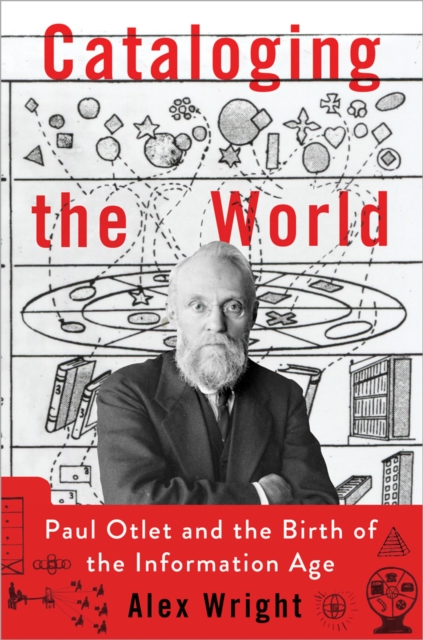
Cataloging the world : Paul Otlet and the birth of the information age
In 1934, Paul Otlet, a Belgian entrepreneur, designed a proto-Internet which he called a réseau mondial-- literally, \"worldwide web.\" Today, Otlet and his vision have been all but forgotten, thanks to a series of historical misfortunes -- not least of which involved the Nazis marching into Brussels and destroying most of his life's work -- but Alex Wright brings Otlet's extraordinary story back into the light in this fascinating look at the dream of universal knowledge.
eBook

Informatica
Informatica -the updated
edition of Alex Wright's previously published Glut-continues the
journey through the history of the information age to show how
information systems emerge . Today's \"information
explosion\" may seem like a modern phenomenon, but we are not the
first generation-or even the first species-to wrestle with the
problem of information overload. Long before the advent of
computers, human beings were collecting, storing, and organizing
information: from Ice Age taxonomies to Sumerian archives, Greek
libraries to Christian monasteries.
Wright weaves a narrative that connects such seemingly far-flung
topics as insect colonies, Stone Age jewelry, medieval monasteries,
Renaissance encyclopedias, early computer networks, and the World
Wide Web. He suggests that the future of the information age may
lie deep in our cultural past.
We stand at a precipice struggling to cope with a tsunami of
data. Wright provides some much-needed historical perspective. We
can understand the predicament of information overload not just as
the result of technological change but as the latest chapter in an
ancient story that we are only beginning to understand.
eBook