
Catalogue Search | MBRL


Are you sure you want to remove the book from the shelf?

{{itemTitle}}
622
result(s) for
"Wright, Judith"
Sort by:

Gauguin : portraits
Paul Gauguin (1848-1903) broke with accepted conventions and challenged audiences to expand their understanding of visual expression. Nowhere is this phenomenon more evident than in his portraits, a genre he remained engaged with throughout all phases of his career. Bringing together more than 60 of Gauguin's portraits in a wide variety of media that includes painting, works on paper, and sculpture, this handsomely illustrated volume is the first focused investigation of the multifaceted ways the artist approached the subject. Essays by a group of international experts consider how the artist's conception of portraiture evolved as he moved between Brittany and Polynesia. They also examine how Gauguin infused his work with symbolic meaning by taking on different roles like the Christ figure and the savage in his self-portraits and by placing his models in suggestive settings with alluring attributes. This welcome addition to the scholarship on one of the 19th century's most innovative and controversial artists reveals fascinating insights into the crucial role that portraiture played in Gauguin's overall artistic practice.
BOOK

Religiosity and spirituality in the prevention and management of depression and anxiety in young people: a systematic review and meta-analysis
Historically, religion has had a central role in shaping the psychosocial and moral development of young people. While religiosity and spirituality have been linked to positive mental health outcomes in adults, their role during the developmental context of adolescence, and the mechanisms through which such beliefs might operate, is less well understood. Moreover, there is some evidence that negative aspects of religiosity are associated with poor mental health outcomes. Guided by lived experience consultants, we undertook a systematic review and quality appraisal of 45 longitudinal studies and 29 intervention studies identified from three electronic databases (Medline, PsycINFO and Scopus) exploring the role of religiosity and spiritual involvement (formal and informal) in prevention and management of depression and anxiety in young people aged 10 to 24 years. Most studies were from high-income countries and of low to moderate quality. Meta-analysis of high-quality longitudinal studies (assessed using Joanna Briggs Institute critical appraisal tools,
n
= 25) showed a trend towards association of negative religious coping (i.e., feeling abandoned by or blaming God) with greater depressive symptoms over time (Pearson’s
r
= 0.09, 95% confidence interval (CI) -0.009, 0.188) whereas spiritual wellbeing was protective against depression (Pearson’s
r
= -0.153, CI -0.187, -0.118). Personal importance of religion was not associated with depressive symptoms overall (Pearson’s
r
= -0.024, CI-0.053, 0.004). Interventions that involved religious and spiritual practices for depression and anxiety in young people were mostly effective, although the study quality was typically low and the heterogeneity in study designs did not allow for a meta-analysis. The lived experience consultants described spirituality and religious involvement as central to their way of life and greatly valued feeling watched over during difficult times. While we require more evidence from low- and middle-income countries, in younger adolescents and for anxiety disorders, the review provides insight into how spirituality and religious involvement could be harnessed to design novel psychological interventions for depression and anxiety in young people.
Review Registration
The systematic review was funded by Wellcome Trust Mental Health Priority Area 'Active Ingredients' 2021 commission and registered with PROSPERO 2021 (CRD42021281912).
Journal Article
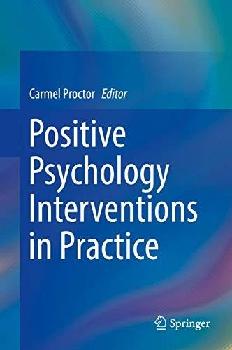
Positive Psychology Interventions in Practice
\"This book presents recent advancements in positive psychology, specifically its application across broad areas of current interest. Chapters include submissions from various international authors in the field and cover discussion and presentation of relevant research, theories, and applications. The volume covers topics such as CBT, Psychotherapy, Coaching, Workplaces, Aging, Education, Leadership, Emotion, Interventions, Measurement, Technology, Design, Health, Relationships, Experiences, Communities. With the growing interest in the applications of positive psychology across diverse fields within psychology and beyond, this book will make a worthwhile contribution to the field. It will also fill the current need for a volume that highlights specifically the various recent advancements in positive psychology into diverse fields and as such will be of benefit to a wide range of professionals, including psychologists, educators, clinicians, therapists, and many others.\" -- Publisher's website.
Book

Review of Australian initiatives to reduce stigma towards people with complex mental illness: what exists and what works?
Background
Australian national mental health policy outlines the need for a nationally coordinated strategy to address stigma and discrimination, particularly towards people with complex mental illness that is poorly understood in the community. To inform implementation of this policy, this review aimed to identify and examine the effectiveness of existing Australian programs or initiatives that aim to reduce stigma and discrimination.
Method
Programs were identified via a search of academic databases and grey literature, and an online survey of key stakeholder organisations. Eligible programs aimed to reduce stigma towards people with complex mental illness, defined as schizophrenia, psychosis, personality disorder, or bipolar disorder; or they focused on nonspecific ‘mental illness’ but were conducted in settings relevant to individuals with the above diagnoses, or they included the above diagnoses in program content. Key relevant data from programs identified from the literature search and survey were extracted and synthesized descriptively.
Results
We identified 61 programs or initiatives currently available in Australia. These included face-to-face programs (n = 29), online resources (n = 19), awareness campaigns (n = 8), and advocacy work (n = 5). The primary target audiences for these initiatives were professionals (health or emergency), people with mental illness, family or carers of people with mental illness, and members of the general population. Most commonly, programs tended to focus on stigma towards people with non-specific mental illness rather than on particular diagnostic labels. Evidence for effectiveness was generally lacking. Face-to-face programs were the most well-evaluated, but only two used a randomised controlled trial design.
Conclusions
This study identified areas of strength and weakness in current Australian practice for the reduction of stigma towards people with complex mental illness. Most programs have significant input from people with lived experience, and programs involving education and contact with a person with mental illness are a particular strength. Nevertheless, best-practice programs are not widely implemented, and we identified few programs targeting stigma for people with mental illness and their families, or for culturally and linguistically diverse communities, Aboriginal and Torres Strait Islander communities and LGBTIQ people. These can inform stakeholder consultations on effective options for a national stigma and discrimination reduction strategy.
Journal Article
Development of mental health first aid guidelines for problem drinking: a Delphi expert consensus study in Argentina and Chile
Background
Among all psychoactive substances, alcohol consumption presents the most significant public health problem and is a leading risk factor for overall disease burden in Latin America. However, most people who meet criteria for a substance use disorder do not receive treatment in primary or secondary care sources. Community members can play a role in helping people to seek help as they are likely to encounter people experiencing problem drinking and recognize the signs. However, many do not have adequate mental health first aid knowledge or skills to provide help. We aimed to culturally adapt the existing English-language mental health first aid guidelines for helping someone with problem drinking for Argentina and Chile.
Methods
The Delphi consensus method was used to determine the importance of helping actions translated from the English-language guidelines and to add new actions suggested by expert panellists. The importance of each statement was rated by two expert panels. Panel one included people with lived experience (either their own or as a support person, n = 23) recruited in Argentina and panel two included health professionals (n = 31) recruited in Argentina and Chile.
Results
Overall, 165 helping actions were endorsed by panellists across two consecutive survey rounds. Endorsed items included 132 of the 182 items translated into Spanish from the English-language guidelines and 33 of the 61 new items generated from panellists’ comments in the first survey round.
Conclusions
While there were some similarities in recommended helping actions between English-speaking countries, and Argentina and Chile, key differences were seen in attitudes to low-risk drinking. While there was a relatively high level of agreement between health professionals and people with lived experience, some divergence of opinion was seen, particularly in the area of commitment to recovery as a condition for help. Future research should explore the implementation of the guidelines.
Journal Article

Sixteen years on the road: a mobile dental unit for vulnerable communities in Bradford
Introduction
As a means of targeting vulnerable populations to offer care outside the traditional clinical setting, mobile clinics exist that permit clinical teams to travel into the community to provide dental care.
Aims
To highlight some of the inequalities faced by vulnerable populations, to discuss the benefits of a mobile dental unit (MDU) and how it may address some of these inequalities, and to reflect on some of the achievements of the Bradford MDU.
Vulnerable populations
Vulnerable communities may include the homeless population, those affected by substance misuse, those suffering with mental health problems, asylum seekers, or an amalgamation. Such groups are likely to have lower expectations of healthcare and may not seek help until oral disease is advanced, with a large proportion likely to have already lost their teeth.
Bradford MDU
The MDU owned by Bradford Community Dental Service is unique in both its longevity of service and populations it serves, and has been providing an outreach dental service to the vulnerable populations of Bradford for the last 16 years. Whilst the COVID-19 pandemic suspended services during the thick of lockdown, the Bradford MDU is slowly re-opening its services, so the care received by these vulnerable populations is no longer compromised.
Key points
In the present day, inequalities in healthcare still exist and are predominantly faced by groups with lower socioeconomic status and vulnerable communities.
Mobile dental clinics are a means of providing care outside the traditional clinical setting and enable vulnerable groups (such as the homeless population; those affected by substance misuse, mental health issues etc) to access the care they may not seek otherwise.
The mobile dental unit provided by the Bradford Community Dental Service is valuable in the diverse populations it reaches out to and the accessible dental care it provides to some of the most vulnerable communities across the city.
Journal Article

Redevelopment of mental health first aid guidelines for substance use problems: a Delphi study
Background
Substance use problems have a major impact on the physical and mental health of individuals, families and communities. Early intervention may have a positive effect on recovery and treatment outcomes for those with substance use problems, reducing related risk and harm. Separate mental health first aid guidelines on how a member of the public could assist someone experiencing or developing alcohol use and drug use problems in high income Western countries were developed using Delphi expert consensus in 2009 and 2011, respectively. This study aimed to synthesise and update these two original guidelines to reflect current evidence and best practice.
Methods
The Delphi expert consensus method was used to determine the inclusion of statements in the redeveloped guidelines. A questionnaire was developed using previously endorsed helping statements from the original guidelines on alcohol and drug use problems, as well as relevant content identified in systematic searches of academic and grey literature. Three panels of experts (people with lived experience, support people and professionals) rated statements over three consecutive online survey rounds to determine the importance of their inclusion in the guidelines. Statements endorsed by at least 80% of each panel were included.
Results
103 panellists completed all three survey rounds. They rated 469 statements and endorsed 300 of these for inclusion in the redeveloped guidelines.
Conclusions
This study has developed a broader and more comprehensive set of guidelines for how to support a person experiencing or developing a substance use problem. The redeveloped guidelines provide more detail on knowledge about and recognition of substance use problems, approaching and assisting people who want to change or are not ready to change, harm reduction, community-based supports and professional help, but have less on physical first aid actions. Mental Health First Aid International will use these guidelines in future updates of their training courses.
Journal Article

The Coral Battleground
The Great Barrier Reef lies off the coast of Queensland: 2000 kilometres of spectacular coral reefs, sand cays and islands, Australia's most precious marine possession. Teeming with life, it covers 350,000 square kilometres. In the late 1960s the Reef was threatened with limestone mining and oil drilling. A small group of dedicated conservationists in Queensland – John Büsst, Judith Wright, Len Webb and others – battled to save the Ellison Reef from coral-limestone mining and the Swain Reefs from oil exploration. The group later swelled to encompass scientists, trade unionists and politicians throughout Australia, and led in 1976 to the establishment of a guardian body: the Great Barrier Reef Marine Park Authority. That it still survives is a legacy of activists, artists, poets, ecologists and students. In 1967 they were branded as 'cranks'; now they should be recognised as 'visionaries'.
eBook
Offering mental health first aid to a person after a potentially traumatic event: a Delphi study to redevelop the 2008 guidelines
Background
Trauma has a major impact on the mental health and wellbeing of people globally. Friends, family and members of the public are often well positioned to provide initial assistance if someone is experiencing extreme distress following a potentially traumatic event. Expert consensus guidelines for high income, Western countries on how to do this were published in 2008. The aim of the current study was to re-develop these guidelines to ensure they are current and reflect best practice.
Methods
The Delphi consensus method was used to determine which helping statements should be included in the guidelines. Helping statements were derived from a systematic search of literature that considered how a member of the public could help someone experiencing extreme distress following a potentially traumatic event. Two expert panels, comprising 28 mental health professionals with expertise in managing trauma and 26 consumer advocates, rated each statement. Statements were accepted for inclusion in the guidelines if they were endorsed by at least 80% of each panel.
Results
Out of 183 statements, 103 were endorsed as appropriate helping actions in providing assistance to someone experiencing extreme distress following a potentially traumatic event. These statements were used to form the re-developed guidelines.
Conclusion
This study has resulted in a more comprehensive set of guidelines than the original version, with the endorsement of 103 helping actions, compared to 65 previously. The updated guidelines better represent the complexities of experiencing trauma and the considered approach required when providing first aid after a potentially traumatic event. The additional guidance on providing initial assistance, talking about the trauma, offering short-term assistance and seeking appropriate professional help reflects current knowledge. A notable addition is the inclusion of content on how a first aider can assist after a disclosure of abuse. The guidelines are available to the public and will inform future updates of Mental Health First Aid training courses.
Journal Article