
Catalogue Search | MBRL


Are you sure you want to remove the book from the shelf?

{{itemTitle}}
117
result(s) for
"WuDunn, D"
Sort by:

Half the sky : turning oppression into opportunity for women worldwide
Two Pulitzer Prize winners issue a call to arms against our era's most pervasive human rights violation: the oppression of women in the developing world. They show that a little help can transform the lives of women and girls abroad and that the key to economic progress lies in unleashing women's potential.
Book

Intraocular pressure-lowering efficacy of bimatoprost 0.03% and travoprost 0.004% in patients with glaucoma or ocular hypertension
Aim: To evaluate the efficacies of bimatoprost and travoprost for lowering of intraocular pressure (IOP) for the treatment of glaucoma and ocular hypertension. Methods: Prospective, randomised, investigator-blinded, parallel-group clinical trial. After completing a washout of all glaucoma drugs, patients (n = 157) were randomised to bimatoprost or travoprost for 6 months. Visits were at baseline, 1 week, and 1, 3 and 6 months. IOP was measured at 09:00 h at each visit and also at 13:00 and 16:00 h at baseline and at 3 and 6 months. Results: No significant between-group differences were observed in IOP at baseline, at 09:00, 13:00 or 16:00 h (p⩾0.741). After 6 months, both drugs significantly reduced IOP at every time point (p⩽0.001). After 6 months, mean IOP reduction at 09:00 h was 7.1 mm Hg (27.9%) with bimatoprost (n = 76) and 5.7 mm Hg (23.3%) with travoprost (n = 81; p = 0.014). At 13:00 h, mean IOP reduction was 5.9 mm Hg with bimatoprost (25.3%) and 5.2 mm Hg (22.4%) with travoprost (p = 0.213). At 16:00 h, the mean IOP reduction was 5.3 mm Hg (22.5%) with bimatoprost and 4.5 mm Hg (18.9%; p = 0.207) with travoprost. Both study drugs were well tolerated, with ocular redness the most commonly reported adverse event in both treatment groups. Conclusions: Bimatoprost provided greater mean IOP reductions than travoprost.
Journal Article

Half the sky : how to change the world
Two Pulitzer Prize winners issue a call to arms against our era's most pervasive human rights violation: the oppression of women in the developing world. They show that a little help can transform the lives of women and girls abroad and that the key to economic progress lies in unleashing women's potential.
Levels of bimatoprost acid in the aqueous humour after bimatoprost treatment of patients with cataract
Aim: To determine the aqueous humour concentration of the acid hydrolysis products of bimatoprost and latanoprost after a single topical dose of bimatoprost 0.03% or latanoprost 0.005% in humans. Methods: Randomised, controlled, double-masked, prospective study. 48 eyes of 48 patients scheduled for routine cataract surgery were randomised in an 8:2:2 ratio to treatment with a single 30 μl drop of bimatoprost 0.03%, latanoprost 0.005% or placebo at 1, 3, 6 or 12 h before the scheduled cataract surgery. Aqueous humour samples were withdrawn at the beginning of the surgical procedure and analysed using high-performance liquid chromatography–tandem mass spectrometry. Results: Bimatoprost acid (17-phenyl trinor prostaglandin F2α) was detected in aqueous samples at a mean concentration of 5.0 nM at hour 1, 6.7 nM at hour 3 and 1.9 nM at hour 6 after bimatoprost treatment. After latanoprost treatment, the mean concentration of latanoprost acid (13,14-dihydro-17-phenyl trinor prostaglandin F2α) in aqueous samples was 29.1 nM at hour 1, 41.3 nM at hour 3 and 2.5 nM at hour 6. Acid metabolites were below the limit of quantitation in all samples taken 12 h after dosing and in all samples from placebo-treated patients. None of the samples from latanoprost-treated patients contained quantifiable levels of non-metabolised latanoprost. Non-metabolised bimatoprost was detected in aqueous samples at a mean concentration of 6.6 nM at hour 1 and 2.4 nM at hour 3 after bimatoprost treatment. Conclusions: Low levels of bimatoprost acid were detected in aqueous humour samples from patients with cataract treated with a single dose of bimatoprost. Latanoprost acid concentrations in samples from patients treated with latanoprost were at least sixfold higher. These results suggest that bimatoprost acid in the aqueous humour does not sufficiently account for the ocular hypotensive efficacy of bimatoprost.
Journal Article

A path appears : transforming lives, creating opportunity
\"From the authors of the #1 New York Times best-selling Half the Sky, a unique and essential narrative about making a difference in the world--a roadmap to becoming a conscientious global citizen. Equal in urgency and compassion to Half the Sky, this galvanizing new book from the acclaimed husband and wife team is even more ambitious in scale: nothing less than a deep examination of people who are making the world a better place, and the myriad ways we can support them, whether with a donation of five dollars or five million, an inkling to help or a useful skill to deploy. With scrupulous research and on-the-ground reporting, the authors assay the art and science of giving--determining the current most successful local and global aid initiatives (on issues from education to inner-city violence to disease prevention), evaluating the efficiency and impact of specific approaches and charities, as well as fundraising. Most compellingly, perhaps, they show us how particular people have made a difference, and offer practical advice on how best each of us can give and what we can personally derive from doing so\"--
Book
Ocular penetration of levofloxacin, ofloxacin and ciprofloxacin in eyes with functioning filtering blebs: investigator masked, randomised clinical trial
Background/aims: To compare the penetration of levofloxacin, ofloxacin and ciprofloxacin in the aqueous humour of eyes with functioning filtering blebs.Methods: In this investigator-masked study, 48 patients with functioning filtering blebs requiring cataract surgery were randomised into six groups of eight patients. Groups 1, 2 and 3 received topical ofloxacin 0.3% (Ocuflox®), ciprofloxacin 0.3% (Ciloxan®) and levofloxacin (Quixin®) respectively; Groups 4, 5 and 6 received the same treatment with the corresponding oral dose of ofloxacin 400 mg (Floxin), ciprofloxacin 400 mg (Cipro) and levofloxacin 250 mg (Levaquin). Aqueous antibiotic levels were determined by mass spectrometry of aqueous samples from each patient.Results: The mean aqueous level for topical levofloxacin was significantly higher than those achieved by topical ofloxacin or ciprofloxacin (p value = 0.02 and 0.01, respectively). The combination of topical and oral levofloxacin was significantly higher than topical levofloxacin alone (p = 0.05) and the ciprofloxacin combination (p = 0.003) but not significantly higher than the ofloxacin combination therapy.Conclusions: Topical levofloxacin penetrates better than ofloxacin or ciprofloxacin into the aqueous of eyes with functioning filtering blebs. The combination of topical and oral levofloxacin may be preferable in the treatment of bleb-associated infections (NCT 00392275; Clinical trials.gov).
Journal Article


Half the Sky: Turning Oppression into Opportunity for Women Worldwide
Half the Sky: Turning Oppression into Opportunity for Women Worldwide is a powerful journalistic account of the oppression of women worldwide, and of the ways that some women and men have struggle against this oppression and discovered new forms of economic empowerment. The book--in its eleventh printing in less than a year, and with testimonials from the likes of Angelina Jolie and George Clooney--is also a publishing sensation. Half the Sky brings much attention to an important and timely topic, and it creatively combines narrative, analysis, and policy prescriptions, and so we invited three prominent scholars of gender inequality and development to reflect on the book's strengths and weaknesses: Ayelet Shachar, Uma Narayan, and Valentine M. Moghadam. [PUBLICATION ABSTRACT]
Journal Article
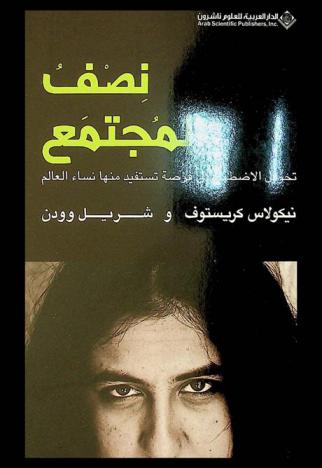
نصف المجتمع : تحويل الاضطهاد إلى فرصة تستفيد منها نساء العالم
يدور موضوع الكتاب حول قضية راهنة من قضايا حقوق الإنسان وهي الانتهاكات الوحشية التي تبتلى بها النساء والفتيات في معظم أنحاء العالم بشكل روتيني وصفته مؤلفتا الكتاب \"كريستوف\" و\"وودن\" بأنه شر مضمر يتكشف مع الزمن على أنه أكبر مشاكل حقوق الإنسان في هذا القرن، ويتضمن الكتاب مجموعة هامة من التقارير والمقالات التي قامت الباحثتان بإعدادها عندما كانتا تعملان لصالح نيويورك تايمز في دول مثل الصين وماليزيا وباكستان وأفغانستان وكمبوديا وغيرها.
BOOK
Half the Sky: Turning Oppression into Opportunity for Women Worldwide
Half the Sky: Turning Oppression into Opportunity for Women Worldwide is a powerful journalistic account of the oppression of women worldwide, and of the ways that some women and men have struggle against this oppression and discovered new forms of economic empowerment. The book--in its eleventh printing in less than a year, and with testimonials from the likes of Angelina Jolie and George Clooney--is also a publishing sensation. Half the Sky brings much attention to an important and timely topic, and it creatively combines narrative, analysis, and policy prescriptions, and so we invited three prominent scholars of gender inequality and development to reflect on the book's strengths and weaknesses: Ayelet Shachar, Uma Narayan, and Valentine M. Moghadam. [PUBLICATION ABSTRACT]
Journal Article