
Catalogue Search | MBRL


Are you sure you want to remove the book from the shelf?

{{itemTitle}}
134
result(s) for
"Yaffe, Martin D"
Sort by:

Reorientation : Leo Strauss in the 1930s
\"Reorientation: Leo Strauss in the 1930s seeks to explain the 'change in orientation' that Strauss underwent during a decade of personal and political upheaval. Though he began to garner attention in the 1950s, it was in the 1930s that Strauss made a series of fundamental breakthroughs which enabled him to recover, for the first time since the Middle Ages, the genuine meaning of political philosophy. Despite this being a period of marked output and activity for Strauss, his research in this era remains overlooked. This volume is the first to assemble in one place an examination of Strauss' various publications throughout the decade, providing a comprehensive analysis of his work during the period. It includes, for the first time in English, five newly translated writings of Strauss from 1929-37, brought to life with insight from leading scholars in the field. \"-- Provided by publisher.
BOOK


Civil Religion in Modern Political Philosophy
Inspired by Machiavelli, modern philosophers held that the
tension between the goals of biblical piety and the goals of
political life needed to be resolved in favor of the political, and
they attempted to recast and delimit traditional Christian teaching
to serve and stabilize political life accordingly. This volume
examines the arguments of those thinkers who worked to remake
Christianity into a civil religion in the early modern and modern
periods.
Beginning with Machiavelli and continuing through to Alexis de
Tocqueville, the essays in this collection explain in detail the
ways in which these philosophers used religious and secular writing
to build a civil religion in the West. Early chapters examine
topics such as Machiavelli's comparisons of Christianity with Roman
religion, Francis Bacon's cherry-picking of Christian doctrines in
the service of scientific innovation, and Spinoza's attempt to
replace long-held superstitions with newer, \"progressive\" ones.
Other essays probe the scripture-based, anti-Christian argument
that religion must be subordinate to politics espoused by
Jean-Jacques Rousseau and David Hume, both of whom championed
reason over divine authority. Crucially, the book also includes a
study of civil religion in America, with chapters on John Locke,
Montesquieu, and the American Founders illuminating the
relationships among religious and civil history, acts, and
authority. The last chapter is an examination of Tocqueville's
account of civil religion and the American regime.
Detailed, thought-provoking, and based on the careful study of
original texts, this survey of religion and politics in the West
will appeal to scholars in the history of political philosophy,
political theory, and American political thought.
eBook

How Francis Bacon’s New Organon Co-opts Biblical Theology for His New Atlantis
Francis Bacon traces the contours of his unprecedented high-tech society of the future in his philosophical parable New Atlantis.¹ Establishment of this society has two basic prerequisites that are more than strictly political. One prerequisite is the refounding, or “fresh start” (instauratio), of the science inherited from the ancients (especially Aristotle) so as to reorient it toward the practical goal of the conquest of nature for “the relief of man’s estate”—that is, for the improvement of the human condition by means of scientific technology.² The refounding of science is sketched aphoristically in Bacon’s New Organon. The other prerequisite is
Book Chapter
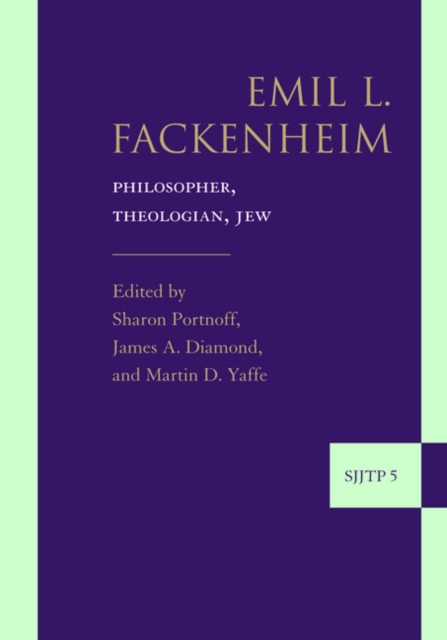
Emil L. Fackenheim
This volume is a scholarly tribute to Fackenheim's memory. It covers a wide spectrum of Fackenheim's work including biographical, philosophical, and theological aspects of his thought that have not been addressed adequately in the past. Elie Wiesel, a close personal friend to Fackenheim for over 30 years, has provided the Foreword for the volume.
eBook

Civil religion in modern political philosophy : Machiavelli to Tocqueville
No detailed description available for \"Civil Religion in Modern Political Philosophy\".
eBook

Interpretative Essay
Shortly after 1938, when he began his decade-plus at the New School for Social Research, Leo Strauss jotted down extensive notes on Gotthold Ephraim Lessing’s dramatic poem Nathan the Wise (1779). The several pages containing them are in Strauss’s minuscule, all-but-illegible handwriting, consisting of crowded paragraphs and miniparagraphs, isolated sentences, numbered lists, bullet points, small flowcharts, textual citations, and the like—ably deciphered and transcribed for this volume by Svetozar Y. Minkov and Hannes Kerber. Included in the notes are an unevenly elaborated sketch of a syllabus for a 1941 course on Nathan and semidetailed plans for a General Seminar
Book Chapter

Philosophy, Jewish Thought, and the American Setting in My Work
I have written at length on several widely scattered topics. These include, for example, how Maimonides and Aquinas read the biblical Book of Job,² whether Shakespeare’s The Merchant of Venice is anti-Jewish,³ and what makes Spinoza’s Theologico-Political Treatise (1670) the philosophical starting-point for what is distinctively modern in modern Jewish life and thought.4 If my work has a unifying theme, it is the ongoing tension between Athens and Jerusalem—more exactly, between philosophy on the one hand and Jewish thought on the other. I keep noticing how this tension shows up in the particular books I have mentioned (and others).
Book Chapter

NATURAL LAW IN MAIMONIDES?
To begin with, I must express my admiration for the serious efforts of David Novak in raising the question of the kinship between Thomas Aquinas and Maimonides in matters concerning our common well-being as law-abiding citizens nowadays. I have in mind that our Founding Fathers appealed to the “Laws of Nature and of Nature’s God” and to the “Protection of Divine Providence” in establishing a government of laws dedicated to the proposition that all human beings are “created equal and … endowed by their Creator with certain unalienable Rights,” and also bequeathed a constitution designed, among other things, to “secure
Book Chapter