
Catalogue Search | MBRL


Are you sure you want to remove the book from the shelf?

{{itemTitle}}
410
result(s) for
"Yancy, George"
Sort by:


What White Looks Like
First published in 2004. Routledge is an imprint of Taylor & Francis, an informa company.
George Yancy holds the McCracken Fellowship in Africaana Studies at New York University. He has edited three previous books, including African-American Philosophers: 17 Conversations (Routledge, 1998), Cornel West: A Critical Reader (2001), and The Philosophical i: Personal Reflections on Life in Philosophy (2002).
\"Not only are these essays provocative, but they are illuminating and useful both to scholars and to neophytes. The anthology as a whole deserves an unqualified recommendation for all interested in this matter.\" -L. Sebastian Purcell, Boston College
eBook


Our black sons matter : mothers talk about fears, sorrows, and hopes
\"From Trayvon Martin to Tamir Rice, the list of young black men who have suffered racial violence continues to grow. Young black people also deal with ... stereotypes and structural barriers. And yet, young black men are often paradoxically revered as icons of cultural cool. [This book] features contributions from women across the racial spectrum who are raising or have raised black sons--whether biologically their sons or not. The book ... addresses painful trauma, challenges assumptions, and offers insights and hope through the deep bonds between mothers and their children\"--Provided by publisher.
Book

Christology and Whiteness
This book explores Christology through the lens of whiteness, addressing whiteness as a site of privilege and power within the specific context of Christology. It asks whether or not Jesus' life and work offers theological, religious and ethical resources that can address the question of contemporary forms of white privilege. The text seeks to encourage ways of thinking about whiteness theologically through the mission of Jesus. In this sense, white Christians are encouraged to reflect on how their whiteness is a site of tension in relation to their theological and religious framework. A distinguished team of contributors explore key topics including the Christology of domination, different images of Jesus and the question of identification with Jesus, and the Black Jesus in the inner city.
eBook

Reframing the Practice of Philosophy
This daring and bold book is the first to create a textual space where African American and Latin American philosophers voice the complex range of their philosophical and meta-philosophical concerns, approaches, and visions. The voices within this book protest and theorize from their own standpoints, delineating the specific existential, philosophical, and professional problems they face as minority philosophical voices.
eBook

Guest Editor Introduction- Moonlight: The Weight of \Intimacy\
After my first viewing of Moonlight in 2018, though it premiered in 2016,1 knew that I had to write about it. The hard part was figuring out why. Obviously, it is not as if I possess a skill set steeped in film exegesis. I had not figured out the film's singular core meaning, assuming that it has only one. I had not discerned some deep and hidden secret that informed the assumptions behind the film's driving narrative force. I could not, unequivocally, articulate the film's raison d'etre. So, what was it? Why Moonlight?Movies touch us; some make us cry, scream, angry, happy, depressed, cynical, disappointed, you name it. For me, Moonlights touch was disorienting. I use the word \"disorienting\" to mean to confuse in terms of direction, though not in terms of spatial direction. Think of only one part of my identity, especially as it is multiple and can be mapped along various identificatory coordinates. Let us keep it л/rø/g/ztforward: I define myself and I am defined as a cisgender, heterosexual Black male. Think about that self-ascripti on and the ways in which I am interpellated. There is nothing nominal about that mode of being rendered intelligible to myself. Being a cisgender, heterosexual Black male bespeaks a mode of being-in-the-world. That identity shapes how 1 move through the world, shapes what appears to me as \"normative\" and \"acceptable,\" shapes the ways in which my gaze is culturally mediated, the ways that my gaze dilates or not, how I self-comport, how 1 am bodily. It is through that orientation that the world is disclosed and simultaneously concealed. To say that 1 \"watched\" Moonlight is probably inaccurate, especially as \"watched\" implies a species of surveyance, which suggests a form of measured judgement - like an unfamiliar landscape. Furthermore, the activity of \"watching\" also implies surveil lance, a mode of keeping track, a form of technology designed to follow and control that which functions as the constituted \"outside,\" the \"problem,\" that which is \"askew,\" that which İs \"oblique,\" \"odd,\" \"out of place,\" \"queer.\"My point here is that being a cisgender, heterosexual Black male is to be part and parcel of a world, an active process of worlding whereby I inherit, instantiate, and perpetuate a certain logics of encompassing and framing that which appears before me. The beauty, of course, is that such a mode of being is not static or invulnerable. Perhaps that is why drawing limits is a process of constant re-worlding, even if done unconsciously and habitually. In short, one must make sure that one is straight, oriented in the \"right\" direction. To be \"touched\" on such occasions, one is prone to anger, perhaps even violence. That brings us back to Moonlight whose touch, for me, as stated above, was disorienting.
Journal Article
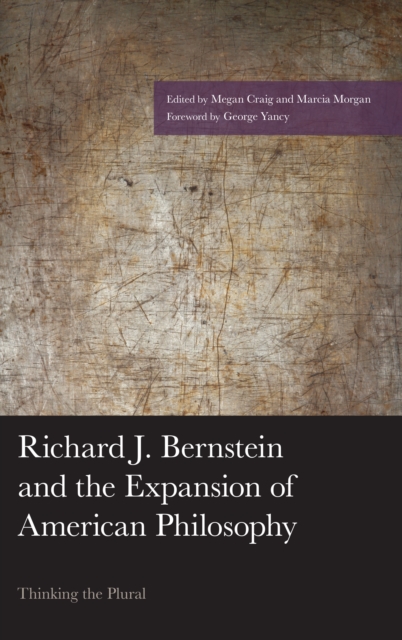
Richard J. Bernstein and the expansion of American philosophy
Thinking The Plural: Richard J. Bernstein and the Expansion of American Philosophy is a text devoted to highlighting, scrutinizing, and deploying Bernstein’s philosophical research as it has intersected and impacted American and European philosophy. Collecting essays written explicitly for the volume from former students of Bernstein’s, the book shows the breadth and scope of his work while expanding key insights into new contexts and testing his work against thinkers outside the canon of his own scholarship. In light of urgent contemporary ethical and political problems, the papers collected here show the continuing relevance of Bernstein’s lifelong focus on democracy, dialogue, pragmatism, fallibilism, and pluralism. Bernstein has always contested the supposed Analytic/Continental divide, insisting on the pluralism of philosophical discourses and styles that contribute to genuine debate and save philosophy from stale academicism. This book enacts Bernstein’s pluralistic spirit by crossing traditions and generating new avenues for ongoing research. A central argument of the book is that thinkers of different backgrounds, using diverse, and even clashing methodologies, contribute to the understanding of a given problem, issue, or theme. This argument lies at the heart of Bernstein’s published works and is central to the fallibilistic pragmatism of his pedagogy. This book therefore does not rest on a single answer to a question or a univocal theme, but shows the differentiation of Bernstein’s scholarship through the extension of pluralism into territory Bernstein himself did not enter. The chapters, individually and collectively, demonstrate the force of Bernstein’s pluralism beyond mere commentary on his works. This book will be of interest to many people: 1) scholars, students and others in American philosophy who have worked on or with Richard J. Bernstein or in the tradition of American Pragmatism widely construed, 2) those interested in the intersections between American and European philosophy or between the Analytic and Continental traditions, 3) professional philosophers, philosophy students, and public intellectuals concerned with the application of theory to contemporary ethical and political problems, and 4) those interested in an introduction to the key concepts animating Bernstein’s work and their relationship to the history of philosophy.
eBook