
Catalogue Search | MBRL


Are you sure you want to remove the book from the shelf?

{{itemTitle}}
19
result(s) for
"Yatromanolakis, Dimitrios"
Sort by:

Epigraphy of Art
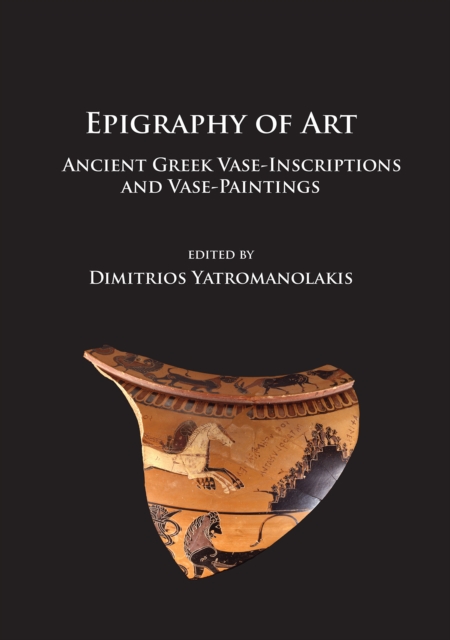
Ancient Greek vase-paintings offer broad-ranging and unprecedented early perspectives on the often intricate interplay of images and texts. By bringing together—for the first time in English-language scholarship—an international group of leading scholars in classical art and archaeology who have worked on vase-inscriptions, this book investigates epigraphic technicalities of Attic and non-Attic inscriptions on pottery as well as their broader iconographic and sociocultural significance. The ten chapters in this book propose original and expert methodological approaches to the study of vase-inscriptions and vasepaintings, while also foregrounding the outstanding but not fully examined importance of the area of vase-inscriptions for current research on ancient Greek visual representations. Epigraphy of Art: Ancient Greek Vase-Inscriptions and Vase-Paintings constitutes a major contribution to the fields of Greek epigraphy and classical art and archaeology and will prove significant for epigraphists, archaeologists, and art-historians interested in the complexities of the interaction of art and text.
eBook
Soundscapes (and Two Speaking Lyres)
Despite the scholarly efforts of nineteenth-and early-twentieth-century German scholars¹ and, later, of John Beazley and other archaeologists and epigraphists, the Attic vase-inscriptions have not yet been exhaustively collected, fully and consistently accurately transcribed,² or comprehensively investigated in interdisciplinary syntheses—that is, investigated epigraphically,³ linguistically, and in light of the complex world of Attic and non-Attic iconography.⁴ After the publication of the fourth volume of Corpus Inscriptionum Graecarum (iv, 1, 1856),⁵ which included incised and painted vase-inscriptions, it was mainly Paul Kretschmer’s Die griechischen Vaseninscriften ihrer Sprache nach untersucht (1894)⁶ that provided an original examination of specific aspects of vase-inscriptions published
Book Chapter


Visualizing Poetry: An Early Representation of Sappho
Yatromanolakis examines one vase depicting Sappho and sheds some new light on the early reception of her figure and her poetry in the classical period. However fictionalizing images of Sappho may appear, they suggest ideas that should be taken into account in an attempt to define the performative dimensions of Sappho's poetry.
Journal Article

Alcaeus and Sappho
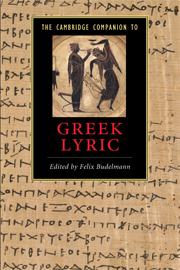
In a letter of 25 July 1907 to his wife, Rainer Maria Rilke drew a connection between an ancient dialogic song associated with Alcaeus and Sappho and an early fifth-century red-figure vase depicting the two Lesbian poets. Rilke writes: ‘Alcaeus was a poet, who on an antique vase stands before Sappho with head lowered and lyre in hand, and one knows that he has said to her: “Weaver of darkness, Sappho, you pure one with the honey-sweet smile, words throng to my lips, but shame holds me back”’. The song that Rilke quotes is a conflation of (a version of) Alcaeus fragment 384 V and Sappho fragment 137 V, while the kalathoid vase he has in mind depicts (on its obverse) two musicians, with their names, Sappho and Alcaeus, inscribed next to their figures (Fig. 5). Holding – or having just struck the strings of – his barbitos, Alcaeus is shown singing. The string of vowels that come out of his mouth do not disclose what he is singing about, but modern scholars – and Rilke – have seen in the lowered position of his head an indication of αἰδώς (‘shame’), thus connecting the image on the vase with the dialogic song between Sappho and Alcaeus that Aristotle quotes in his Rhetoric 1367a – a (fragmentary) song attributed by a number of editors to Sappho (137 V).
Book Chapter