
Catalogue Search | MBRL


Are you sure you want to remove the book from the shelf?

{{itemTitle}}
29
result(s) for
"Yenika-Agbaw, Vivian"
Sort by:

Adolescents rewrite their worlds
Adolescents Rewrite their Worlds offers alternative ways teachers can engage young adolescents with the writing process using literature. The contributors discuss the values of writing in twenty-first century classrooms and global societies, remarking that writing is first a personal exploration that is informed by cultural practices.
eBook
Race, women of color, and the state university system
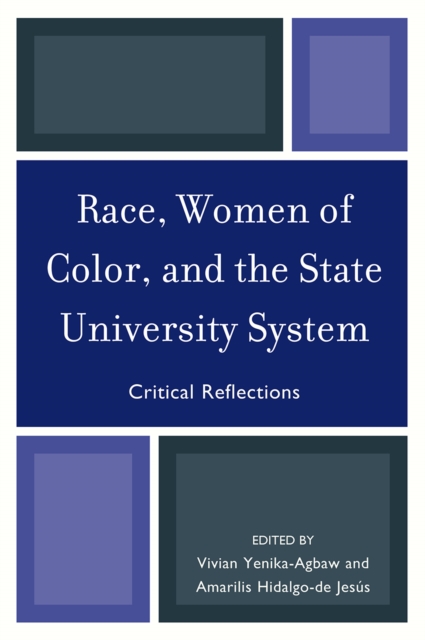
Race, Women of Color, and the State University System focuses on challenges women of color experience or have experienced while teaching or pursuing administrative duties within the Pennsylvania State System of Higher Education. The book systematically examines how women of color —- administrators, faculty, and staff —- cope with the demands of the profession, their disciplines, the expectations from the system, and the isolation that comes with working in institutions and/or environments that are predominately all white. The book identifies challenges that are unique to the state system, although they may be applicable to the academy in general. Contributors, through their testimonies and shared experiences, provide academic tools and strategies to navigate the academy successfully.
eBook

Textbooks, Literacy, and Citizenship: The Case of Anglophone Cameroon
Textbooks are commonly used to teach English in Africa, and most often are designed either by Westerners who are native speakers or by the Western-trained educators who took over the education of Africa's children after colonialism. The issue is whether these educators can emancipate learners through the curricular choices they make in the versions of textbooks endorsed by their governments. Unfortunately, this is not the case. This article examines the content of nonfiction passages in four textbook series that have been used or are currently in use for English language and literacy education in Anglophone Cameroon to understand the shift in educational philosophies that might have occurred between the colonial period of the first textbook and the modern globalization period of current textbooks. It also questions the criteria for selection of passages to be included in these textbooks and their possible ramifications for learners' identities as Africans, Cameroonians, and global citizens. Informed by postcolonialism, with a particular bent toward decolonial theory, the study utilizes content analysis, a qualitative research method that validates textual interpretations through inference (Krippendorf, 2004) and that seeks to understand meanings embedded in texts and their sociocultural/political significance. Findings reveal that while the Oxford English Readers for Africa of the colonial times are long gone, this series' ideology of white superiority lingers in contemporary textbooks. They also reveal that there is an attempt to standardize cultural practices and belief systems based on Western models. This draws attention to minority rights, reminding educators to acknowledge pluralism in their literacy practices.
Journal Article

Children's Literature in an Age of Accountability: Interrogating Inequity and Power While Centering Humanity
[...]don't mess with our babies! [...]as constructed in children's books such as Astrid Lindgren's (1945) Pippi Longstocking and the recent books in the Woke series, these children come ready to disrupt that space in a carnivalesque sense-turning the tables on the adults (Bakhtin, 1984/2009) through humor. From a postcolonial perspective, they also understand when to ignore the bourgeois adults within their cultural spaces that are high on mainstream educational indoctrination (Ngugi wa Thiong'o, 1986/2011), and who sometimes unconsciously or consciously facilitate the colonization of children's minds-coercing our young to conform to the dictates of the status quo or serve as brokers who perpetuate social injustices even within private spaces that are supposed to be sanctuary for our youths. Overall, a new world order is setting in that allows for a healthy and inclusive dialogue moving forward. [...]we are all watching the crumbling of the old ways of doing and knowing that ranked Western epistemologies at the top of the knowledge hierarchies.
Journal Article

Revolutionary War and Contemporary Students: It Happened a L-O-N-G Time Ago!
Sharing personal responses is a great way to informally assess the students' understanding and processing of the novel and sets the pace for a healthy discussion of the issues raised by readers and/or the author. Because meanings negotiated from texts initially can be refined, expanded, or connected to other aspects of life and media, the teacher can probe further for clarification. By doing this, students will somewhat experience the war as characters as they attempt to communicate the young men's desire to enlist in the army, the parents' anguish/disillusionment about war, and the narrator's solemn comments on the pain and suffering involved in the process of social change. [...]students will claim ownership of the literature experience as they fuse thought and feeling to bring the Revolutionary War experience alive in their own way (Rosenblatt). While working with my eighth-grade son on a similar project for a conference, we came up with a well-scripted text from five novels that explored war experiences. Because our topic was \"war across cultures,\" we were able to capture basic elements about war from different perspectives and make the newly constructed text tell a story of universal pain and suffering. Each group should create a Web page on the Revolutionary War from a particular perspective. [...]three to four of the groups must include specific information on their Web pages from the United States perspective (Sons of Liberty) and the remaining three from the Canadian view (Loyalists).
Journal Article
The Complexities of #OwnVoices in Children's Literature
The writing of this introduction coincides with the recent murder of George Floyd, a Black man whose cries that he could not breathe were ignored by the white police officer who knelt on his neck for nearly eight minutes. Ultimately, if we truly believe that children's books serve as windows, mirrors, and sliding glass doors (Bishop, 1990), and if we believe that children's books shape the minds and lives of young readers, and if we believe that children's books don't merely reflect but help create the reality in which we live, it is essential that the field ceases the perpetual spinning that allows those in positions of power and privilege to stay perplexed or continue to \"take time to think and read\" without doing anything else and ultimately leave the field unchanged. In \"The Present Past: Black Authors and the Anti-Black Selective Tradition in Children's Literature,\" Roberta Price Gardner defines an anti-Black selective tradition in children's literature and uses historical and contemporary examples of children's books to demonstrate the need for students and educators to engage in critical racial literacy practices to counter the anti-Black selective tradition in youth publishing.
Journal Article
Changing the Stories We Share: Transforming the Children's Literature Landscape
Kathy G. Short (2012, p. 17) AS PROFESSORS OF EDUCATION literacy, and children's and young adult literature, we value the unique position that the Journal of Children's Literature (JCL) occupies in the field, bridging theory and practice by publishing research-based and theoretical manuscripts that have immediate implications for the ways in which children's books are shared in elementary and middle-grade classrooms and discussed in communities outside of the classroom. With the November 2015 approval of the National Council of Teachers of English (NCTE) \"Resolution on the Need for Diverse Children's and Young Adult Books,\" JCL is committed to the recognition of diverse voices; to the support of emerging Indigenous, Black, and People of Color (IBP°C) scholars and researchers; and to excellence in interdisciplinary research and scholarship in the field of children's literature. [...]we welcome submissions that center literature studies in relation to issues of social justice and equity, representations of populations that have been historically marginalized or underrepresented in children's texts and culture, and the intersections between popular culture and identity. THOMAS CRISP, PHD ASSOCIATE PROFESSOR OF LITERACY, GEORGIA STATE UNIVERSITY Thomas Crisp is an associate professor of literacy and children's literature in the Department of Early Childhood Education in the College of Education at Georgia State University. MARY NAPOLI, PHD ASSOCIATE PROFESSOR OF READING, PENN STATE HARRISBURG Mary Napoli is an associate professor of reading in the School of Behavioral Sciences and Education, where she teaches both undergraduate and graduate literacy courses, including children's and adolescent literature.
Journal Article

Capitalism and the Culture of Hate in Granfield's \Amazing Grace: The Story of the Hymn\
In this article, I argue that hateful practices that are prevalent in society are, for the most part linked to our excessive quest for materialism. To demonstrate this, I discuss different ways John Newton, author of the popular hymn, Amazing Grace, justified why he became a slaver in Granfield's non fiction picture book, Amazing Grace: The Story of the Hymn. Knowing fully well that slavery was wrong, Newton willingly participated in the triangular trade business, because he believed it was truly the only he could make a living.
Journal Article

\RUMPELSTILTSKIN\ A Picture Book Multicultural Retelling
Yenika-Agbaw postulates that in her \"renegotiation\" of gender, class, and race in The Girl Who Spun Gold, a Caribbean retelling of \"Rumpelstiltskin,\" Virginia Hamilton recreates a multicultural tale that acknowledges black socio-cultural history in Africa, in the Caribbean, in the United States, and in the African diaspora from an Afrocentric perspective. Yenika-Agbaw also discusses some ways Hamilton incorporates Africana Afrocentric elements as she constructs what Yenika-Agbaw refers to as her version of West Indian culture in The Girl Who Spun Gold. The assumption then is that she integrated customs and cultural practices that originate from Africa, or that seem to suggest this connection in her tale, in addition to privileging \"African ideals and values\" in her retelling. It is important to note, however, that her adaptation is based on a West Indian variant that already has Afrocentricism as its core.
Journal Article